If there is one event that unites firemen, regardless of whether they are a retired fireman or one of today’s firefighters (perhaps something we would much prefer didn’t unite us) then at the top of a very short list would be that first fatal fire. You would have to be someone very special if the sad details of that happening were not permanently etched in your brain. I know mine are, some fifty-seven years after that particular ‘shout’.
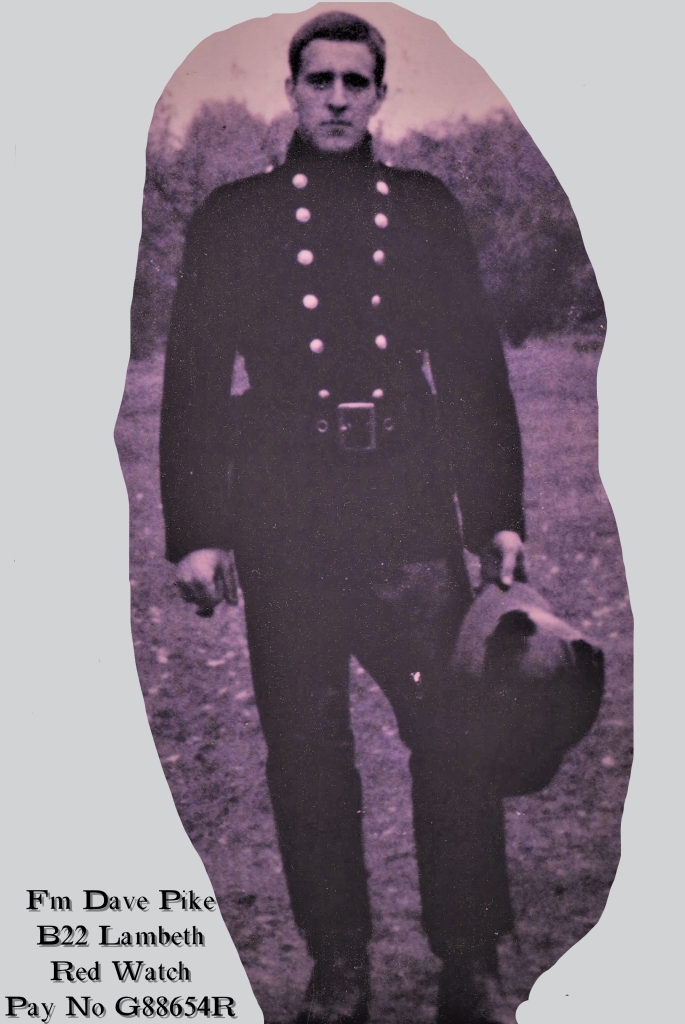
I was a mere probationer on Lambeth’s Red Watch. I got an occasional ride on the pump but most duties I’m riding the back of the PE and slowly gaining in confidence as the ‘shouts’ mount up. Our Station Officer, Don Brown, had returned from extended sick leave after he was hit over the head with a beer bottle at a shout on Brixton’s ground on New Year’s Eve. Its 1967 and I’m eighteen. The guvnor’s return sparks a noticeable rise in our working jobs, much to the dismay of some who think he should go off sick again.
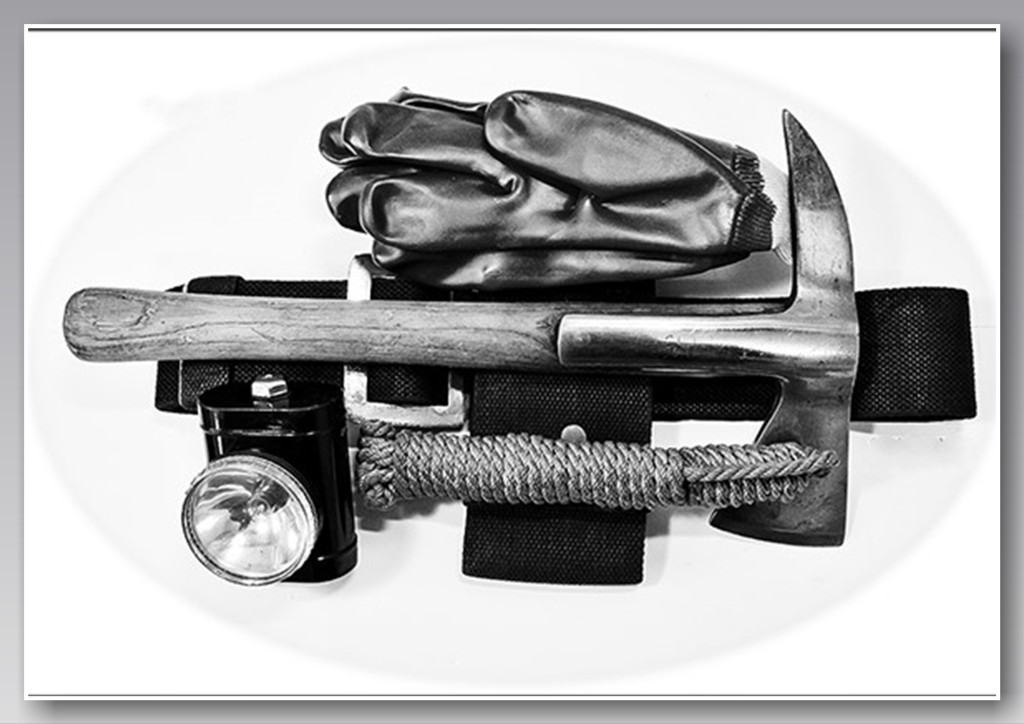
Tools of the trade for a London fireman. A belt and axe; belt line; a bicycle lamp(worn on the belt); and PVC protective gloves. Image: copyright of Pete Weight (reproduced with his permission).
What I would later call ‘bread and butter’ jobs, the numerious fires in surrounding LCC built council flats and derelict buildings were a probationers dream. Those tasked to keep me under their wing cared about the ‘job’ and were bloody good role models. Their language might have been ripe at times but I was learning on the job and although you hoped you were doing the right thing at the right time their supervision ensured, 98% of the time, it was. The everyday hosereel jobs, the noxious stink of smoke, red and sore eyes whilst coughing up soot, and with snot down the front of your tunic, were all part of the everyday mix. If you were lucky enough, a wink or a nod indicated ‘well done boy’. The Red Watch names I can recall with clarity. A couple of the jobs, in those first six months, stand out but (just after I past my six-monthly probation) the events of that day remain crystal clear.
It’s a day duty. A couple of the White Watch had already come onto the station and given the nod to the on-duty guys so that they can shoot off at five p.m with a mutual exchange. But there would be no mutual exchanges that day. The call was to a fire in a flat in Kennington Road. SE1. Lambeth’s pump-escape (PE); pump(P); and turntable ladder(TL) turn out and Southwark’s P makes up the initial attendance. Eric Burns, now out of his probation, and I are in the back of the PE. Both wearing the hook belts, Eric grabs the hydrant location book and shouts out the location to Dick Richardson our Sub Officer in charge of the PE. As we head down Black Prince Road we hear Lambeth control summoning our pump telling them additional calls have been received. They are send on Southwark’s PE additionally.
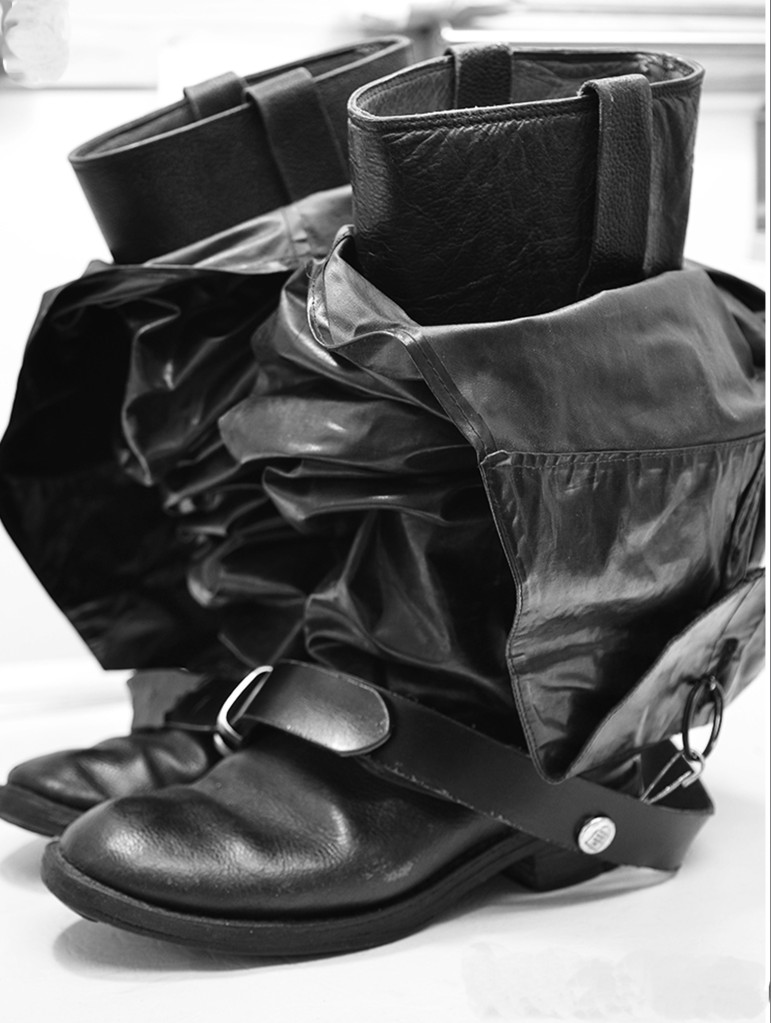
London firemen’s boots and leggings in readyness. Image: copyright of Pete Weight (reproduced with his permission).
Even as a sprog I was beginning to tell the difference from the smell of one smoke from another. Turning into Kennington Road we could smell the smoke from the fire. Dick Richardson remained as a cool as ever, without turning around he told us we have a ‘job’. As we drew closer to Wedgewood House, a series of former London County Council 5 storey flats, opposite the Imperial War Museum gardens, there was a distinct smell of burning mattresses. The smell got to you every time. Smoke you could almost taste. A smell was just a prelude for what was awaiting for us. A scene of utter despair.
The desperate screaming of the young mother coming from the second floor flat balcony echo around the enclosed courtyard. They were sights and sounds that generations of London firemen had confronted before me, different settings, different locations, but the anguished heartache sounding exactly the same. For me this was all new. A situation where that poor woman put her total faith in us to save her children. Dick Richardson had already seen the oily brown smoke forcing its way around the window frames facing Kennington Road. As Lambeth’s machines drove into the courtyard, Dick jumped down from the engine before it stopped and was gone.
Lambeth’s pump-escape. Circa 1967. Image-London Fire Brigade.
As we jumped down from the PE we saw the woman being held back by a neighbour, her screams still filling our ears near the open flat door. Even before the guvnor got down he sent the message “make pumps four-persons reported.” Dick, meanwhile, had raced to the second floor. Teddy Walsh was the Leading Hand on the TL and one of pump crew grabbed Proto breathing apparatus sets, slung them over their heads and turning them on as they ran. Their mouthpieces were put their mouths unsecured. They were not the only ones running. The three drivers were feeding out hose, putting the pump’s tank of water into the PE’s whilst Charlie Watson, the long standing TL driver and senior hand, was heading to the hydrant with a standpipe, key and bar. Despite his years of experience Dick was unable to force himself into the hallway without BA. He shouted down to the guvnor; “need two more up here in BA, the kids are at the back of the flat.” There was furious and intense activity all around me. Activity I would become all too familiar with whenever lives were involved in a fire.
George Newton was Southwark’s guvnor. He arrived as we had got the hose pulled up, by line, to the flat. He heard Dick’s call and had his BA crew heading in as he grabbed Eric and I. “Get an extension ladder around the back quick.” With someone from Southwark’s crew we did just that. The pitch was not hard and the brittle glazing smashed as soon as the top of the ladder touched the blackened window. The pent up heat and smoke rose up the side of the flats.
As we climbed, with Eric leading and a hosereel jet with us, the windows of an adjoining room were opened by a BA fireman and more heat and smoke escaped from the flat. At the window Eric cleared away the broken glazing but our entry into the room was momentarily halted because of the hot gases and smoke still forcing its way out. But the needs of the children proved too much for Eric and he forced himself through the window. I followed not knowing what to expect!
For a few seconds we were both disorientated. We had half stepped, half fallen onto the room across a bed. The room was a charred shell. The BA crew had hit the ceiling with jet at some point and plaster covered every surface, including the bed. Nothing in that had not been severely burned. The heat was still radiating from the walls, the steam mixing with the smoke. We managed to kneel and then stand. As our eyes adjusted to obscured scene we noticed the strange, inter-twinned, shape under fallen plaster on the bed we had just crawled over. Moving closer we looked on in dismay before fully realising what we had just discovered. The charred remains of the siblings, locked together in an embrace of death.
We were mere make-weights now as the two guvnors conferred with Mr Samler-the B Division Red Watch Assistant Divisional Officer (ADO) who had arrived from the Clapham HQ. Dick was old school and the escape was got away and we were headed back to the station. We drove back in silence. Dick Richardson said, when we arrived, we would talk about the shout on the next shift. (I can’t recall if we ever did?)
We got back to the station well after 1800 and into the evening shift. The White Watch were usually subdued, none of their normal banter, as we hung our kit up in the gear room. The only words spoken were to book out in the watchroom. I caught my train home from Waterloo. That night, in the privacy of my bedroom, the emotion came out as tears flowed for those two little innocents.
Cut away those fire brigade cliches, the London Fire Brigade nostalgia and what have you got? Most will say a mixure of memories from real people; recollections of real situations plus, reminiscences of the real ‘working’ life of the London fireman. It is some recipe. Much of our time at work was spent, well if not actually laughing then at least very happy. We were left, at times, wishing something would happen and then, occasionally, regretting it had!
Lambeth’s Dennis pump-escape. The first operational fire engine I rode at the age of 18 and 4 days old. The appliance was new to the LFB fleet but the equipment it carried would have been familiar to those who rode London fire engines in the 1950s. Picture credit-London Fire Brigade.
For those now deemed dinosaurs ours was a generation of smokey jobs, of snotty noses and blood shot eyes. The adrenalin rush when the bells went down, regularly followed by the ‘downer’ of arrriving at another shit’n rubbish shout. But you never, ever, took things for granted especially when the shit’n rubbish was going like a bastard and is involving surrounding property, sometimes even lives!
The refuse collection strikes in the early 1970s resulted in piles of rubbish and uncollected waste lying for weeks in London streets. Hundreds of rubbish fires were started which kept firemen extremely busy in addition to their normal workload. Picture credit-London Fire Brigade.
To be fair, ours was a generation of different rules. Some things we took for a certainty: Of putting on a cold wet tunic on those long winter nights: Of getting a wet arse because the seperate black leggings never actually covered your bum: Of ears acting as thermometers, when wearing a BA Proto set, and knowing you’re going to have to push yourself down (or up) through a heat barrier to reach the fire. Then there’s the coughing fit! Normally atributed to sucking up smoke, whilst crawling into a fire on your belly, because you’re not riding BA. Then, for the unlucky few like myself, who were not natural ‘smoke-eaters’ there were the terrible headaches whilst the carbon monoxide exited your system.
Slipping and pitching the wheeled escape. Picture credit-London Fire Brigade.
There were the straining sinews whilst expending the maximum amount of effort in the shortest possible time when pushing in a wheeled 50 foot escape ladder or lugging heavy, charged, lengths of hose up flights of stairs into the unknown. All delivered with the satisfaction of working as part of a well-oiled team and only very occasionally having a sense of unease knowing that some ‘skate’ was taking the ‘pee’ especially when it mattered!
We dinosaurs all started very much the same. We learnt our craft from those that came before us. From the people wearing black cork helmets and having bicycle lamps issued as firemen’s torches and when we all sat on fire engines that carried bells.
The engine below just happens to be Brixton’s, but it could be anyone’s. A fire engine carrying a ladder that, to us oldies, brings a certain wistfulness. There was one at every London fire station. It one of so many common bonds we share. All individual segments of a tale that made us who we are. It might come as a surprise but I don’t actaully live in the past but I feel so privileged to have lived that LFB past.
Brixton’s pump escape- 1969.
These were the heady days of Dennis and of boxy shaped fire engines. Engines with wooden ladders, some with big wheels, others had teeth, bills and hooks. Days of heavy, rubber lined, canvas hose and large, red, weighty hand-controlled branches named London! Proto breathing apparatus sets came in two colours; blue and yellow. It was a black fire-ground uniform except for silver tunic buttons and a belt buckle plus the red plastic gloves! Ours was a uniform consisting of Melton woven material, leather and cork helmets. A uniform we once wore to fires. Days when we were told, ‘You stick with so and so. Do whatever he tells you and do nothing else’. Of old LCC fireman who taught you your craft. Of firemen with WWII medal ribbons on their undress uniform-of others who had also won them but said nothing.
Lambeth’s iconic Station Officer Jack Stacey-a true character and highly respected fire officer. A modest man who had signed up to join the Army at the start of WWII. He was part of the long-range desert patrol group (foreunner of the SAS) and conducted raids and sabotage far behind enemy lines, and operated in conjunction with the existing Long Range Desert Group (formerly No.8 Commando). They had looked for suitable recruits with rugged individualism and initiative. Jack fitted the bill perfectly, both then and in his London Fire Brigade career. Picture credit-London Fire Brigade.
The flat jobs were, in the main, in the LCC styled flats, the house jobs in old style brick housing stock They might have been anywhere in London; Hackney, Hammersmith, Holloway or Peckham. The next pictured happens to be ‘sarf’ of the river, and despite what you read the a common ‘stop’ message: ‘Small fire flat/house, hosereel. BA.’ Behind those five simple words was many a tale. Tales of smoke-filled room’s, easily involving the whole flat or house. Of horse-hair mattresses, or armchairs, producing smoke so thick you could cut it with a knife. Its distinctive odour filling nostrils as firemen crawled in low, sometimes on bellies pulling behind them the hosereel tubing and seeking the fires origin. So pernicious was the smoke its malignant effects could deprive the occupants of life and it frequently did. Adrenaline charged firemen always went the extra mile whenever the possibility of someone, especially a child, was believed involved.
Rotherhithe. Original LCC built council flats now-in the late 1960 and 70s-managed by the GLC and local borough councils. Picture credit. London Borough of Southwark
For the terraces, be they two-storey or the bigger three and four storeys, many where in multi occupancy. Regardless, the smoke and its consequences were no respecter of colour or creed. Fireman rushed in where others were rushing out. Their coughing and spewing part of the price of getting in low with a hosereel jet whilst others, with streaming eyes. checked around to make sure everyone, that should be, was out and safe.
Fire at Perrins Court, Hampstead. Two girls jumped 25 foot as fire swept through the building. Tragically one of the girls later died in hospital. 12 April 1974.
The melton tunics acted like blotting paper, soaking up both water and the stench of the smoke. Its lingering reek filling the gear room with its unique aroma at the end of the shift. And with the drama resolved, not always with the fire out, the guvnor sends his simple message. The crews, with sore eyes and snotty noses, tick off yet another ordinary ‘bread and butter’ job.
Dark days.
For me, who was once a London fireman, the Grenfell Tower fire remains off the scale! It started as one of today’s London firefighters ordinary ‘bread and butter’ jobs. A job that went ‘tits up’! Through no fault of their own, London firefighters are still ‘left holding the baby’ for the consequences of tower block fire covered in highly flammable cladding despite the fact that for so many it meant getting struck in close up and personal. Clearly those on today’s frontline maintain the same pride in the LFB I will carry to the grave even when there were dark days…
The details of the 1969 explosion, and its aftermath, one that killed six, five of whom were East London firemen were there to read in the watchroom teleprinter message book. Stark messages, in its typical scant fire brigade speak, were repeated across the Brigade . The Chief Officer’s message announced ‘with the deepest of regret etc’… Deaths that seemed all the more poignant by the fact that they had died at an incident which appeared, at the outset, to be almost trivial.
At Lambeth, that evening, a Brigade Headquarters principal officers’ car driver, the late Johnny Guy, added grim details to the briefest of information given out on the official teleprinter messages. He told of his small part in the extraction of some of the bodies from the oil laden sludge in the partly demolished oil tank farm at Dudgeons Wharf.
It was on that fateful Thursday morning, the 17th July, that Millwall’s pump escape and pump, Brunswick Road’s pump, a foam tender from East Ham together with the fireboat Massey Shaw that were dispatched to Dudgeons Wharf on the Isle of Dogs at 11.22 a.m. A small fire had broken out in one of the huge oil storage tanks at Dudgeons Wharf. An expansive former tank farm site situated between the riverfront and Manchester Road. The tank in question, which was empty but not purged, had a capacity of twenty thousand gallons. The demolition workers believed they had actually put the fire out. The land fire crews, which totalled twelve in number, arrived to make sure it was. Meanwhile the Massey Shaw fireboat was en-route to the scene from Greenwich.
What later became common knowledge was that the Dudgeons Wharf disaster was caused by a workman hot cutting away an inspection cover securing bolts on an oil tank. An oil tank that had contained flammable substances. Although the affected tank was marked ‘light oil and linseed oil’ the lettering was indistinct. There was certainly no warning of the potential dangers to firemen having to deal with a fire within them. The national papers, the following day, gave fitting tributes and reported, “They died simply doing the day-to-day job of a London fireman.”
What the papers didn’t report at the time was the lead-up to that awful July day in 1969. It was in 1951 that commercial operations had stopped at Dudgeon’s Wharf. It remained empty for many years before any demolition work actually commenced. By 1967 the company owning Dudgeons Wharf tank had no further use for it. But unable to find a suitable buyer they decided to demolish it, clear the site and sell the land for development. Despite two large and experienced demolition companies tendering for the demolition contract it was awarded to, what effectively was, a one-person contracting company. Whereas the larger companies would have required the tank farm owners to clear the site of accumulated refuse and receive assurances that the tank farm vessels were thoroughly clean inside the small scale, inexperienced, contractor was prepared to take on the job as seen. It was for that reason he was awarded the demolition contract!
It was during the subsequent public inquiry, conducted byA. W. M. Davis QC, into the fatal disaster that the attitude of the demolition contractor and that of the scrap dealer, to whom it was planned to sell the salvaged was metal, was found to be purely a commercial one. Even the site owners gave safety a low priority.
The funeral service, at West Ham Parish Church, was held for the other four and when the procession reunited the five comrades started their final journey to the City of London Crematorium and Cemetery in Manor Park.
The East End went into mourning following this tragic loss. Hundreds of firemen from all over Britain arrived the following week for the funeral of their comrades: from Millwall, Sub Officer Michael Gamble and Firemen Alfred Smee; from Brunswick Road, Firemen John Appleby and Terence Breen; and from Clerkenwell fire station Fireman Trevor Carvosso – who had volunteered to stand-by at Millwall.
City of London Crematorium and Cemetery in Manor Park.
On the 29th September, the same year Acting Leading Fireman Michael Lee was killed at a fire in Goswell Road. EC1. Like myself he was a former Junior Fireman. Only a year seperated our ages. The month before disaster could have repeated itself when nine London firemen were injured in a gas expolsion in East London. In the first five years of my service 10 London firemen died in the line of duty. Seven at operational incidents, three from on duty accidents. In modern peacetime, post WWII, the 1960s remains the worst decade for LFB fatalities.
2nd August 1969. Mile End Road/Burdett Road. 9 London firemen and 2 Metropolitan policemen were injured in a gas explosion.
Methy’s…
In age before ‘PC’ we simply called them ‘Methy’s’. Homeless people who lived on the streets and, in the main, drank cheap liquor such as British Ruby Wine and, it was said, methylated spirits! Their fires, either caused by them or the lit fires to keep warm, were a frequent shout. Occasionally they were the beginning of a much bigger blaze, especially when they chose to occupy a derelict warehouse or factory.
Southwark firemen assist the London Ambulance crew remove a homeless man to Guy’s Hospital after a fire in a derelict shop fire in London Road. SE1.
The fires, large or small, also resulted in regular rescues of those overcome, normally by smoke, but others were just ‘dead’ drunk! In many slum clearance areas, but especially around the Elephant and Castle prior to its redevelopment in the early 70, hardly a night went by when we weren’t pulling a ‘methy’ out of some smoky job; normally with them not wishing to leave or even rescuing an unfortunate, unconscious, man and giving mouth-to-mouth resuscitation. (There were very few homeless women then.) Sadly, some never made it. Their death becoming another fire statistic and given a simple paupers grave in the local council graveyard.
However, one such man did teach me a valuable life lesson. Living in a Kennington back street it was a frequent shout as people reported the small fires in the derelict houses awaiting clearance. We had meet this man maybe half a dozen times, and me still being the junior buck, I was normally tasked to escort him out of the house even we all knew he would return as soon as we left the scene to relight his fire. He was very well spoken and amoung his few treasured possession were some books in French and Latin (my Sub-told me it was Latin!).
This way of life was all very new to me. One night he managed to set the derelict house properly alight! I was again his minder whilst the others put the fire out. It turned out the man had been a college professor, the death of his wife meant his world fell apart and he turned the man to drink, ending up living on London’s streets. It was not unknown of some riding fire engines to treat the ‘methies’ like vermin or, at best, a bloody nuisance. However, this old bloke had a way about him, you might call it a dignity…My lesson was to not to judge a book by its cover. I didn’t always succeed but reminded me there are individual stories behind those we simply referred to as ‘methy’s.
Brixton Hill. SW2.
It’s 1967 and I am sitting in the rear of Lambeth’s pump. We were ordered to a shout in support of Brixton’s pump-escape and pump crews’ and a ‘person’s reported’ fire on Brixton Hill. I was a total ‘make-weight’, no experience, and a very ‘junior’ buck.
Brixton’s Red Watch were a tour de force. Old, steady, experienced LFB hands. Some were ex-army and one former Royal Navy sailor. Tony Sowerby was their ‘junior buck’. Like me a former Junior Fireman but with almost two years’ service now. On our arrival there was a serious house fire, one involving children. Brixton’s crews were fully committed. Lambeth’s pump crew seemed to know exactly what was required to be done and immediately set about doing it. I was left standing there like a spare-part!
Brixton’s Red Watch- Tony Sowerby 4th from the left of the picture. Acting Station Officer ‘Nobby’ Clarke in charge. Picture credit-London Fire Brigade.
Blackened, crazed, gazing at the front first and second floor windows gave a clue to the extreme heat inside. One of Brixton’s experienced hands was vomiting on the door step. A clue to the vile smoke that filled the house as I walked up to the front door to peek inside. Three with BA, the others without, the house seemed full of firemen. Firemen desperately searching for the missing children whilst fighting the fire.
Suddenly there was a commotion coming down the stairs. Shouted orders and some confusion too. Sowerby is holding a one child and I am given another as the fireman about turns and heads back into the smoke filled house. Sowerby cradles his child wrapped in something, I can’t recall what. The toddler I am holding is covered with grime and is smoke stained. Neither child is breathing but neither Sowerby nor I wish to believe the children are dead. They can’t be. We find ourselves on the back of an ambulance being driven at break neck speed, under police escort, to Kings College Hospital in south London. Neither of us stop trying to revive the unmoving children. The ambulance man in the rear, monitoring our progress, tries to hold us steady.
“Keep going lads” he encourages.
The arrival at ‘King’s’ A&E sees an initial frenzy of activity. The children are taken from our arms and carried inside. We seemed to wait for ages but in reality it was a short time. The doctor’s face told us what we never wished to hear. The children never made it. He thanked us for our efforts, which counts for nothing when you fail!
It was the police car that returned us to the fire scene. There was a palpable sense of loss in the firemen’s faces. Their blood shot eyes, snotty running noses and blacked faces telling its own tale of their determined efforts to rescue the two children. Sowerby and I say nothing. Not to each other nor to anyone else either. We try to avoid the faces of the other firemen. Brixton’s guvnor calls us to one side. He was a big, gruff, powerful man and tells us we were already fighting a losing battle. We could not have done anything more than what we did. However, it was not his words that mattered it was the nods and a wordless pat on the back from firemen. Firemen who I was in awe of and which showed a compassion, a sympathy and benevolence that this eighteen year old had not seen, or ever experienced, before. You could see the genuine sadness in their eyes that their efforts, this time, had been in vain. But they left me feeling that they would do it all again in a heartbeat to try and save a life. It was because of them (and so many more that followed them) this still sticks. I knew I had made the right choice to be a fireman. It was a feeling that lasted for the next thirty plus years.
The rank of fireman may, in the opinion of some, be a humble one but they know the work which a fireman had to do, in all its guises. To be able to climb up, get down, to crawl in and use your senses when common sense tells those getting out to run even faster. We young firemen learnt our craft from people called FIREMEN. The senior hands who took and believed in this noble calling. A proudest moment was to save a life. Yet we were full of pride when told by these ‘old’ hands “We’ll make a fireman of you yet son”.
1968. Lambeth’s pump escape and turntable ladder at a Vauxhall Walk fire. ‘Small fire in flat. Hosereel. BA’
‘Small fire flat-hosereel.’
These were different times. Times when we sent messages over the R/T, more often than not underplaying what was actually happening. Small was a relative term. If it hadn’t spread up, down or sideways, it was normally the ‘stop’ message of choice for so many London ‘old school’ guvnors. Occasionally, they might add two simple letters after it which said ‘BA’.
It didn’t matter if two or more rooms were well alight, providing no life risk was involved, ‘small fire flat’ seemed to tick their stop message box! Whilst the message might have been a simple one, for those getting low and crawling in the task was anything but straightforward. The taint of horsehair filled mattress would hang heavy in the air. As families updated their homes foam filled furniture became their preferred choice. In either event the noxious, foul, horrible and injurious smoke drove those crawling in with the hosereel down to the floor. What the smoke failed to do then the heat barrier would try its very best to do exactly the same thing. All the while, the smoke you could cut with a knife, gave its own signature of a small fire.
For the fireman edging into the flat, sometimes clambering, frequently struggling to inch forward, their eyes watered from stinging fumes and lungs getting a dose of harmful smoke, they were encouraged to get in with a range of expletives that could make a Billingsgate fish porter blush! The hosereel might be two or occasional would disguise itself as pip-squeak jet. Often the ‘stop’ message was sent as an act of faith. The faith of the guvnor in his crew, a crew who had yet to actually put the fire out! When the fire was covered, to the informed observer, came the next clues that this was a little ‘job’ The pump delayed for a few hours turning over and cutting away or the London Salvage Corps (LSC) requested to ‘secure the premises’. This had little to do with putting a padlock on the front door but rather sheeting up the fire affected windows.
Station work.
Once, at any London fire station, you could divide the average working day of a fireman life into thirds They would consist of drills, volley ball and station work. Which, if you were lucky, might be interrupted by a ‘shout’ or two. Our blue work overalls (No 4 rig for the purists out there) were worn in a range of hues, depending on their age, and were the normal rig of the day. Even at station drills only shoes were exchanged for ‘boots and leggings’ but overalls, together with your soft cap, remained the accepted rig.
The firemen at Euston fire station restowing a pump-a Home Office, former Auxiliary Fire pump, which were ofter placed into service due to the dire state of the reserve appliance fleet!
At Lambeth it was the Sub Officer who had day-to-day responsibility for the detailing the morning or afternoon station work routines, including appliance and equipment maintenance; outside station work, or station drills. The leading firemen monitored the progress of station work, or appliance maintenance, throughout the day.
It was a long-standing tradition on Lambeth’s Red Watch that the very senior hands were excused certain station routines, but in particular station cleaning. As the mere sprog I had no such privileges and certainly not as their youngest ever junior buck. I soon built up an intimate relationship with cleaning every corner of the Fm’s toilet. At Lambeth this was the size of large public lavatory. Two long troughs of separate, full length, urinals, six crapper booths and an adjoining multi-sink fireman’s washroom. I would eventually get ‘promoted’. I moved onto cleaning the junior officers’ toilets; but only after a next junior buck had arrived on the watch.
Fireman Ken Thorne (and myself) at the Old ‘folks’ Christmas party held annually by Lambeth’s Red Watch at the headquarters station. Ken was the station’s senior hand and only ever drove the Emegency Tender. A consummate and respected fireman he joined the LFB, in the AFS, in 1938. The winner in both Brigade pump escape and pump competitions in the 1950s he was a giant of a fireman and human being too.
But in my four years at Lambeth I never reached high enough in the pecking order to polish the locker room floor or, the very best job of all, the iconic Lambeth billiard/snooker room floor, with its two full size snooker tables that sat in this majestic timber panelled room. Here framed photos of Lambeth’s winners of the Brigade’s Pump and Pump Escape competitions hung in pride of place from the walls and a young, handsome looking, Ken Thorne; Taff Webber and Bill Skipsey, (both now serving on the fireboat), looked down on a room that hadn’t changed a jot in appearance since the Headquarters first opened in 1937.
Lambeth’s, central, main corridor ran almost the whole length of the headquarters building. It was named the ‘golden mile’ and was cleaned daily. Occasionally I would be extended the honour of scrubbing, then polishing the ‘golden mile’. But not with the Electrolux floor polisher, reserved for the more senior hands and the floors of the locker and billiard room. No my polishing implement was the bumper… the weighty breeze block on a stick. Given an application of liquid polish the bumper was pushed and pulled the length of the corridor. The sweat soon started to pour as our collarless shirts took up the excess perspiration. Pushing a bumper was a serious work-out and not for the faint hearted. I was always told there were many naval traditions in the fire brigade and that bloody bumper was akin to holy-stoning the deck of on a ship of the line.
But the one aspect of station cleaning that was always welcome. It was a real joy. The weekly scrub-out of Lambeth’s seven-bay, tiled, appliance room floor. Our scrub-outs were always carried out on a Friday. The rota system meant that we got to scrub out twice every six weeks. With the vast appliance room cleared of its fire engines, senior officers’ cars and the Brigade’s control unit and parked in the drill yard the metal drip trays were finally pulled clear. Then we all armed ourselves with a bass broom. With the surface of the appliance room floor thoroughly soaked from a jet fixed to a hydrant in the station yard comprox was poured onto the wet surface and we scrubbed the floor. We worked in a long line across the width of the appliance room, pushing our brooms from one end to the other and mixed the comprox with the water.
The water, the comprox and the sweeping action brooms resulted in a blanket of white soapy foam that covered the whole appliance room floor. It was incredibly slippery, especially on the grooved tiled floor of Lambeth’s appliance room. It became a great surface on which to play the brigade’s version of ‘ice hockey’. Using a large bar of carbolic soap as the puck, bass brooms as hockey sticks and fireboots as ice skates we had thirty minutes, or so, of unrestrained rough and tumble as we slid about trying to hit the “puck” from one end of the appliance room to the other. The junior officers often joined in this frivolity and passing senior officers would gaze in at our game, privately wishing they too could let their hair down and pick up a broom.
Lambeth’s empty appliance room-great venue for ‘Comprox’ hockey on a Friday.
As the suds slowly disappeared so the surface lost its slimy veneer and the game was over until the next scrub-out. Now it was just a matter of cleaning off the grime and stains by washing the appliance room clean with jets of water. This, more often than not, resulted in the inevitable water fight. But especially so on hot summer days when the temptation to give someone a thorough soaking became overpowering. Occasionally it all got out of hand, or rather the jet did, and a passing bus would get a dousing too, much to the annoyance of the guvnor who had to mollify an irate bus inspector from the local bus depot.
The new Lambeth headquarters when opened in 1937. The Lambeth fire station accommodation, on the first floor, had remained the same ever since. Picture credit. London Fire Brigade.
It was an era when us young boys ‘learnt by rote’. We carried that message into the 80’s, some more successfully that others and always reliant on those crawling in with the hosereel. I have no idea what today’s firefighters would think of our dinosaur attics-but they were special times. Glad to have been part of them. It doesn’t matter if you call yourself a London fireman or a firefighter. It remains a badge I wear with pride.
Wrong place-right time. Receiving a ‘pat’ on the back from Fielf Marshall Geradd Templer at the 1969 Annual Review.





 A retired London Fireman