
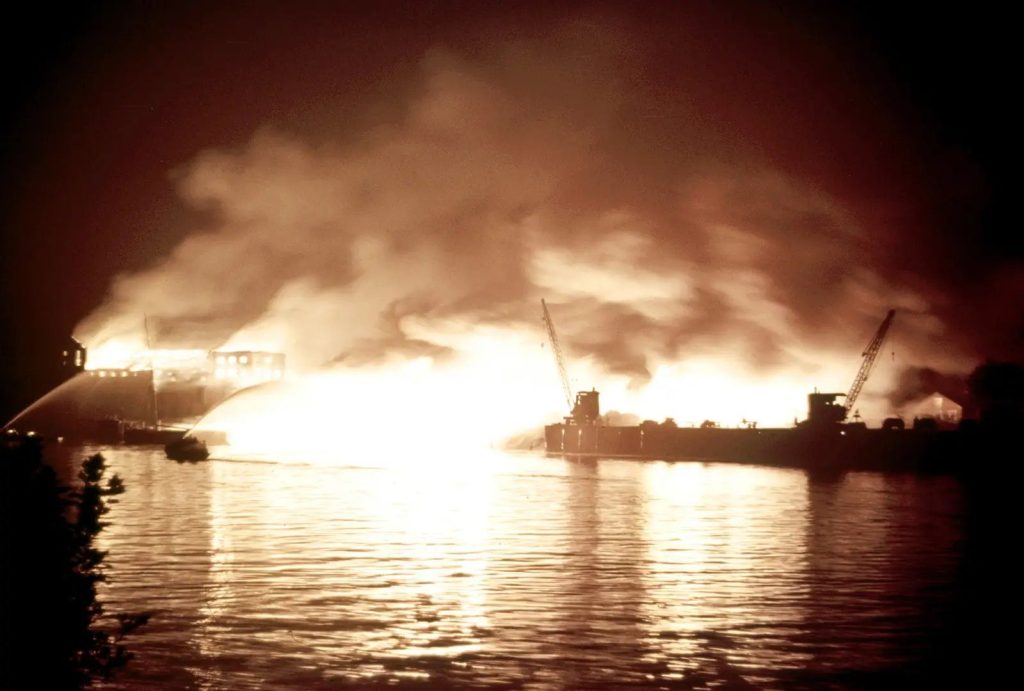
London and the River Thames waterfront were the prime targets for the intensive enemy bombing campaign in the early part of World War II, which became known simply as the ‘Blitz’. Hitler had two objectives; to disrupt trade through the country’s largest port and breaking Britain’s spirit. But the Germans were to be proved to be wrong on both points. The German plan, overseen by Reich Air Marshall Goering, had been to reduce London, and other large populated cities, to rubble and ashes, shattering the infrastructures of everyday life. His aim to paralyse administration and industry and to leave the population exhausted, terror-struck, and cowering in their shelters. From this onslaught, it was hoped, Britain would sue for peace. Goering’s strategic bombing dissolved the clear distinction between the battlefield and homeland. His tactics turned a distant city into an embattled ‘home front’. The docks, warehouses, and munitions plants of London were obvious targets; but so were the utilities and transport networks that served them, together with the millions whose labour was the city’s lifeblood.

This was industrialised war; a ‘total war of materiel and attrition’. The people of London became targets. As such, they faced a choice: they could be mere victims, waiting in the damp and muck of a crowded shelter for the bomb that destroyed them – or they could become combatants in their own right and fight back by simply not giving in to the bombing. Londoner’s chose the latter.

Throughout the summer of 1940 the Luftwaffe (German Air Force) had targeted the Royal Air Force (RAF), both in the skies over southern England and its bases in the Home Counties, especially across the South-east. The Germans needed air superiority before they could mount their planned invasion of England. This was the Battle of Britain, and despite heavy losses of men and aircraft, the RAF gradually gained the upper hand, forcing the Germans to change their tactics. The Germans did.
In September 1940 London’s burning docklands provided a beacon for the German navigators following the Thames upriver. For those on the ground and fighting the dock and warehouse fires, the contents, added to hazards the firefighters faced nightly. There were pepper fires, loading the surrounding air heavily with stinging particles, so that when firemen took a deep breath, it felt like burning fire itself. There were rum fires, with torrents of blazing liquid pouring from the warehouse doors, and barrels exploding like bombs themselves. There was a paint fire, another cascade of white-hot flame… A rubber fire gave forth black clouds of smoke so asphyxiating that it could only be fought from a distance.

ARP wardens were on active duty during the bombing, enforcing the blackout, guiding people to shelters, watching for incendiaries, attending and reporting ‘incidents’. Under such fire and doing this essential work, they were as much combatants as the regular soldiers, manning AA guns, searchlights, and barrage balloons around London. (The ARP suffered three thousand eight hundred and eight casualties during the war, one thousand tree hundred and fifty-five of them killed.)
On that first night of the Blitz, 7th September, only one in five of London’s firefighters had had any previous experience. The dangers they faced were numerous and unpredictable. During the war, more than eight hundred firefighters would be killed and more than seven thousand, seriously injured. Many of them blinded by heat or sparks. At the end of the ten-week onslaught of intensive Blitz on London fire-crews were all utterly exhausted by lack of sleep, excessive hours, irregular meals, extremes of temperature, and the constant physical and mental strain.
On the river, beside the Massey Shaw and London’s other fire-fighting craft, London’s air defence precautions included the River Emergency Service. More than a dozen pre-war pleasure steamers were converted to first aid and ambulance boats. They were moored at various points along the river including Silvertown Wharf, Wapping and Cherry Garden Pier, alongside the Beta III. To give a taste of what the fire-float crews, and others, endured on the Thames that first night (7th September) it is perhaps best illustrated by a personal account given by Sir Alan Herbert, who was in command of the Thames Auxiliary Patrol’s vessel Water Gypsy, which was heading downriver:

“Half a mile or more of the Surrey shore was burning. The wind was westerly and the accumulated smoke and sparks of all the fires swept in a high wall across the river.” He pressed on into the clouds of smoke: “The scene was like a lake in Hell. Burning barges were drifting everywhere. We could hear the hiss and roar of the conflagrations, a formidable noise but we could not see it so dense was the smoke. Nor could we see the eastern shore.”
As dawn broke on the 8th September the scale of the destruction was revealed. Four hundred and fifty Londoners had been killed and one thousand five hundred badly injured. Three main railway stations were out of action and one thousand fires were still burning, all the way up the river from Deptford to Putney. They included two hundred acres of timber ponds and stores in the Surrey Commercial Docks, destroying one third of London’s stocks of timber – which was badly needed for building repairs in the coming months.
The Blitz on London had started. The German bombers struck for fifty-seven consecutive nights and sometimes by day as well. The riverside communities from Woolwich to Lambeth bearing the brunt of the onslaught. Some streets had sturdy, well-constructed public air raid shelters; in others people had to rely on quickly-built Anderson shelters made from a couple of sheets of corrugated iron with earth piled on top. The shelters were for the civilians, there was no such safe haven for the emergency services, but especially the firemen, working on the streets and along the river.

Meanwhile it was not exactly business as usual for the docks and wharves as traffic was reduced to half its pre-war levels. But more freight was carried by tugs and lighters (barges) since, unlike the roads, the river was never blocked by bomb damage. For Londoners, and particularly the East Enders, it was the winter from hell. From that September their homes, and their city, had been pounded almost nightly by the German bombers. In riverside communities from Woolwich and Silvertown in the east, and Lambeth and beyond in the west, everyone knew the bomb-damaged streets, the families whose homes had been destroyed or who had lost a loved one in the Blitz.
The night-time raids that followed were equally terrible and deadly. Night after night the bombers returned. The Strand, the West End and Piccadilly were attacked. St Thomas’s Hospital, St Paul’s Cathedral, Buckingham Palace, Lambeth Palace and the House of Commons were all hit. Between September and November 1940 almost 30,000 bombs were dropped on London. In the first 30 days, almost 6,000 people were killed and twice as many badly injured including London’s firefighters.


There were many acts of ‘Blitz’ outstanding gallantry. One fireman was awarded the George Cross, the Nation’s highest civilian gallantry award. Others received the George Medal, tragically some medals and commendations were awarded posthumously. In late 1940 Acting Sub Officer Richard Henry ASHTON’s actions saw him awarded the Medal of the Most Excellent Order of the British Empire (BEM) for Meritorious Service. (Published in the London Gazette Supplement No 35058, 31st January 1941, pp. 611.) About fifty people were cut off by a serious fire and were in danger of being driven into the river by the flames. With great difficulty and while bombing was continuing Sub-Officer Ashton, who was in charge of a fire-float, rescued the stranded people by towing them in a barge, skilfully avoiding other burning barges and disembarked them in safety.
Also awarded the Medal of the Most Excellent Order of the British Empire (BEM) for Meritorious Service was Auxiliary Messenger Samuel STILLWELL. At a large Docks fire this boy (16) was discovered holding a hose until relieved by firemen. He continued afterwards to deliver messages-and bring drinking-water to officers and men who were unable to leave their positions. Altogether Stillwell was at the fire in the Docks on the first day and night for over 14 hours and on five succeeding nights carried out duties at fires in the same area with great courage. He was quite indifferent to the danger he was in and, although ordered to shelter, he turned up again and again later in the night and the next morning carrying drinking water to the men on the hoses.
Just after Christmas, and at 6.30 p.m, on the 29th December the massive night attack began in earnest. Baskets and baskets of enemy incendiaries clattered down on the roofs and streets of the City of London. All around St Paul’s Cathedral fires sprang up and quickly spread. Some fire bombs fell on the cathedral’s roof but all were cast off or extinguished. The water supply in London failed, important mains being shattered by high-explosive bombs. Only by dragging heavy canvas hose across the mud from the fire-floats working in the Thames could water be brought to the bank. In the river bed firemen toiled, coaxing slimy hose-pipes into a battery of lines for their vital water supply. It was most one of the most notorious raids of the Blitz to date. The enemies focus was the City of London. An area from Aldersgate to Cannon Street and Cheapside to Moorgate went up in flames. Nineteen churches, including sixteen built by Christopher Wren after the Great Fire of London, were destroyed. Miraculously, however, St Paul’s survived. Of the thirty-four Guild Halls, thirty-one were decimated. When Paternoster Row, centre of London’s publishing industry, was destroyed, around five-million books were lost. Two fire officers and fourteen firemen were killed that night. Across London two hundred and fifty officers and firemen were injured fighting the one thousand-five hundred fires that blazed into the early hours of the following day.

After that the air raids continued sporadically, with major raids on 16 and 19 April 1941. More than one thousand people were killed on each night in various areas across the capital. Finally, on 10 May, bombs fell on Kingsway, Smithfield, and Westminster and across the City, killing almost three thousand and hitting the Law Courts, the Tower of London, and many of London’s museums and the House of Commons.

By May 1941 forty-three thousand people had been killed across Britain and almost one and an half million had been made homeless. Not only was London attacked but so were many other British cities. Coventry and Plymouth were particularly badly bombed. Few, if any of Britain’s cities escaped enemy bombing. Manchester, Glasgow and Liverpool all suffered major damage, the loss of life and its populations serious injury.

In the closing weeks of the Blitz the bravery of London’s firefighters was never far from the bombing. Fire stations from the outskirts of greater London headed into the fray, many attending the riverside docks and warehouse fires. The Blitz on Britain was called off in May 1941. Hitler had a far more prized target. In the following month, Operation Barbarossa was launched, the attack on Russia. The huge military force needed for this attack included many bombers and two-thirds of the German military was to be tied up on the Eastern Front for the duration of the war. Meanwhile it was not exactly business as usual for London’s docks and wharves as traffic was reduced to half its pre-war levels. But more freight was carried by tugs and lighters (barges) since the river was always clear of any bomb debris which blocked the capitals roads.


 A retired London Fireman