Hook Ladders, love ’em or hate ’em?

LCC-LFB horse drawn steamer at hook ladder drill at the then London Fire Brigade-Southwark Headquarters. circa 1909

To some London firefighters they are simply the stuff of myth and legend. Another piece of defunct fire kit, along with the 50 foot escape ladders, Proto sets, that the old ‘soaks’ around the fire station would go all dewy eyed about when referring to them. But for those of a certain era, those who once called themselves ‘firemen’ they were a regular companion. And for a few a companion they were not overly keen to keep company with on a regular basis either. But regardless, if we weren’t testing them, checking them for incipient flaws, we were polishing the reinforced steel ring with the tiny bit of emery cloth which we kept tucked in the back pocket of our blue overalls, especially when the Sub Officer was on the prowl looking for those striving out of station work!


Hook ladder training of London Fire Brigade recruits at the then Lambeth training school. Circa 1950s.


There were the hook ladder drills; one man-one ladder, two men-one ladder, two men-two ladders. Hooks ladder(s) from the head of the 30 foot extension ladder, from the head of the escape ladder or from the head of the first floor ladder, tied onto the head of escape. Even used from the top of a 100 foot turntable ladder. The combinations were as versatile as the ladder itself. Of course the hook ladder was, like other ladders, a rescue ladder. So rescue drills were frequently incorporated into its training use. Firemen carrying a lowering line aloft across their backs before lowering a casualty underfoot. Station drills, combined Divisional drills and the annual Brigade reviews, a regular constituent was always the hook ladder.

It was a ladder that always demanded the utmost respect. Tragic losses had resulted from its use in training however, never operationally. As tragic as the deaths of London firemen were (they were not termed firefighters then) it was never because of a defective or a malfunctioning hook ladder.

Hook ladders scaling Lambeth’s nine storey drill tower in the 1930s.

All would train with then, get to know every square inch of its ash (free from knots) timber construction, its metal reinforcing rods, the pianoforte wire, the strengthened top three rounds, the shroud, the steel ring and not forgetting the hook itself with its eight teeth and six inch bill, that gave the ladder vits name. That said relatively few would bring all that training into play and get to use the ladder operationally, despite the secret desire of many to do just that.

Hook ladders also had their own companion, the hook-belts. You could tell a lot from the hook-belt, or rather the wearers of the said device. No’s 3 & 4 of the pump escape crew should always have worn them on any turn out to a fire call (and you could bet that at least one of the wearers was the stations young junior buck!). Some station watches, that took a lax approach towards such rules, would frequently raise doubts in the discerning eyes of others as to what else they might be lax about? (But let’s not go there…)

Testing the hook belt before use.


The hook ladders demise by the early 1980s was hotly debated. Its withdrawal from service lamented over by most at station level, barring those that were less than confident in its use. I was one that thought the removal for the ladder a grave error of judgement. A judgement made on the back of economic considerations and pressure from the Fire Brigades Union (who had a national policy for the ladders removal). It was an area where the Union and I agreed to differ-not that they listened to me much anyway…

During its time the ladder had a checkered history. It was first introduced because people (mainly young women) had died on the upper floors of a City of London office fire. A blaze that the normal escape ladder couldn’t reach. Its ultimate demise was, in part, due to the loss of firemen’s lives training with the ladder, but the ladder was a saver of life throughout its 80 year tenure. Now just another item of fire service history the debate continues between the detractors and the supporters of one the special items in the once firemens tool bag.

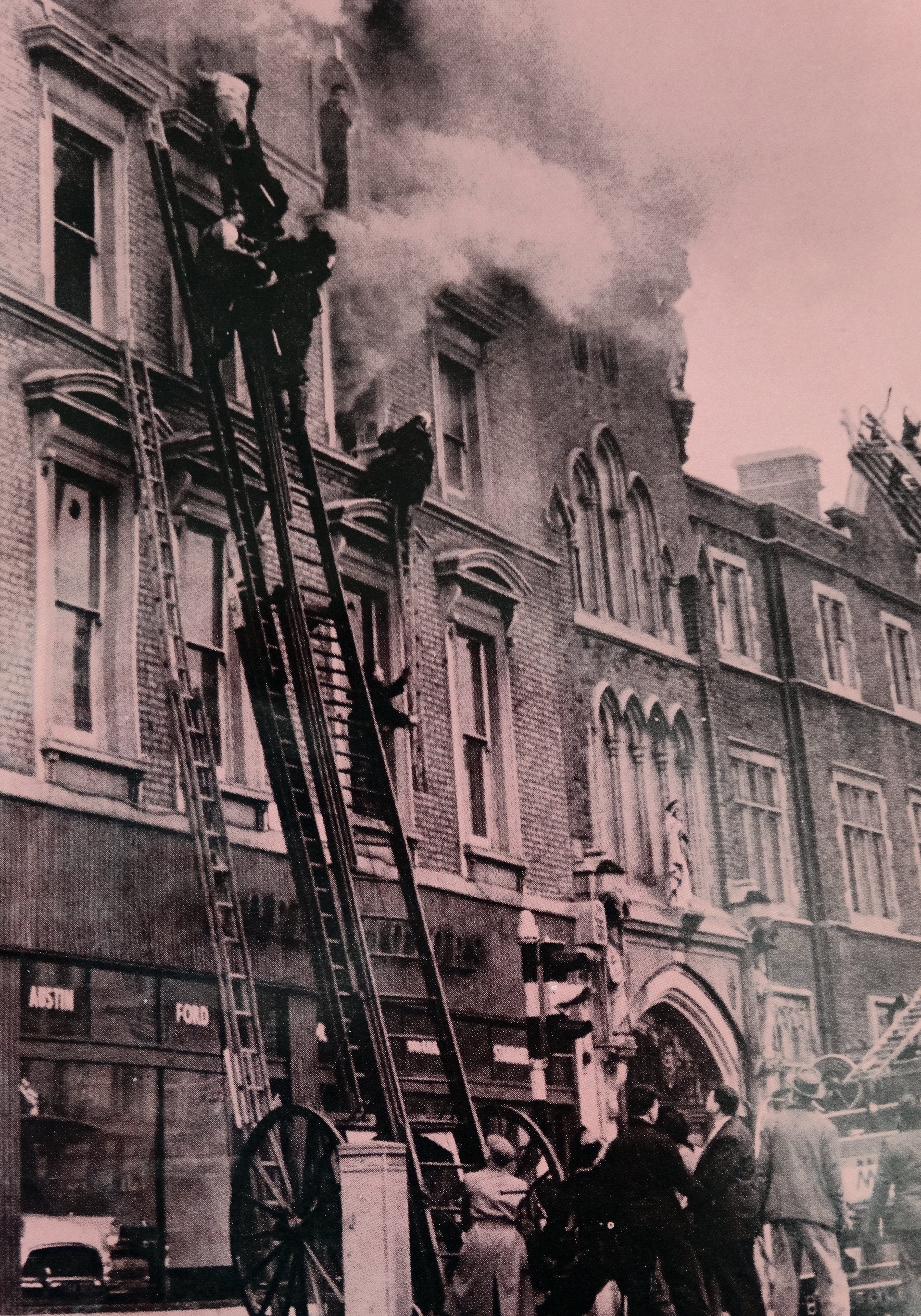
Hook ladder rescue-City Road. EC2. 1950s.


Those that perished.
17th September 1913. (Died 18th September-Fell from hook ladder)
Fm William H.E. Martin. Knightsbridge fire station.

3rd January 1933. (Died 5th January- Fatal injuries performing hook ladders.) Fm Arthur J. Stillman. Southwark HQ.

13th June 1935. Fatal injuries performing hook ladder drills.)
Fm Arthur J. Putt. Edgware Road fire station.

1st June 1956. (Fatal fall whilst at hook ladder drills)
Fm Ronald Stiles. Downham fire station.

Those that were saved.
1950. Fireman Dan Ival (Soho). Awarded a Chief Officers Letter of Congratulation for his actions in rescuing a badly burned man from the second floor by hook ladder at a fire in Gerrard Street.W1.

1955. Leading Fireman Dan Ivall and Fireman Beer (Knightsbridge). Were both awarded a Chief Officer’s Letter of Congratulation for the rescue of a woman from the rear fourth floor window using hook ladders and carrying a lowering line.

1961. Fireman Richard Errington (Holloway) was Commended by the Chief Officer for the hook ladder rescue he performed at a fire in Holloway.

1964. Sub.O Tony Lynham (Kentish Town) received a Chief Officer’s Letter of Congratulation for his actions in performing a hook ladder rescue and bringing to safety 5 children and a large woman.

1966. Sub Officer Leonard Tredwell, Leading Fireman Leslie Hone, Firemen’s Norman Long, Colin Oliver, Christopher Richardson, Colin Wyatt and John Wyatt (Hendon) were each awarded a Chief Officer’s Letter of Congratulation for their actions at a fire in the Hendon Hall Hotel. A man was rescued by means of an escape and hook ladder.

1968. Fireman Robert Arrowsmith (Shoreditch) received a Chief Officers Letter of Congratulation for performing a hook ladder rescue of a man from a fire at Grimsby Street, East London in September.

Multipule rescues at the Leinster Tower hotel fire in 1969.

1969. Leinster Tower Hotel fire. Leading Fireman Gerald Fuller and Fireman Peter Mars (Paddington) for rescuing at least 15 people between them and using hook ladders to bring people to safety from the third and fourth floors. Both men were subsequently awarded the Queens Commendation for Brave Conduct. Leading Fireman Richard Ellicott (Euston) for the difficult hook ladder rescue of a man trapped at a third floor window. Firemen John Hughes and Paul Stephens (Manchester Square) for a hook ladder and line rescue of a man from a fifth floor and lowering the man to safety. Both men were subsequently awarded the Queen’s Commendation for Brave Conduct.

1969. Leading Fireman Robert Fielder, Fireman Michael Ruffell (Paddington) and Sub Officer Roger Winter (Westminster) received Chief Officer’s Commendations for a hook ladder rescue at the St Ermin’s Hotel fire in Caxton Street. Victoria in June. Using the hook ladder they brought with them they climber to the sixth floor and entered the room where the elderly man was suffering from heat and smoke. Sub Officer Winter was also searching for the man and had reached the fifth floor. Seeing the hook ladder he climbed to the sixth. The three men lowered the elderly man by line to ground level where he was treated and removed to safety. Leading Fireman Fielder and Fireman Ruffell were subsequently awarded the British Empire Medal for Gallantry.

Passer-bys photograph of the Fielder/Ruffell rescue at St Ermin’s hotel.


1969. Temporary Station Officer Charles Dixey (Dockhead) was Congratulated by the Chief Officer for his part in rescuing two men from a fire at Rotherhithe New Road in August. On arrival the Brigade found the upper two floors of the building alight and two men, at different windows, were trapped at the rear of the building. Using an extension and hook ladder so as to reach the men they helped one man to climb down to safety. Whilst reaching the second man Station Officer Dixey was burned when a lower window shattered and a heat blast caught him and the hook ladder, undaunted he carried on and helped the man down to safety.

1970. Fireman Keith Wheatley (Barnet) received a Chief Officer’s Letter of Congratulation for rescuing a man from a block of flats in Margaret Court, Barnet in May. Using a hook ladder Fireman Wheatley gained access to the flat via a rear window. Although there was dense smoke and very hot he searched the flat and found a heavily built man, overcome on the floor, by a burning settee. With considerable difficulty he managed to drag the man to the window and lift his head and shoulders so they were outside. The man was then carried down an extension to safety.

1970. Fireman Donald Maclean (Belsize) was awarded a Commendation and Sub Officer Colin Brum (Belsize) a Letter of Congratulation for rescuing a girl trapped by hook ladder at a house fire in Glenilla Road, Belsize Park in December. The operation was particularly difficult because of the nature of the windows, which were set back of a flat roof. Sub Officer Brum had to hold Fireman Maclean by the hook belt so the ladder could be pitched to the next level. A precarious climb but Fireman Maclean managed to reach the girl and assisted her back down the ladder to safety.

1971. Sub Officer Douglas Horsman (Kentish Town) received a Chief Officer’s Letter of Congratulation for the part he played in performing a hook ladder rescue of two women and one man at a fire in Maiden Road, Kentish Town in April. One of the women was pregnant and in considerable distress.

1971. The Chief Officer issued TEN Commendations following the serious and fatal fire at Hill’s Hotel, Kensington in May. Temporary Station Officer Ellis, temporary Sub Officer Levitt and Firemen Cannon and Austin, using hook ladders together brought down a woman trapped on a window sill difficult to reach at the rear of the hotel and who had collapsed and had to be carried down.

The scene at the Hill’s Hotel the morning after the fire.

1971. Temporary Sub Officer Colin Livett (Kensington). In less the 3 weeks Colin Livett earned a second Chief Officer’s Commendation for his actions in rescuing a man from the a hotel fire in Inverness Terrace, Bayswater in June. Arriving at the scene of the fire Temporary Sub Officer Livett and two other firemen went with hook ladders and lowering lings to the rear of the hotel. A man was seen trapped at a third floor window and the rooms below and above, together with the only staircase leading to the room, were alight. He used a hook ladder, through extremes of heat, to reach the man in a hazardous rescue operation. He persuaded the man to get on the hook ladder and guided him to eventual safety. Temporary Sub Officer Colin Livett was subsequently awarded the British Empire Medal for Gallantry.

1973. Fireman Derek Simpson (Ealing). Awarded a Chief Officer’s Letter of Congratulation for reaching a woman, trapped at a third floor window, by hook ladder at a fire at Fairlea Place, Ealing in October. He then calmed the woman down sufficiently so she come be assisted down an extension ladder.

1974. Station Officer Keith Hicks (Soho) and Temporary Station Officer Roy Dunsford (Knightsbridge) were both awarded a Chief Officer’s Letter of Congratulation for their efforts at a fire in Rathbone Place, off Oxford Street in April. A fierce fire was in progress on the top floor of a four storey building. A woman was seen shouting for help on the roof outside a top floor dormer window at the rear of the building. With access for other ladders impossible and the internal staircase impassable Temporary station Officer Dunsford, assisted by Station Officer Hicks and other firemen took a hook ladder to the rear of the building. Working from the flat roof of an adjoining building they managed to pitch the hook ladder to the parapet where the woman was trapped. Station Officer Hicks climbed the ladder, through considerable smoke and heat, and reached the woman who he discovered was in her late seventies. Shielding her from the heat he persuaded the woman, who was also in shock, to return to the ladder where Temporary Station Officer Dunsford was waiting to assist the woman down the ladder and back on to the adjoining building and safety.

1978. Acting Leading Fireman Christopher Shaw (Kentish Town) was Congratulated for his actions at a fire at Rectory Road, Stoke Newington in February. Called to a three storey terraced house fire, thick smoke was coming from the top floor and one person was believed trapped. Joined by two other firemen, who had brought a hook ladder with them, Acting Leading Fireman Shaw climbed the hook ladder and reached the man, but only after a difficult climb. The man was removed to hospital suffering from burns to his head and feet.

1981. Fireman Peter Bailes (Willesden) and Fireman Robert Webb (Wembley) were Commended whilst Station Officer Lionel Galleozie and Fireman Michael Walker (Willesden) received Congratulations from the Chief Officer for their actions at the fire at Redcliffe Walk, Chalkhill Estate, Wembley in February. A severe fire was affecting the fifth and sixth floors of a block of flats. Access to the fire was severely hampered by vehicles blocking the way and sloping and muddy grassed areas. Station Officer Galleozie and his crew together with Wembley’s TL and crew went to the rear of the flats and saw a number of people, cut off by fire, screaming for help from their flats’ balconies. The fire was getting much worse the Station Officer ordered another escape pitched to the fourth floor and a hook ladder pitched to the fifth floor. Fireman Webb took a hook ladder to climb to the fifth, reassuring people as he went. Now assisted by Fireman Bailes they passed three children and two adults out from the fourth floor to other fireman on the escape. The escape was pitch for the third time and Firemen’s Bailes and Webb went aloft carrying a lowering line. Fireman Bailes grabbed a hook ladder on the way up and pitched it from the head of the escape and climbed to the top floor. He and Fireman Webb lowered a woman and child to safety. With fire now affecting the balconies Webb and Bailes came down the hook ladder again to the fifth floor. In the meantime Fireman Walker had climbed and escape to the fourth floor and hook ladder to the fifth where he found a family trapped by fire. Station Officer Galleozie had followed him to the fourth floor was now sat astride the fourth floor balcony parapet. With the father placing one of his children on Fireman Walker’s back he went down the hook ladder where the child was taken by Station Officer Galleozie. The operation was repeated for the second child before the wife was assisted down followed by the father.

Hook ladder rescue. 1930’s


1982. Fireman Stephen Colman (Westminster) was Commended and Fireman Ian Nivison (Chelsea) received a Chief Officer’s Letter of Congratulation for their actions and rescues at the Shelavin Hotel fire, 98-100 Belgrave Road, Pimlico in March. A severe fire was in progress when the Brigade arrived at the hotel. With some 80 guests residents and debris flying from the upper windows firemen were told people were trapped at the rear of the hotel and children were on a small flat room, also at the rear. Using the short extension ladder on the flat roof and hook ladder from the head of that ladder Fireman Coleman, followed by Fireman Nivison climbed the ladders. Thick smoke and flames poured from a window overlooking the flat roof totally obscured the boy who was now screaming he was alight. With complete disregard for his own safety lunged through the smoke and flames and whilst reaching for the boy was completely enveloped in a ball of flame but still managed to retain his grip on the boy and pull him to the top of the hook ladder. Despite the intensity of the fire Fireman Nivison remained at the head of the hook ladder and took the boy from Coleman before carrying the boy down to a waiting colleague. He then returned to assist Fireman Coleman down the hook ladder. Fireman Coleman sustained severe burns to his hands and right knee during the rescue, was taken to hospital and detained. Fireman Stephen Coleman was subsequently awarded the Queen’s Commendation for Brave Conduct.

Lodon’s last hook ladder rescue-1983.

There were undoubtedly other acts of bravery using a hook ladder. Many went unreported, others attracted local congratulations from the Divisional Commander. By the mid-1980s all the hook ladders were withdrawn from operational service in the London Fire Brigade.

Pump escapes showing the pairs of hook ladders carried, in addition to the escape ladder and a first floor ladder, which could be tied to the top of the escape to give additional height.
Fulham Road. 1960s.

Incident at St Johns-1957

A Christmas Tragedy by Gordon White

“The evening rush hour of Wednesday 4 December 1957 was a very foggy one.”

If she had not been seven months pregnant at the time, my sister would surely have died on 4 December 1957. As long as I could remember my sister was always in a hurry, always running when others chose to walk. Why stroll to the station when a last minute dash would achieve the objective?

Such was the case on that fateful, cold and murky day when most of London lay shrouded in one of those distinctive yellowish fogs that preceded the dawning of the smokeless-zone age.

My sister worked as a receptionist for a London advertis­ing agency just off the Strand. Her lunchtime had been spent dashing, as usual, from shop to shop searching for and buying Christmas presents. There was an added dimension to her urgency since it was to be her last Christmas at work and she planned to buy gifts for close colleagues as a farewell gesture. The baby, her first, was due in February.

Her regular train home to the south London suburbs was the 5.18 p.m. electric service from Charing Cross toHayes in Kent, which she would board at Waterloo (now Waterloo East). Her breathless arrival on the platform invariably coincided with the train’s imminent departure which meant standing room only in one of the last two carriages before the throng of commut­ers thinned out as the train made staccato progress to its final destination.

Clutching an assortment of bags and parcels my sister was, as usual, late leaving the agency building in Brettenham Place. The fog was thick enough to blanket the view of the vast Shell Building, which then dwarfed Waterloo Station, from the north side of thebridge.

Five minutes would normally have been enough time for my unencumbered sister to catch her train. Now,weighed down with her unborn son and her clutch of parcels, she lost the race.It was to be the saving of her life. She arrived breathless on the platform just to see the red tail light of her train vanishing rapidly into the foggy gloom towards London Bridge. Her long wait on the cold platform at Waterloo began.

The fog had disrupted the British Rail train services. Not severely, but enough to throw the already hectic rush hour timetable into disarray. Particularly badly hit were the longer distance commuter trains to and from theKent coast, which in those days were hauled by stream locomotives. Lacking the acceleration of the electric trains the steam engines found it virtually impossible to regain time lost through a series of signal checks which accompanied the fog.

The steam express locomotive ‘Spitfire’ was barely ten years old and capable of hauling the coastal trains with consum­mate ease. It was scheduled to pull the 4.56 p.m. service from Cannon Street to Ramsgate. Already arriving late in London on the inward journey the steam engine was well behind on the days schedule when it reversed onto the carriages waiting at Cannon Street. There was no time for the engine’s fireman to fill up the tender with water. The crew were told to take on water at Sevenoaks, the first scheduled stop. With no sign of the thick fog lifting Spitfire got under way from Cannon Street, easing slowly round the curve into London Bridge and then off across the viaducts of Bermondsey towards New Cross.

Some two miles ahead of Spitfire, the Hayes electric train had setoff again, through the murk, after a stop at New Cross. This train was not booked to stop at Lewisham and after passing through St John’s station it was switched to the down main line. It would follow this for a short distance,before veering off at Parks Bridge Junction to regain the Hayes line, just before Ladywell station. A red light brought the Hayes train to a halt on the main line just before the junction.

With its brakes applied fully, to counter act a slight incline, the ten-carriage Hayes train trailed back to a point where its two rear coaches stood beneath an overbridge that carried the railway line from Nunhead to Lewisham. The scene was now set for a tragedy.

Despite the poor visibility the crew of the Spitfire had built up speed on the long, straight run from London Bridge to New Cross where it passed through the station at something like 40mph. For many years this stretch of line had been equipped with multi-coloured signalling, in theory, was far easier for a train driver to read that the conventional semaphore signals that were mounted on posts or gantries. Tragically the driver of Spitfire powered his train, first, past a double yellow signal light, and then a yellow signal. This should have warned him that the next signal would be RED and require him to bring his train to a standstill. Instead only after Spitfire, the Ramsgate express, had passed the red signal at St John’s was there a brake application. It was too late.

Spitfire and its train, several hundred tons all told, ploughed into the back of the still stationary Hayes train. The force of the impact was catastrophic and deadly. With its brakes on, the Hayes train offered a deadweight resistance. Its rear carriages were smashed beyond all recognition. The leading coaches of the Ramsgate train buckled and the locomotive hit the pillars supporting the overbridge with such force it caused the struc­ture to collapse on the wreckage below.

The one glimmer of fortune to shine on an evening of carnage came moments later when the driver of the train approaching on the line from Nunhead, that would take him over the bridge towards Lewisham, saw through the fog that the line suddenly disappear in front of him. Applying the brakes for an emergency stop he brought the train to a jolting halt just yards from the precipice where only minutes before the bridge had been. An even worse disaster had been averted by only the narrowest of margins.

A characteristic of fog is that it muffles sound. Residents from nearby streets would later recall hearing only a ‘dull thud’ at the moment of impact. Fortunately some who had telephones had the presence of mind to realise that something had happened and summoned the emergency services. Others scrambled up the embankments flanking the lines to see what could be done. The driver of the Hayes Train which had been catapulted forwards by the collision, staggered from his cabin to the signalbox at Parks Bridge Junction to report the crash. He found that the signalman had already set all the signals under his control to red.

In 1957 (emergency services) major accident procedure did not exist. But it was very apparent to the three emergency services that the crash was of catastrophic proportions. Access to the crash site was extremely difficult. It could only be made, initially, by means of an extension ladder pitched, to form a bridge,from the roof of an appliance to the top of a 12ft high brick wall. Also a steep embankment had to be negotiated to reach the permanent way.

 The sight that met the first fire enginecrews from Lewisham, and then surrounding fire stations, was almost impossible to comprehend. The impact had thrown many passengers from the trains and they were lying, some already dead and others with life-threatening injuries, on both the permanent way and the embankment. The death toll was the most severe,however, in the rear coaches of the Hayes train. These had been packed to‘standing room only’ capacity. Miraculously, some passen­gers in this part of the train had survived the crash itself but now lay entombed in the midst of the entangled remnants of the carriages.

Emergency tender crews were to the fore – there were only two then in the London Fire Brigade – and set about the task of extracting the trapped and moving away the bodies of the dead. Alongside London’s firemen, doctors and nurses also moved among the injured administering morphine to those in pain.

One of the London fire brigade’s two emergency tender. 1950s.

The Brigade control unit, from Lambeth, was located in the adjacent Thurston Road, and four advanced control points were established around the scene of the wreck making use of the walkie-talkie equipment. Extracutting equipment was brought in as rescue work continued through the evening and into the night.

The cold, grey light of dawn revealed the true scale of the disaster. It was as if a giant had plucked the trains from the track, crumpled them in a rage and hurled them back to the ground. The last remaining bodies were removed to a make­ shift mortuary at Lewisham Hospital. Grim faced police offic­ers gathered up the array of personal belongings that littered the scene whilst British Railway workman busied themselves with the task of shoring-up the overhanging sides of the overbridge.

The death toll was initially ‘officially’ listed as 90, although subsequent records would show a slightly higher number due to the victims who succumbed to their injuries.

The communities of Hayes, West Wickham,Elmers End and Eden Park, where my family lived, were hard hit by the tragedy and as a schoolboy I recall the seemingly endless processions to the local crematorium. We all seemed to know at least one family affected by the crash.The inevitable inquiry into the ‘Railway Accident at St John’s’, not Lewishamas it was, found that the colour light signals had been installed at a time when most locomotives were right-hand drive. Conversely Spitfire was driven from the left-hand side which, coupled with the length of the engine’s boiler, made the sighting of the signal less easy. However, the point was made that given the weather conditions the train driver should have asked the fireman to assist with the observation of the warning signals from the right-hand side of the cab. Comment was also made on the pre-war, WWII, rolling stock of the electric train, which offered little protection to passengers on impact. The inquiry concluded that the sole blame for the accident rested with the driver of the Ramsgate train. Yet public opinion was divided when the decision was made to charge him with manslaughter. Many felt that little could be gained from prosecuting a man who was never going to wipe from his memory the event of that fateful day. A broken man, he died within a few years.

(Gordon White was ‘LFB’ through and through although he never actually wore a fireman’s uniform. He was the editor of the Brigade’s in house magazine the London Fireman before it was rebranded as the London Firefighter.  He wrote the foreward for the book, London’s Firefighters which contains many of the contributions to this award winning magazine. I was honoured to know Gordon and call him my friend. He died in January 2016 from cancer.)

London’s fire engine horses.

Horses had been pulling the fire engines to fires for quite some time prior to the creation of the Metropolitan Fire Brigade (MFB) in 1866. First for London’s Insurance fire brigades then followed by the London Fire Engine Establishment. Horses were usually kept stabled at the rear of the station, close by the engine house and brought to the engine to be harnessed, when the summons forassistance came. Both organisations had provided their own horses to pull, first the manual pumps and then, later, the steam pumps that were gradually replacing the manual, and man-power intensive, fire engines. However, these were usually any horse that a local livery company could supply to the fire brigade and had no special training for the work involved.

Captain Eyre Massey Shaw had been the Superintendent of the London Fire Engine Establishment before being chosen as the newly created Chief Fire Officer of the Metropolitan Fire Brigade (MFB). He had changed who pulled London’s fire engines within a year of taking command of the Capital’s enlarged and progressive fire brigade. He turned to one Thomas Tilling, who ran many of London’s horse-drawn buses, to supply these specialised fire engine pulling horses. From 1867 Tillings held the contract to supply the MFB and later the renamed London Fire Brigade (LFB) with horses trained just for fire brigade work.

Islington fire station stables, Upper Street, showing a white horse named Kruger. The station opened in 1899. Horses would remain in use in the London Fire Brigade until 1921, although motorised fire engines were being introduced into the service in increasing numbers from the early 1900s. Kruger is shown ready for action, wearing the quick release harness developed for fire brigade use so as not to delay the turnout of the engines. Coachmen were designated firemen responsible for driving the horse drawn engines and caring for the horses at the scene of a fire. Station stalls were either within or adjacent to the engine room for the duty horses. The stables formed part of the general station layout. early 20th century

The Tilling Company traces its origins to 1846, when Thomas Tilling started in business. Thomas Tilling was born in 1825 at Gutter’s Hedge Farm, Hendon, in Middlesex. At the age of 21 he went into the transport business in London  working as a ‘Jobmaster,’ the provider of horse, carriage, tack and driver on a rental basis, rather like a car hire firmof today, in Walworth using a horse and carriage which cost him £30. By January 1850 he had progressed to purchasing his own horse bus, together with the licence, to run four journeys a day between Peckham and Oxford Street. By 1856 he owned 70 horses which he used for bus and general carriage work. Tilling won the contract with the London County Council to supply the Metropolitan Fire Brigade. Tilling was also contracted to train the horses to haul the fire engines. These horses, Tilling trained to respond quickly and, prior to their handover to the fire brigade, they were employed on the bus services (primarily the Peckham route) to gain experience of heavy London traffic. Tilling eventually became the biggest supplier of horse power and vehicles in London, having a stable of 4,000 horses by the time of his death in1893. Thomas Tilling was buried at Nunhead Cemetery in south London.

Once inthe fire brigade the horses served about eight years and like the firemen themselves some stood out as characters in their own right, and they won themselves a place in the firemen’s, and Londoners’, hearts as these magnificent animals sped through the streets in urgent response to the call for help.

By the mid-1880s the previous methods of bringing the horse from their stables was abandoned in favour of having the horses kept in ‘duty’ stalls adjacent to their respective engines with a loose harness already fitted to which the engine could be speedily attached. (Captain Shaw had visited some fire brigades in the United States previously and had brought this American system back to London, together with adopting the ‘sliding-pole’into his London fire stations.)

Metropolitan escape cart and crew.

The stories about the horses were endless. Just how true all of them were is open for debate. However, some are still worth repeating, even if over the passage of time a degree of exaggeration has crept into the tales. There was, they said, one pair who were so intelligent that when the call came they looked across to the watchroom where a disc would fall as the street alarm was pulled, showing the point at which it had been given. These two were so astute that, according to the location of the alarm, they would turn left or right outof the station without any direction from the fireman ‘coachman’ on the box.

Firefighters and appliances at headquarters. The caption reads: Making up and getting away home after district call at headquarters. 19th century

The horses would also regularly stamp their hooves if they were kept ‘on watch’ for more than their requisite two hour stint in the stalls. One pair were believed to have known before any of the other firemen at the station that their fireman ‘coachman’was losing his sight. The horses covered for him, galloping round obstacles andsensing their way to the fire long before it was discovered that he was doing very little to help them. Several newspapers reported on a fire horse from Deptford fire station and his antics on the way to a fire. Called to ‘Fire inGlobe Street,’ the occupiers of the house had already extinguished the fire before the reinforcing fire engines could be prevented from attending the call. Still en route, Deptford fire engine was galloping down Deptford High Street when the horse suddenly stopped. No amount of cursing or cajoling by thefiremen on board, and particularly the coachman, would makethe animal move. It was then the firemen realised why, the house they had stopped outside was on fire too.

By the late 1880s five pairs of horses were kept at most stations, with two always ‘on watch’ and ready to go.The horses on watch had their collars hooked to the ceiling of the engine room,by a rope, to ease the weight on their necks. Additionally other ropes were attached to their blankets so that when the alarm sounded they could speedily be removed and left hanging in mid-air with the horses ready to trot to the shafts of the engine.

The Tooley Street fire station-Bermondsey

Whilst every engine was clearly marked LCC-Metropolitan Fire Brigade the horses themselves carried the initials ‘T.T.’ on their blinkers. The ‘greys’ supplied by Tilling’s were a conspicuous colour.It was considered that the greys were, apparently, more fortunate than theothers in getting a clear road, and do well in an engine. Although theengine-horses were rarely troubled with burns, and appeared quite heedless ofthe sparks which could sprinkle on to their backs from the unguarded funnel,they were not free from other accidents. Tilling’s had to replace horses, bynight or day, on receipt of a telephone message from a fire station, so that sufficient horses were held in readiness at the station yard for emergencies. Given the vast stock of Tilling’s animals it paid to maintain infirmaries to which the sick and injured animals were sent and even a farm fortheir convalescence.

Camberwell fire station and a Tilling’s pair of greys.