THE EARLY DAYS OF THE LONDON SALVAGE CORPS.

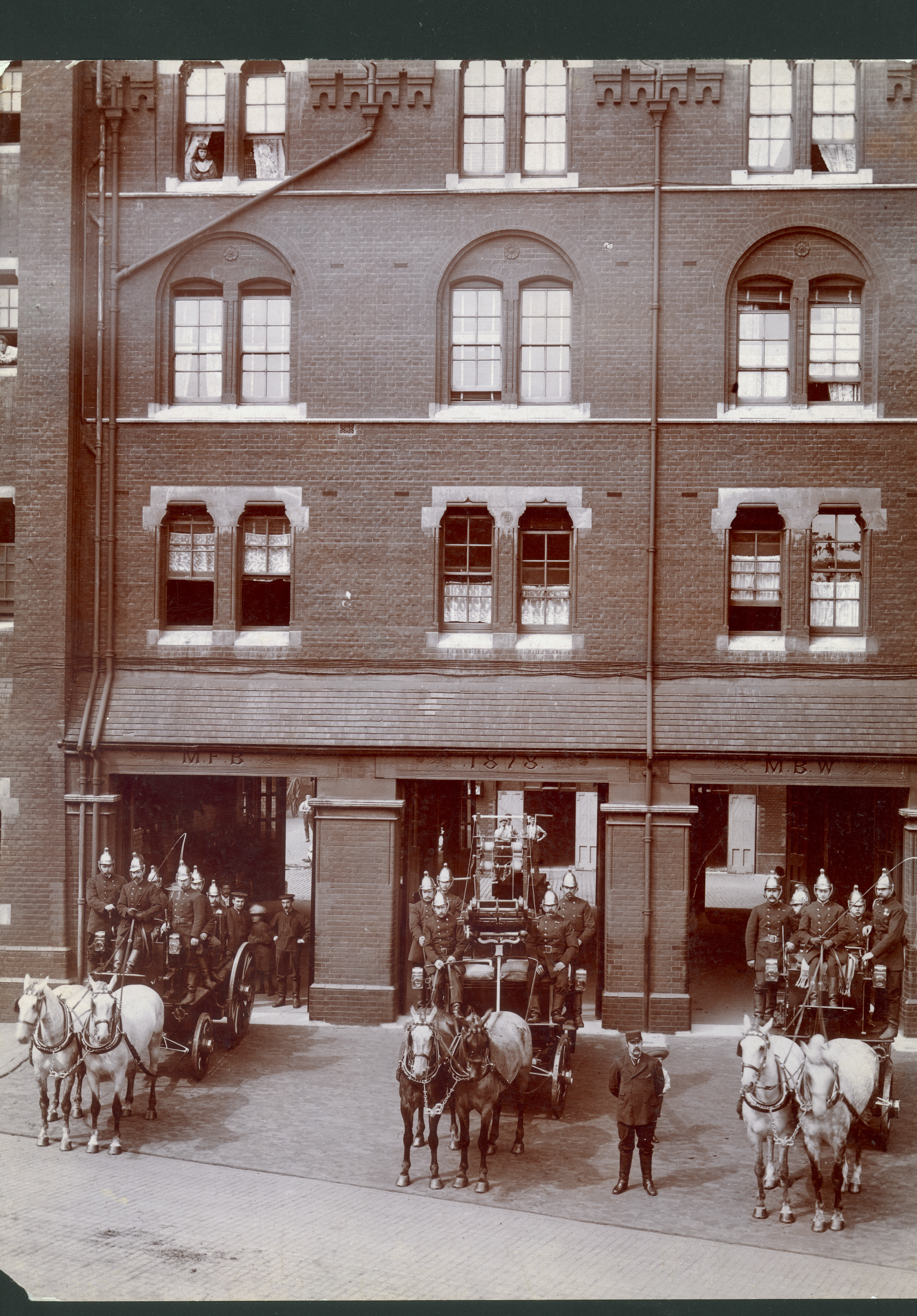
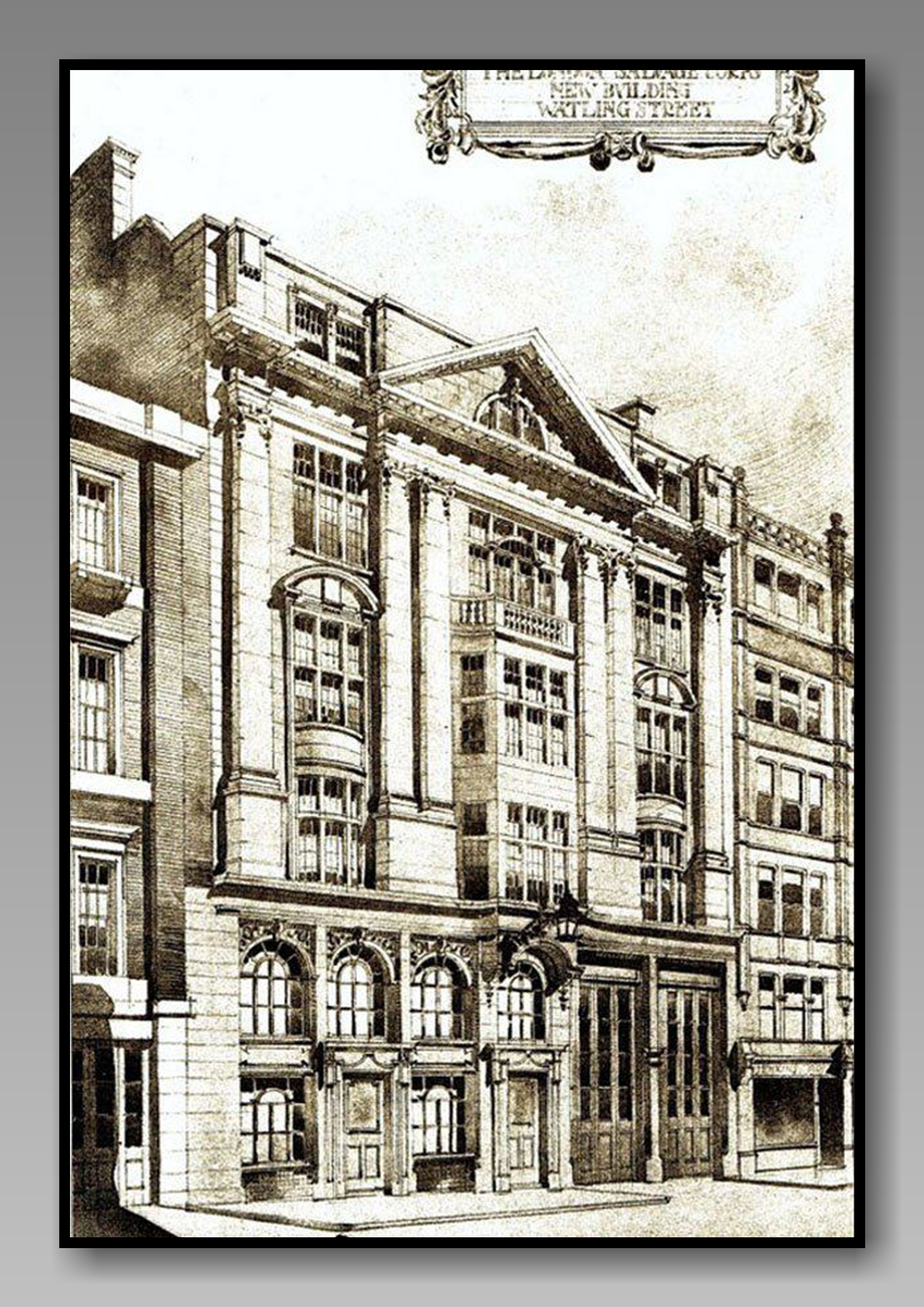
The London Salvage Corps at their Watling Street headqurters station.
(Watling Street was also the location of the Metropolitan Fire Brigade HQ from 1866-1878)

“Where is the fire?”

“City, sir; warehouses well alight.”

“Off, and away!”

The salvage corps horses are harnessed to the scarlet cart as quickly as though it were a fire-engine; the crew of ten men seize their helmets and axes from the wall beside the cart, and mount to their places with their officers; the coachman shakes the reins; and away dashes the salvage-corps trap to the scene of action.

The wheels are broad and strong. They do not skid or stick at trifles; the massy steel chains of the harness shine and glitter with burnishing, and might do credit to the Horse Artillery; the stout leather helmets and sturdy little hand-axes of the men look as fit for service as hand and mind can make them. Everything was in its right place; everything was ready for action; and at the word of command the men were on the spot, and fully equipped in a twinkling.

Superintendant John Blyth and his sons, Herbert and William at an LSC station.

The call came from the fire-brigade. The brigade pass on all their calls to the salvage corps, and the chiefs of the corps have to use their discretion as to the force they shall send. The public do not as a rule summon the salvage corps. The public summon the fire-brigade, and away rush men and appliances to extinguish the flames and to save life. The primary duty of the salvage corps is to save goods. There is telephonic connection between the brigade and the corps, and the two bodies work together with the utmost cordiality.

We will suppose the present call has come from a big City fire. The chief has to decide at once upon his mode of action. No two fires are exactly alike, and saving goods from the flames is something like warfare with savages—you never know what is likely to happen; so he has to take in the circumstances of the case at a glance, and shape his course accordingly. Should the occasion require a stronger force, he sends back a message by the coachman of the cart; and in his evidence concerning the great Cripplegate fire, Major Charles J. Fox, the chief officer of the salvage corps, stated that he had seventy men at work at that memorable conflagration.
But see, here is the fire! Streams of water are being poured on to the flames, and the policemen have hard work to keep back the excited crowd. They give way for the scarlet cart, and the salvage men have arrived at the scene of action. Entrance may have to be forced to parts of the burning building, and doors and windows broken open for this purpose.

Crash! crash! The axes are at work. And a minute more the men step within amid the smoke. The firemen may be at work on another floor, and the water to quench the fire may be pouring downstairs in a stream. The noises are often extraordinary. There is not only the rush and roar of the flames, the splashing and gurgling of the water, but the falling of goods, furniture, and may be even parts of the structure itself. Walls, girders, ceilings may fall, ruins clatter about your ears, clouds of smoke suffocate you, tongues of flame scorch your face; but if you are a salvage man, in and out of the building you go, while with your brave brethren of the corps you spread out the strong rubber tarpaulins you have brought with you in your trap, and cover up such goods as you find, to preserve them from damage. Under these stout coverlets, heaps of commodities may lie quite safe from injury from water and smoke.

Overhead you still hear terrible noises. Safes and tanks tumble and clatter with dreadful din; part of the structure itself, or some heavy piece of furniture, falls to the ground; dense volumes of water poured into the windows rain through on to your devoted head. But you stick to your post, preserving such goods as you can in the manner that the chief may direct. May be you have to assist in conveying goods out of reach of the hungry fire, and your training has taught you how to handle efficiently certain classes of goods. Sometimes quantities of water collect in the basement, doing much damage; and down there, splash, splash, you go, to open drains, or find some means of setting the water free.

On occasion, the men of the salvage corps find themselves in desperate straits. At the Cripplegate fire, one of the corps discovered the staircase in flames, and his retreat quite cut off. With praiseworthy promptitude, he knotted some ladies’ mantles together into a rope, and by this means escaped from a second-story window to the road below.

On another occasion, Major Fox himself, the chief of the corps, was rather badly hurt on the hip, when making his way about a burning building at a fire in the Borough. The probability of accident is only too great, and it was no child’s play in training or in practice which enabled the corps to attain such proficiency as to carry off a handsome silver challenge cup at an International Fire Tournament at the Agricultural Hall in the summer of 1895.

The duties of the salvage corps do not end even when the fire is extinguished. They remain in possession of the premises until the fire-insurance claims are satisfactorily arranged. They do not, however, know which office is paying the particular claims, and all offices unite in supporting the corps. It is, in fact, their own institution, though established under Act of Parliament; and it is not, therefore, like the London Fire-Brigade, a municipal service.

When the brigade was handed over to the Metropolitan Board of Works by the Act of 1865, provision was made for the establishment of a salvage corps, to be supported by the Fire-Insurance Companies, and to co-operate with the brigade. The corps has now five stations, the headquarters—where the chief officer, Major Fox, resides—being at Watling Street in the City. The eastern station is at Commercial Road, Whitechapel; the southern, at Southwark; the northern, at Islington; and the western, at Shaftesbury Avenue.

The Islington station of the Corps.

The force consists of about a hundred men. Their uniform somewhat resembles that of the fire-brigade, being of serviceable dark blue cloth, but with helmets of black leather instead of brass. They are nearly all ex-navy men, excepting the coachmen, some of whom have seen service in the army; indeed, candidates now come from the royal navy direct, but receive a special training for their duties, such as in the handling of certain classes of goods. Their ranks are divided into first, second, and third-class men, with coachmen, and foremen, five superintendents, and one chief officer.

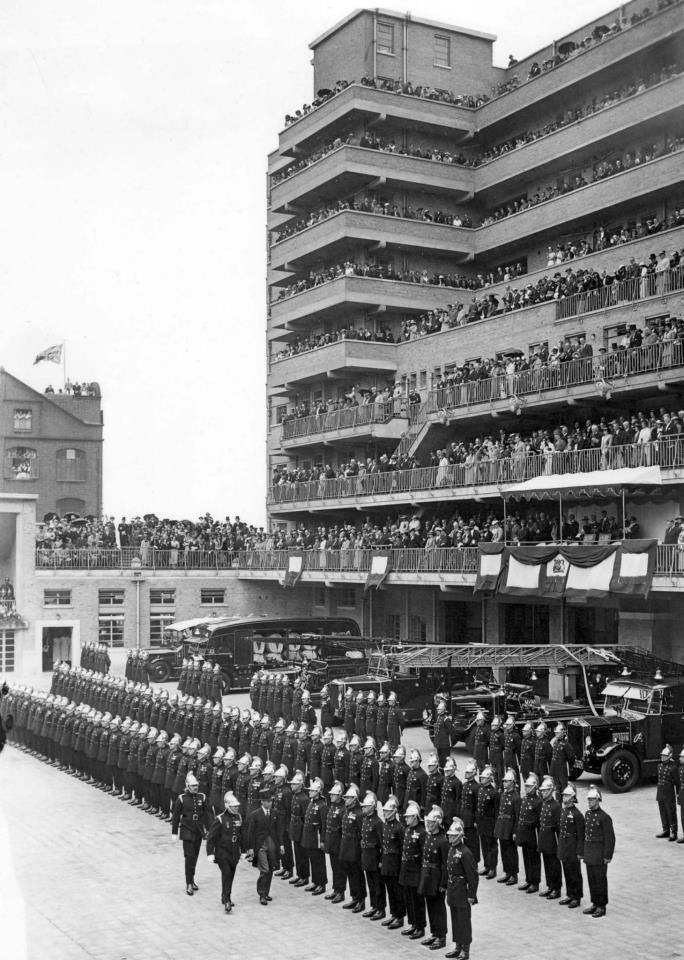
The London Salvage Corps line up in tribute to a fallen London fireman at their
Southwark Salvage Station and opposite the Brigade’s Headquarters station
in Southwark Bridge Road.

Their work lies largely outside the public eye. They labour, so to speak, under the fire; and it is difficult to estimate the immense quantity of goods they save from damage during the course of the year. Thousands of pounds’ worth were saved at the great Cripplegate fire alone in November, 1897. That huge conflagration, which was one of the largest in London since the Great Fire of 1666, may well serve to illustrate the work of the corps.

The alarm was raised shortly before one o’clock mid-day on November 19th, and an engine from Whitecross Street was speedily on the spot. As usual, the salvage corps received their call from the brigade; and in his evidence at the subsequent enquiry at the Guildhall, Major Fox stated he received the call at headquarters from the Watling Street fire-station, a warehouse being alight in Hamsell Street. He turned out the trap, and with the superintendent and ten men hurried to the fire. He also ordered other traps to be sent on from the other four stations of the corps, and left the station at two minutes past one. The Watling Street fire-engine had preceded him; and when he turned the corner of Jewin Street out of Aldersgate Street, he saw “a bright cone of fire with a sort of tufted top.” It was very bright, and he was struck by the absence of smoke. He thought the roof of one of the warehouses had gone, and the flames had got through. Perceiving the fire was likely to be a big affair, he at once started a coachman back to Watling Street with the expressive instructions to “send everything.”

The coachman returned at thirteen minutes past one, so the chief and his party must have arrived at the fire about five minutes past one; that is, they reached the scene of action in three minutes. The major and superintendent walked down Hamsell Street, and found upper floors “well alight,” and the fire burning downward as well. It was, in fact, very fierce; so fierce, indeed, that he remarked to his companion what a late call they had received. The firemen were getting to work, and he himself proceeded with his salvage operations.

Believing that some of the buildings were irrevocably doomed, he did not send his men into these, for the sufficient reason that he could not see how he could get the men out again; but they got to work in other buildings in Hamsell Street and Well Street, though the fire was spreading very rapidly. Many windows were open, which was a material source of danger, causing, of course, a draught for the fire. They shut some of the windows, and removed piles of goods from the glass, so that the buildings might resist the flames as long as possible. Eventually, the staff of men, now increased to seventy in number, cleared out a large quantity of goods, and stacked them on a piece of vacant ground near Australian Avenue. In spite of the heat and smoke and flame, in spite of falling tanks and safes and walls, the men worked splendidly, and were able to save an immense quantity of property.

Meantime, the firemen had been working hard. On arrival, they found the fire spreading with remarkable rapidity, and the telephone summoned more and more assistance. Commander Wells was at St. Bartholomew’s Hospital examining the fire appliances when he was informed of the outbreak. He left at once, and reached Jewin Street about a quarter past one. Superintendent Dowell was with him; and on entering the street, they could see from the smoke that the fire was large, and that both Hamsell Street and Well Street were impassable, as flames even then were leaping across both the streets.

Steamers, escapes, and manuals hurried up from all quarters, until about fifty steamers were playing on the flames. Early in the afternoon, the girls employed in a mantle warehouse hastened to the roof in great excitement, and escaped by an adjoining building. A staff of men soon arrived from the Gas Company’s offices; but the falls of ruins were already so numerous and so dangerous, that they were not able to work effectually. In fact, the whole of Hamsell Street was before long in flames; and in spite of all efforts, the fire spread to Redcross Street, Jewin Crescent, Jewin Street, and Well Street. The brigade had arrived with their usual promptitude; but before their appliances could bring any considerable power to bear, the conflagration was extending fast and fiercely.

The thoroughfares were narrow, the buildings high, and the contents of a very inflammable nature, such as stationery, fancy goods, celluloid articles (celluloid being one of the most inflammable substances known), feathers, silks, etc., while a strong breeze wafted burning fragments hither and thither. Windows soon cracked and broke, the fire itself thus creating or increasing the draught; the iron girders yielded to the intense heat, the interiors collapsed, and the flames raged triumphantly.

Capt Wells of the Metropolitan Fire Brigade.

In Jewin Crescent, the firemen worked nearly knee-deep in water, and again and again ruined portions of masonry crashed into the roadway. Through the afternoon, engines continued to hurry up, until at five o’clock the maximum number of about fifty was reached. The end of Jewin Street resembled an immense furnace, while the bare walls of the premises already burnt out stood gaunt and empty behind, and portions of their masonry continued to fall.

Firemen were posted on surrounding roofs and on fire-escape ladders, pouring immense quantities of water on the fire, while others were working hard to prevent the flames from spreading. All around, thousands of spectators were massed, pressing as near as they could. They responded readily, however, to the efforts of the police, and order was well maintained.

This was the critical period of the fire. It still seemed spreading; in fact, it appeared as though there were half a dozen outbreaks at once. But after six, the efforts of the firemen were successful in preventing it from spreading farther. As darkness fell, huge flames seemed to spurt upward from the earth, presenting a strikingly weird appearance; they were caused by the burning gas which the workmen had not been able to cut off. Crash succeeded crash every few minutes, as tons of masonry fell; while in Well Street, at one period a huge warehouse, towering high, seemed wrapped in immense flame from basement to roof.

An accident occurred by Bradford Avenue. Some firemen, throwing water on the raging fire, were suddenly surprised by a terrible outburst from beneath them, and it was seen that the floors below were in flames. To the excited spectators it seemed for a moment as though the men must perish; but a fire-escape was pitched for them, and amid tremendous cheering the scorched and half-suffocated men slid down it in safety.

Cripplegate Church, too, suffered a narrow escape, even as it did in the Great Fire of 1666. On both occasions, sparks set fire to the roof, the oak rafters on this occasion being ignited. But the special efforts made by the firemen to save it were happily crowned by success, though it sustained some damage. Also Mr. Nein, one of the churchwardens, assisted by Mr. Morvell and Mr. Capper, posted on the roof, worked hard with buckets to quench the flames.

It was late at night before the official “stop” message was circulated, and eight o’clock next morning before the last engine left. It was found that the area affected by the fire covered four and a half acres, two and a half being burnt out; and no fewer than a hundred and six premises were involved. Fifty-six buildings were absolutely destroyed, and fifty others burnt out or damaged. Seventeen streets were affected; but happily no lives were lost, though several firemen were burnt somewhat severely. The total loss was estimated at two millions sterling, the insurance loss being put at about half that amount. The verdict, on the termination of the enquiry at the Guildhall on January 12th, 1898, attributed the conflagration to the wilful ignition of goods by someone unknown.

The quantity of water used at this fire was enormous. Mr. Ernest Collins, engineer to the New River Water Company, in whose district the conflagration took place, said that, up to the time when the “stop” message was received, the total reached to about five million gallons. No wonder that the firemen were working knee-deep in Jewin Street. The five million gallons would, he testified, give a depth of about five feet over the whole area. But, further, a large quantity was used for a week or so afterwards, until the conflagration was completely subdued. In addition to the engines, it must be remembered that there were fifty hydrants in the neighbourhood.

These hydrants can, of course, be brought into use without the turncock; but, as a matter of fact, that official arrived at two minutes past one, the same time as the first engine; while the fire was dated in the company’s return as only breaking out at four minutes to one, and the brigade report their call at two minutes to one.

The water used came from the company’s reservoir in Claremont Square, Islington. But this receptacle only holds three and a half million gallons when full. It is, however, connected with another reservoir at Highgate having a capacity of fifteen million gallons, and with yet another at Crouch Hill having when full twelve million gallons. As a matter of fact, these two reservoirs held twenty-five million gallons between them on the day of the fire, and both were brought into requisition, as well as the Islington reservoir. The drain was, however, enormous.

In the course of the first hour, the water in the Islington reservoir actually fell four feet. It never fell lower, however; for instructions were telegraphed to the authorities at other reservoirs to send on more water, and the supply was satisfactorily maintained,—a striking contrast, indeed, to the Great Fire of 1666, when the New River water-pipes were dry!

It was about nine o’clock when the chief officer of the salvage corps felt able to leave. During the eight hours he had been on duty, his men had saved goods to the value of many thousands of pounds. He had known to some extent the class of goods he would meet with, for the inspectors of the corps make reports from time to time as to the commodities stored in various City warehouses, and he is therefore to some extent prepared. On the following day, the 20th, the corps were occupied in pulling down the tottering walls of the burned-out warehouses which were in a dangerous condition.

(Taken from; The Project Gutenberg EBook of Firemen and their Exploits: 

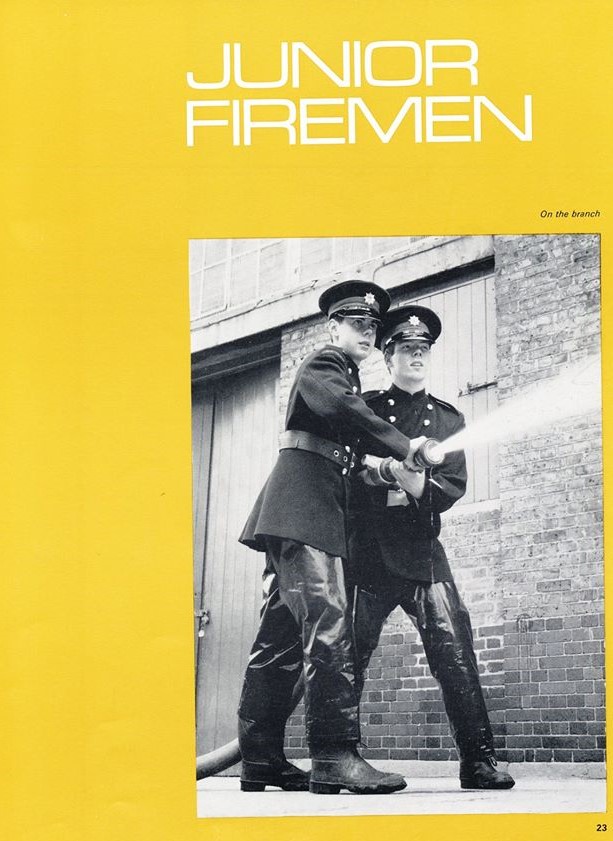
The London Fire Brigade Junior Firemen Scheme. 1964-1969.

The scheme was started with the London County Council, prior to the change over to the Greater London Council (GLC) in April 1965. London was not the first Brigade to introduce ‘lads’ to this strange new fire brigade world: that honour fell to Kent FB. The early London squads, with the likes of Tony Sowerby, Ray Ford and John Shawyer, the grandson of the legendary Alfie Shawyer. They all started and finished their Junior Fireman training at the London Fire Brigade’s Southwark training school in Southwark Bridge Road. As well as the 18 months to 2 years practical and theoretical fire brigade stuff there was also the weekly educational training at the City Day College in the Barbican that involved hydraulics and sciences.

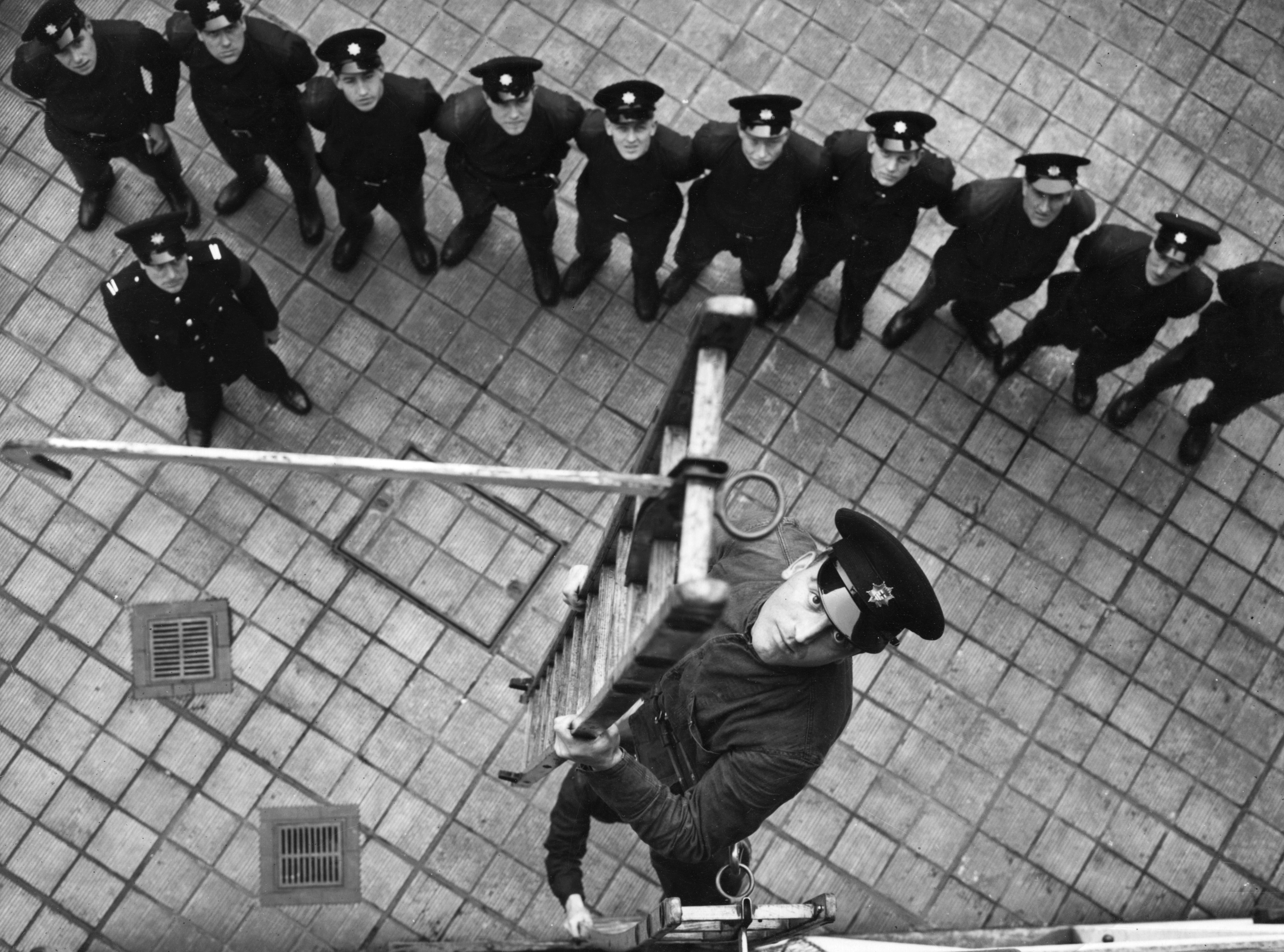
Junior firemen, with their distinctive RED cap bands, learning the skills required of a
London fireman.

I joined the LFB’s Junior Fireman scheme in 1965, starting at Southwark and following an identical regime. The Junior Firemen’s locker room was located on the ground floor of the former MFB Headquarters building. We were the only occupants in this semi-derelict building. All Junior Firemen had to undertake an outward bound course and after returning from mine back to the Southwark training school in late January 1966 it heralded a new direction for us “Cadets’. Our Junior Firemen training was to become residential.

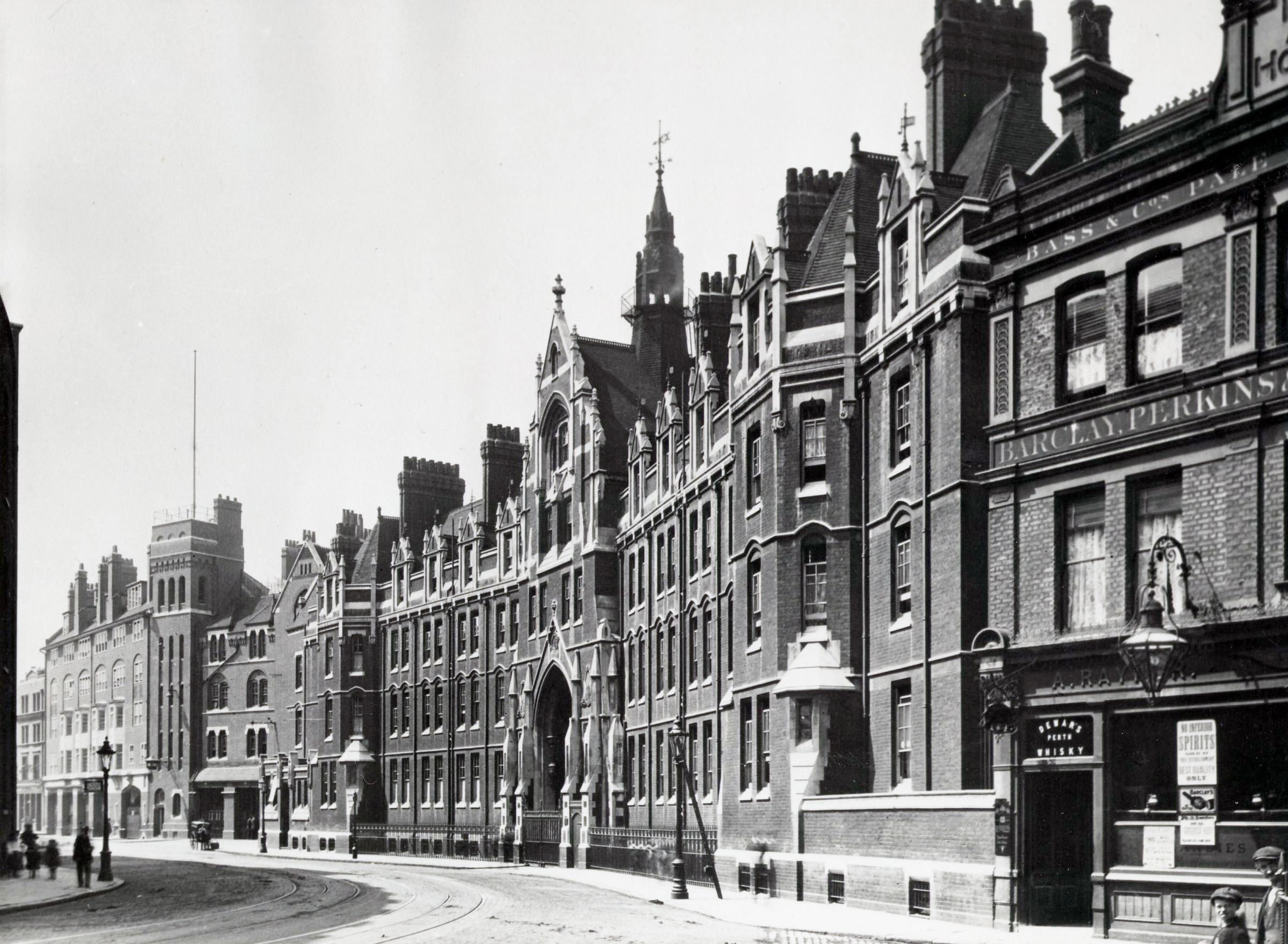
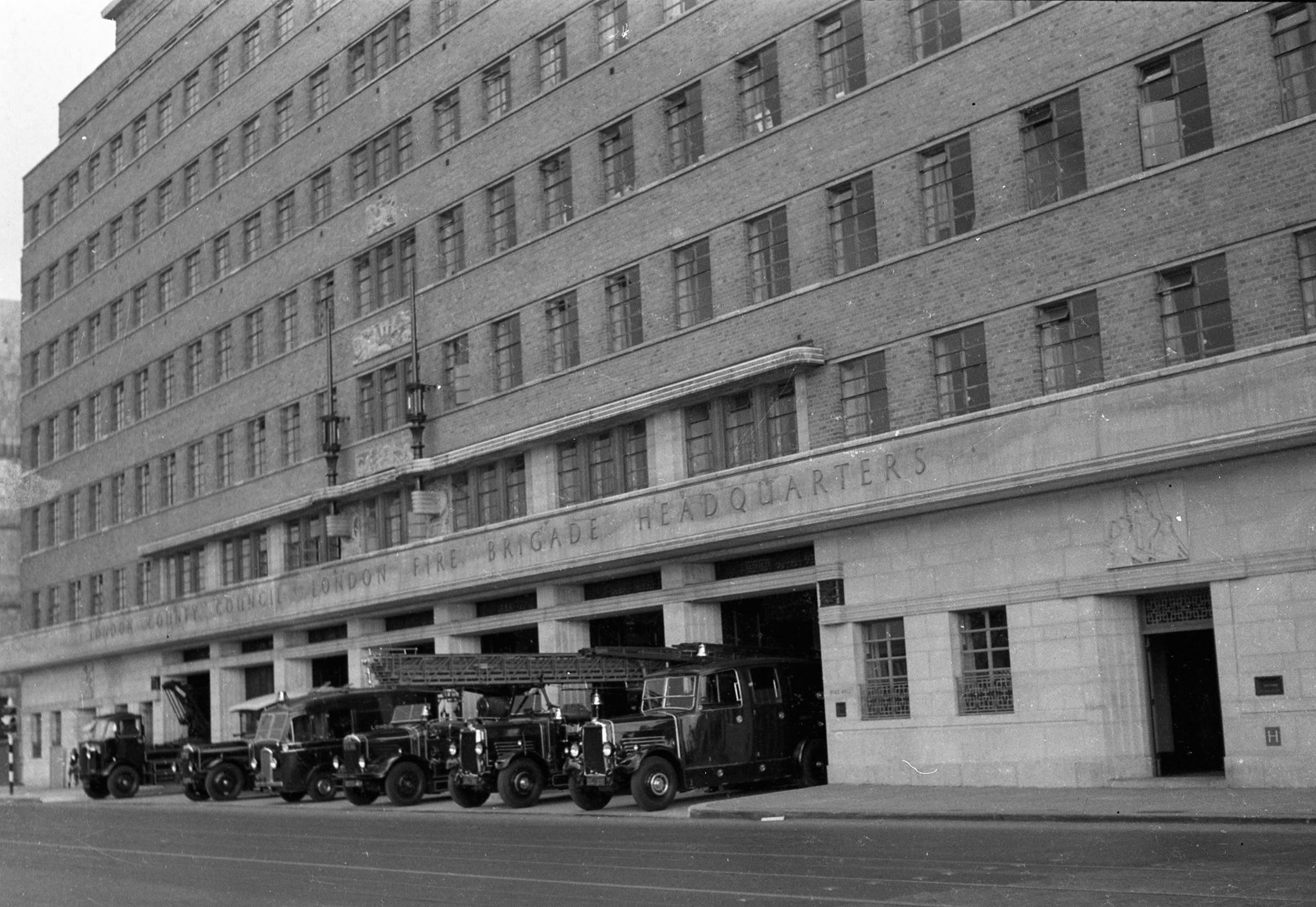
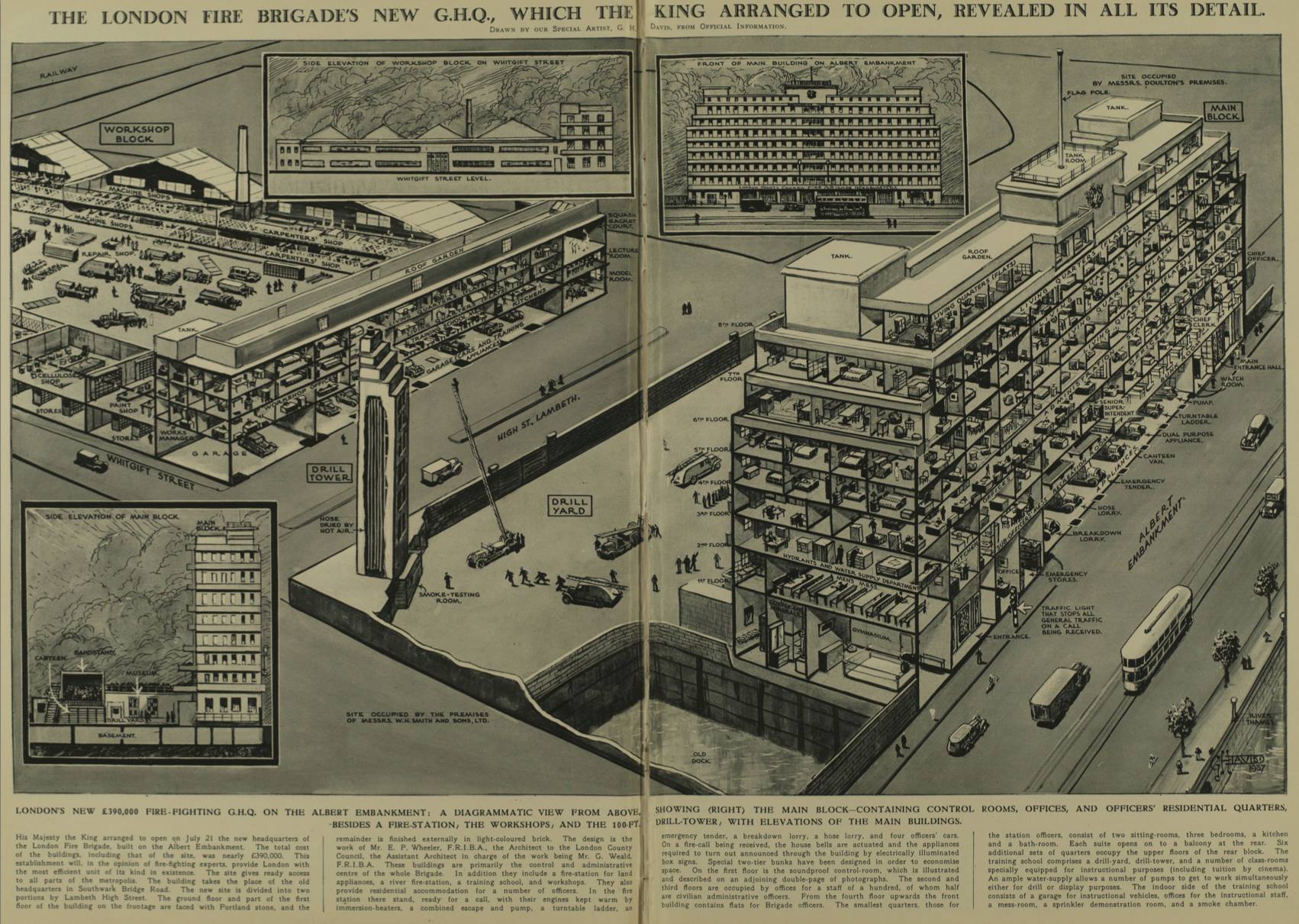
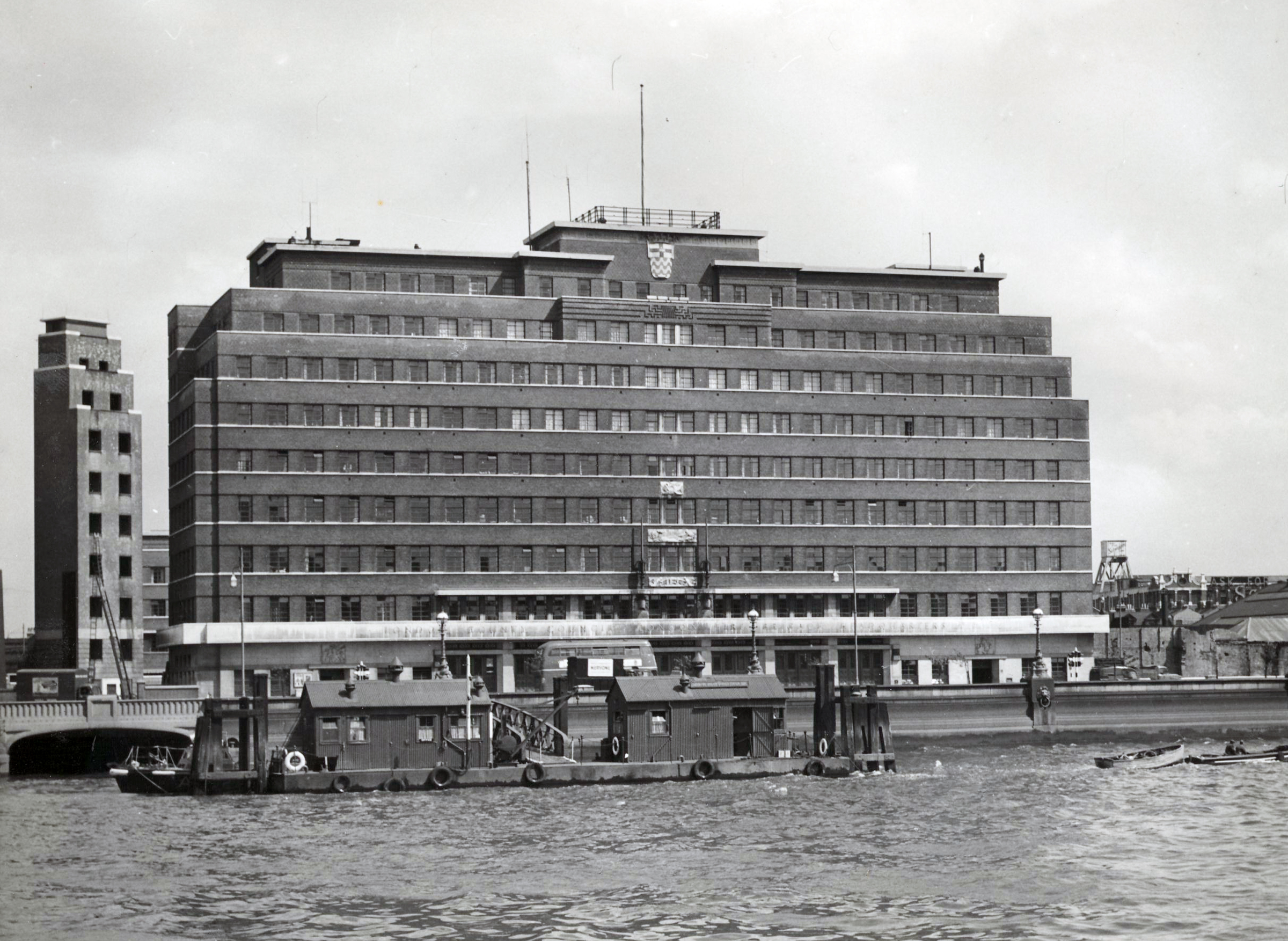
Built for the Metropolitan Fire Brigade, after the Watling Street headquarters building became too small for the growing fire service, this building in Southwark Bridge Road SE1 remained the Brigade’s headquarters until relocation to the new Lambeth site on the Albert Embankment in 1937. The arched frontage, with the spired tower, was demolished in the late 1960s by the Greater London Council. Picture circa 1920s

A former care institution, standing in its own extensive wooded grounds on the Kent and London border had been purchased by the GLC. It was located on the outskirts of Swanley, a sprawling village then near Sidcup. The building had once been, a Victorian isolation hospital, later a residential care facility and, most recently, a care home for children with behavioural problems run by Kent County Council. Clearly the powers that be thought we would fit in there just fine.

The move to Swanley took place between late March and early April 1966. Our training continued at Southwark until then but with the odd excursion to the new site transporting equipment and acting as removal men, cleaners and odd-job men. The two most senior Junior Firemen squads remained at Southwark as they had nearly completed their training. They would have been hampered by the distraction and interruptions caused by the move. The remaining five squads, E: F: G: H and J (the new boys) were the first boarders at what was to become known as the Junior Firemen’s Training College.

The work routines there were as uncertain as the training facilities. The building was not designed, nor intended for, training firemen, junior or otherwise. Someone obviously had had a vision of the site’s potential, but when our instructors returned from increasingly frequent planning meetings about the future of the college they were largely unimpressed. Our instructor, Station Officer Len Knight, confided to us; “There’s no ‘effing’ drill tower, no pressure in the hydrants, a fire engine that no one wants and facilities that only exist on paper”. His uniform cap took another battering as he threw it to the ground in frustration and despair. This ex-naval man had taught us, at an early stage in our training, that to be a successful fireman you have to be extremely adaptable. It was what Len said we would be. We would make it work and be the best squad at the college. He was proved to be right.

First day at the Swanley Junior Firemen College.

The college, as it was now called, looked exactly like somewhere that David Copperfield or Tom Brown might have attended as a boarder in the nineteenth century. This red-brick building had a long wide frontage and was three storeys high. It had two higher domed square towers at either side of the main entrance that were separated by a central ornate pointed turret which made the whole building look much taller. Tiny round windows near the top of the towers added an air ofmystery and intrigue. The combination of towers and turrets with numerous tallbrick chimneystacks gave it the appearance of having once been a poshVictorian school for the sons of the wealthy, but its remoteness and isolation meant it was more likely to have been a hospital for contagious diseases or perhaps a lunatic asylum. The main building had an imposing front entrance with striking solid wooden double doors. On either side, and along the front of the building, were arched walkways that extended outwards providing balconies on the first floor. A long tree lined driveway led uphill from the main entrance gate and its adjacent lodge house, which was half a mile from the main college building. In addition to the main college building there were a range of other single and two-storey buildings that included an expansive chapel, two semi-detached houses, extensive garages and storerooms, a boiler house and a mixture of various out-houses.

Early March and work was still very much in progress, getting ready for our imminent arrival. Piles of old iron hospital beds and mattresses filled the courtyard near the once chapel. It was clear that the last owners had not much cared for garden maintenance as the once laid out shrubbery and flowerbeds had been left unattended for some considerable time. Large rhododendron bushes filled the undergrowth along the driveway, whilst extensive woodland made up the college’s enclosed grounds and which were interlaced with pathways and vehicle tracks. The college was adjacent to what would eventually become Junction 3 of the M25, but for now it was surrounded by unspoilt Kentish countryside.

The week before our move we were transported at Swanley each day; normal training having been abandoned. We were cleaning, sorting out gear and shifting equipment. The ground floor of the college was given over to senior officer offices, instructional rooms, canteen, kitchen, staffroom and our recreation rooms. The dormitories were situated on the first floor. They were a mix of smaller rooms that four cadets shared, or larger dormitories that would accommodate a whole squad, as ours did. The instructors also had their accommodation on this floor. They were required to sleep at the college on a rota basis to baby-sit us each night and over the weekends. The second floor was converted into residential family accommodation for the two senior officers who were responsible for the Junior Fireman training college. They were to move in and live permanently at the college with their wives and children.

The College building was also the junior firemens’ drill tower.

Our training had been progressing well at Southwark according to our instructor, Len Knight. We still had a long way to go but could “mount and dismounta fire engine without falling over each other. We were able to “slip and pitcha wheeled fifty foot escape and a thirty foot extension ladder. This meant getting the ladder off the fire engine, wheeling or carrying it into position, then winding or pulling it up to the required height on the drill tower. Hose drills had progressed to incorporate pump drills and we could connect hose to a fire engine and work and control the pressure of the water coming out the end of the nozzle. We could now even climb hook ladders to the third floor in solo drills and we were due to learn two ‘man’ drills. All things considered our knowledge and skills were developing and we enjoyed every day at Southwark. So when the time came to leave it in early 1966 for Swanley it was a feeling of uncertainty rather than sadness that we shared with each other.

The than Home Secretary, Roy Jenkins, formerly opened the College and speaks to J.Fm Dave Pike.

Naturally we all mixed with other squad members and had got to know each other but now we were off to live together, day and night. Some cadets had never been away from home before, going home each night since childhood. Our parents or guardians had been informed about the forthcoming changes but they received no invitation to see the embryonic college. That was not the London Fire Brigade’s way of doing things……

Junior firemen learnt to drive after their 17th birthday as part of their training.

In 1969, and in the final months of Chief Officer Leete’s tenure, the plug was pulled on the Junior Firemen’s scheme and the college was closed. The GLC cited financial reasons and despite strenuous opposition from the Labour GLC councillors they was no reprieve. Almost 300 boys entered the London Fire Brigade via the Junior Firemen scheme. Like their adult counterparts as firemen some rose to higher rank, two to Chief Officer rank. One tragically died. Temporary Leading Fireman Michael Lee was killed at Goswell Road in 1969. Two former Junior Fireman remain serving in the LFB after over fifty years continuous service.

London’s Dockhands and the London Fire Brigade.

Sometimes simply referred to as the Port of London but which, in fact, was an area of the River Thames from St Katherine’s Dock to the east side of London Bridge. It always was a busy and congested stretch of the river, yet the extent of the docks headed eastwards to the London boundary on both sides of the Thames. By 1900 its wharves and docks were said to be receiving about 7.5 million tons of cargo each; an inevitable result of the extending reach of the great British Empire. By the mere nature of its size and grandeur, the Port was a place of work for many labourers in late 19th and early 20th century London. While most were casual labourers, there were skilled workers in the stevedores who skilfully loaded ships and the lightermen who unloaded cargo from moored boats via barges.

While such dockhands found regular work, the average dockhand lived day to day, hoping he would be hired whenever a ship came in. Many times these workers would actually bribe simply for a day’s work; and a day’s work could be 24 hours of continuous labouring. In addition, the work itself was incredibly dangerous. During the early 1900s many suffered fatal injuries e.g. falling cargo and the death toll was almost one every week. The number of non-fatal injuries (many life changing) happened even more often.

The London’s dockers handled exotic imports; precious stones, African ivory, Indian spices, and Jamaican rum. Things that they could never dream of purchasing themselves and pilfering and robberies were common in the London docks. Dockers would either hide goods under their clothes while leaving or break into warehouses at night. While tobacco, pineapples, bearskins, and other goods were all targets of thievery the most common transgression was drinking. Many reports from the early 20th century detail dockers stealing bottles of brandy or gin and drinking rather than working. The consequences of their crimes were harsh. Five weeks of hard labour for stealing one bottle of Hennessy brandy was not unheard of.

By the mid 1970 London’s docks had fallen into terminal decline. But to firemen of that era, and those that showed us their craft, and the generation befoe them, docks and warehouse normally ‘sparks’ different memories of London’s docklands.

Old Southwark fire station. 94 Southwark Bridge Road…Closed 2014 and sold off in 2019…RIP.

Southwark, an extension of the London Fire Brigade headquarters was opened in 1911.

I got interviewed for the London Fire Brigade in early 1965, the very end of the London County Council’s era. By the time I walked under the Southwark Training School arch the Greater London Council had been created. My first fire station was Lambeth, located on the Albert Embankment. By early 1970 I was promoted to the exalted rank of a Leading Fireman and posted to Southwark fire station in Southwark Brigade Road. It was, and remains, a special place to me.

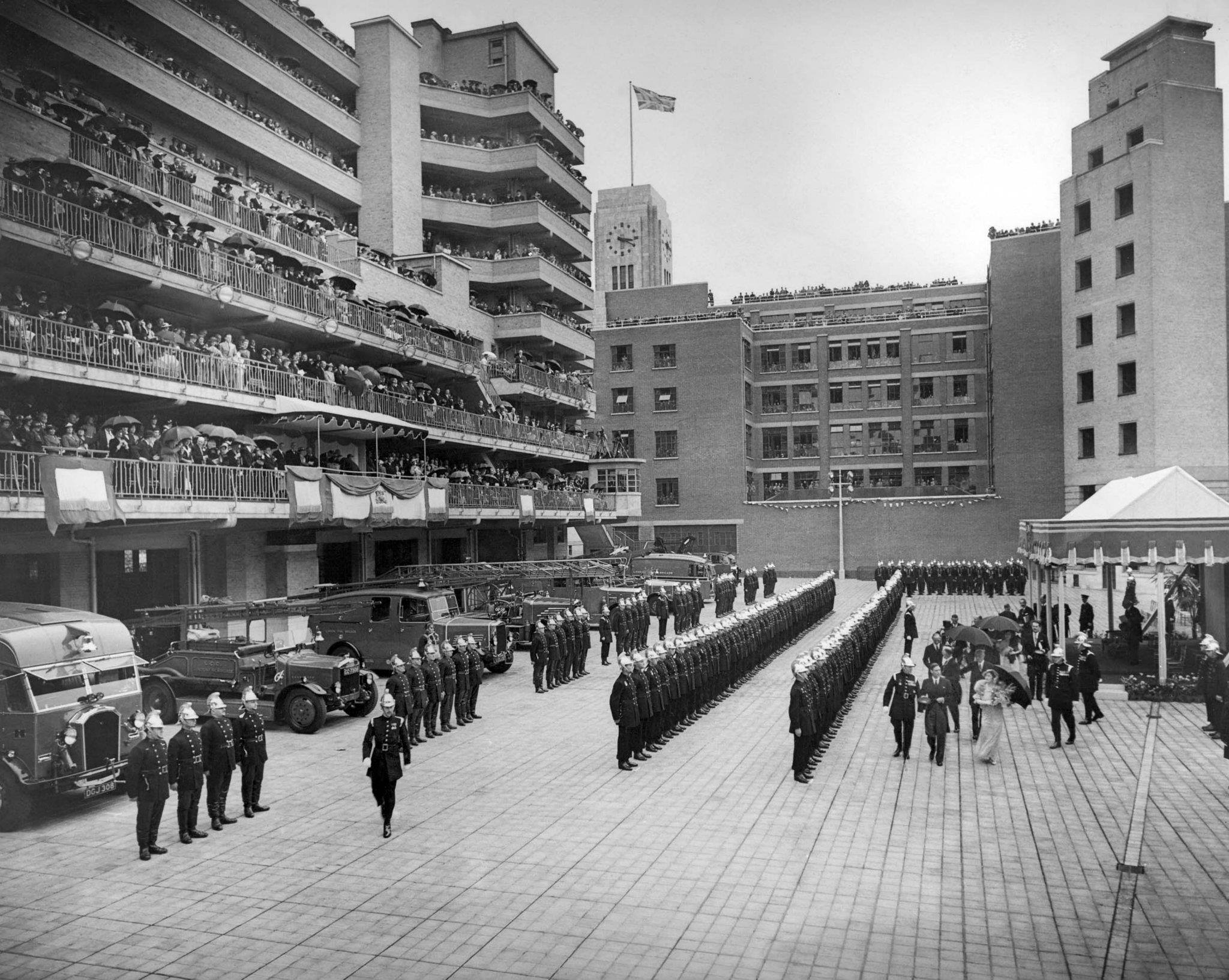
Typical roll call and parade in the London Fire Brigade.

Only a few miles separated the fire stations of Southwark and Lambeth. Yet Southwark’s ground was quite different from that of Lambeth’s. This was strange as the two grounds shared a common boundary. One that extended from the river down to the Elephant and Castle. Southwark then still had heavy industry mixed amongst the decaying, but occupied, riverside warehouses. New modern office developments had sprung up along Southwark Street, including a vast Government department building, plus a high security banking complex and a range of other commercial buildings. Guy’s Hospital, itself the size of a small town, was further to the East. Its state of the art multi-storey tower (still under construction in 1970) would be topped off by its distinctive cantilever lecture theatre overlooking the Thames and St Paul’s Cathedral. The other hospital on our ground was the former Evelina Children’s Hospital, which stood directly opposite the fire station. The gargantuan brick built structure of Bankside Power station directly faced St Paul’s Cathedral, whilst our own, more modest, Southwark Cathedral was hidden from the river by St Mary Olave’s Wharf. It could be found amongst the narrow cobbled roads that formed Bankside and Clink Street (site of the original Clink debtors’ prison). Clink Street led into the famous Borough fruit and vegetable market, with its plethora of stalls and adjoining warehouses, supplying produce to swanky West End restaurants and South London street markets traders alike.

However, the most surprising, and noticeable, aspect of the immediate area surrounding the fire station was the range and quantity of impoverished housing. These included drab little terraces, tenement buildings (run by various charities), poorly maintained pre-war council flats (none of which had its own inside bathroom) and the former artisans dwellings. Peeling paintwork and brickwork deprived of mortar combined to tell of the community’s own sad hard-up story.

Leading Fireman Dave Pike at a Southwark ‘shout’.

Add to this canvas the proliferation of dingy and grubby little corner public houses, with their bare wooden floors and simple tables and chairs and you could be forgiven for believing you were still in the very streets that Charles Dickens had brought to a wider public’s attention when highlighting the most appalling social deprivations that Southwark’s inhabitants had then to endure. Things had obviously improved in this rundown area since those Victorian times, but I was still bemused by the level of squalidness, meagreness and scarcity that I had not realised still existed in the 1970s. Parts of this area, to my impressionable eye, looked reminiscent of the harsh poverty-stricken living conditions in the works of Dickens. Especially so when the rows of smoking chimney pots added their own exhaust fumes to the frequent autumn fogs that still occurred (despite the implementation of the Clean Air Act). Yet despite the physical appearance of the surrounding streets, the local population came across as cheerful with a remarkable toughness and resilience. Most local inhabitants also worked within the immediate area and were either costermongers, local factory workers or other blue-collar workers. These workers could bring home only a meagre wage so seemed imprisoned in these conditions. It appeared to me that this was evidence enough of an enduring class system that would keep them in their place; the bottom. I also could not help but notice that for many a feeling of social justice was just an ever present dream.

Typical LCC council flats taken over by the GLC. Many a ‘bread and butter’ shout. Tragically, fatalities too.

Unsurprisingly it was these very conditions which provided Southwark fire station, and its two fire engines, with a fair chunk of its considerable operational workload. Candles were still regularly used to supplement, or provide the only, lighting; poorly maintained property meant electrical systems became incapacitated, overheated and started fires. Careless smokers, often fuelled by too much drink, discarded lit cigarettes with insufficient care. These, when falling onto armchairs or beds, led to smoky, sometimes fatal, smouldering fires. Young children, left unattended, discovered the sometimes lethal attraction of playing with lighted matches. Yet around this time the most frequent and potentially serious cause of a house fire was the portable paraffin heater. These devices (sometimes bought second-hand and generally poorly maintained, if at all) when knocked over, whilst lit, provided a ready cause of fire. Tragically, and in increasing numbers, they were the cause of frequent fires including many where lives were lost. The headline, “Children die in oil heater blaze” became an all too commonplace winter feature in our daily newspapers. The London Fire Brigade was the very first UK Fire Brigade to take a fire prevention initiative and bought prime time on commercial television to back up its public awareness campaign in an attempt to reduce the number of these often fatal fires.

Southwark’s less than prosperous neighbourhood and its resultant fires was not unique. Many of London’s fire stations were located in areas that had similar problems of social deprivation and who saw increased operational workloads because of it. Some stations, such as in the East End of London, far exceeded the number of calls that Southwark had to deal with. But regardless of wherever these areas were located the fires tested the crews’ teamwork and fireground skills. In those early months at Southwark, I helped pitch the 50 foot wheeled escape ladder at more fires than in all the previous four and a half years I had served at Lambeth.

A “Small fire flat/house, hose reel, Breathing Apparatus” may well have been one of the most frequent ‘stop’ messages sent from our run-of-the-mill “domestic” incidents. However, those few words simply could not portray the reality of these regular dramas nor the intense effort that went into resolving them. Neither could that simple message portray the plight of the occupants. Often heart-rending scenes that would involve the human and social predicaments that the impoverished found themselves facing. There might be child welfare dilemmas we passed onto Social Services, or in the case of careless or uncaring parents the Metropolitan Police. Lastly, there were the unscrupulous landlords, owners of neglected and run-down properties who left their tenants exposed to serious fire and other health hazards. Southwark fire station’s ground provided a valuable schooling for this new young Leading Fireman. Some of the lessons, for this twenty-two-year-old, were much harder to absorb than others.

The Denmark Place fire occurred on 16 August 1980.

Until the recent tragic North London Grenfell Tower fire the worst post war UK fatal fire occurred in London’s Soho. It killed 37 and injured another 30. Outside of terrorist attacks it remains the worst mass murder on mainland Britain. The resultant fire following an arson attack. The majority of those who perished were believed to have been Spanish and Latin American customers and staff of the unlicensed club and drinking bar.

Located at 18 Denmark Place were two unlicensed, but popular, bars. Both were located on the building’s top two floors. Named ‘The Spanish Rooms’ they were a late night bar, frequented by locals, and a salsa club popular with Latin American immigrants. Admission to either bar was restricted to members who obtained entry by shouting up from the street below in order to obtain a key. Access was through the locked front door and up a fire escape enclosed with plywood. Being unlicensed the bars were obscured from the outside world by boarded up windows. The door in Denmark Street that led to the fire escape was bolted shut. The Metropolitan Police were planning to shut the place down on Monday 18 August. A farewell party was being thrown over that fatal August weekend.

On the night of 16 August, John ‘Gypsy’ Thompson, age 42, had entered ‘The Spanish Rooms’ and drank there. Thompson, a petty drug dealer, was known to the police. Believing that he had been overcharged for the drink an argument and then a fight ensued with the bartender. Thompson was ejected from the building and the entry door was locked behind him. Thompson had found a 2-gallon container outside the club before hailing a taxi and then travelled to a 24-hour petrol station in Camden. There he filled the container with petrol before returning to 18 Denmark Place. In the darkened alley of Denmark Place he poured the petrol through the letterbox of No 18’s front door followed by a lit piece of paper.

The petrol erupted with explosive force. The burning petrol swiftly igniting the staircase owing to its considerable timber construction. Flames, and superheated gases, rose upwards with great energy and force. The fireball found those on the upper floors. The searing heat peeling skin whilst cloths caught fire. People could not easily escape their fate due to the boarded up windows; the locked fire escape and the lack of any fire safety precautions owing to the bars unlicensed status. The club, being unlicensed, was off the London Fire Brigade’s inspection radar.

The fire moved quickly up and through the building, destroying the main entrance and the exit from the bars. Some patrons tried to escape via the back door but found it locked. Others smashed windows and jumped out onto the street below. On Denmark Street there was a music shop that backed onto the clubs and some patrons were found here trapped behind the security shutters fearful the fire would follow them. Some were clearly luckier than others.

Inside the inferno

Soho’s firefighters, in their Shaftsbury Avenue station, were still up having recently returned from another call on a typically busy Soho night shift. They were chatting in the mess-room. In fact they were listening rather than chatting; listening to their Guvnor, Station Officer Turk Manning who was reminiscing about the ‘good old days’. At 03.33 the station bells sent the Green Watch crews on their way once again, However, the address given was Denmark Court, off Charing Cross Road and Turk Manning knew that there was no Denmark Court on Soho’s ground. He contacted the Wembley Control room immediately by radio message and told them so. Whilst the crews waited for the control room staff to check the address someone came running up to Soho fire station to report a fire in Denmark Place. Manning instructed his crews attend Denmark Place.

When Soho’s crews arrived Turk Manning looked down Denmark Place and saw what he thought, at first, was a rubbish fire some way down the narrow alley. As he went to investigate a man came out of the night, a man who Turk Manning thought might have been in a fight by the way he looked and staggered. The man, clearly distressed, said “There are people in there-lots of them.”

As Station Officer Manning reached the building he saw smoke escaping from around the shuttered windows, then the flames appeared from the first before showing from the second floor windows too. The fire was spreading and very fast. Instructing that a hydrant be set in and jet got to work Station Officer Manning sent a priority message making ‘pumps four-persons reported’.

Soho’s crews had struggled to break into the locked door as shards of hot sparks and glowing embers showered down on them. They watched as people ran off into the night despite some clearly being injured. But from inside the building, other than the sound of burning, nobody was heard calling for help, not even a shout of panic.

As entry was finally made from Denmark Place they saw the fire which was consuming all before it. The staircase was fully engulfed in flame. Turk Manning had sent a firefighter to check the other side of the building. When he arrived he had found six people trapped behind security grills of an adjacent shop. With an entry affected the people inside were rescued, all suffering various degrees of serious cuts or burns. It was through that shop that the first effective attack on the fire was made. Turk Manning had also instructed Soho’s turntable ladder be pitched to see what rescues it might be able to perform and to assess the true extent of the fire from its high vantage point.

The aftermath of the fire at 18 Denmark Place.
(Picture credit-London Fire Brigade.)

With Assistant Division Officer Tom Kennedy now en-route from Paddington, the ‘A’ Divisional headquarters, the Wembley controls’ Officer of the Watch rung the Divisional Commander, Roy Baldwin at his Paddington quarters to inform him of the incident. Balwin was not required to attend this size of incident but responded immediately. Balwin was later to comment that; “Manning would not normally make-up unless he had a good job and his fours were normally worthy of a six!”

At 0341, eight minutes after the time of call, Station Officer Manning made pumps six. Balwin would take command of the fire two minutes after he arrived at the scene. Details, on the ground, were scant about who and how many people might still be in the building? Balwin found the street filled with ‘foreign-looking’ people all seemingly in great distress. None would give answers to the firefighters requests for information about who else might be inside the burning building. It was a policeman that informed Balwin that the building was used as illegal club and as many as 150 people may have been inside it.

It was Soho’s Sub Officer Ron Morris (QGM) who led his crew to the main staircase and made a successful attack on the fire, although it was not out by any means. Now Baldwin and Manning could make a preliminary survey of the devastating effects of the fire. Balwin’s message back to the Wembley control room gave the initial body count as eight. But what was evident to the experienced fire officers looking at the severity and pattern of burning was that this was no accidental fire. The smell of an accelerant, most likely petrol, was still present at the base of the staircase. The fire was deliberate and Baldwin sent a request for the Brigade photographer to attend the scene and the police to commence their investigations.

Divisional Commander Roy Baldwin

The main fire was put out in just under two hours. Crews had used three jets and breathing apparatus. Now as the damping down started the death toll rose to 13 as five more charred bodies were found on the second floor. The total number in the clubs prior to the arson attack was never actually determined but 50 people were recorded as escaping the blaze and 30 of those were treated in hospital for a variety of injuries and some with serious burns.

It soon became difficult for the crews to give Balwin a definitive number of fatalities. The speed of the fire was so rapid that many of the bar patrons died where they were sitting or standing. So firefighters found bodies slumped exactly where they had been when the fireball hit them, some apparently still clutching glasses. Bodies were pilled one on top of another or filling tiny spaces after they had crawled in attempting to escape the horror of the flames. Others had tried to escape by clawing at the walls and windows. Some did break through into the guitar shop behind the club on Denmark Street and used electric guitars to smash through its front window. (It took forensic experts two months to identify all the victims and who came from eight countries.)

Fireman David Smith (Soho Red Watch) captured in a press photograph after the photographer sneaked pass the police cordon following the fire.

Now the daunting task of body recovery began. It was a harrowing assignment for those concerned. Baldwin was later to comment to the Press that he had nothing but praise for the firefighters performing their unenviable job. “It was above and beyond the call of duty and I am proud and privileged to serve with such men.”

As Soho’s Green Watch left the scene at 9 a.m. they were replaced by the station’s Red Watch who continued the task of removing the charred bodies, many unrecognisable, from the scarred building. Lowing the bodies to the ground proved problematic too. Despite the firefighters desire to handle the bodies with dignity some body parts fell to the ground whilst another broke in two hitting the round with a sickening thud.

‘Gypsy’ Thompson was arrested nine days later while drinking at a club a short distance from his own crime scene. He was tried at the Old Bailey in May 1981 and charged with just one murder, that of Archibald Campbell, 63. (It was apparently simpler that way.) His trial clashed with the Yorkshire Ripper’s, drawing most reporters to the next-door court. Thompson’s life sentence earned a few column inches. When he died of lung cancer on the anniversary of the fire, in 2008, handcuffed to a hospital bed, nobody noticed.

Soho’s pump at the scene of the fatal fire as the body recovery contines.
(Picture credit-London Fire Brigade.)

Footnotes;

  1. The initial call was A24 (Soho) PE P TL and A23 P
    (Euston). Euston’s PE went on a minute later with multiple calls. A22
    (Manchester Square) pair came on at make pumps six. Euston’s pair entered via
    the music shop with Stn/O Weston in charge. Euston made their way up the rear
    fire escape and met Soho’s crew on the first floor landing. It was then decided
    that Euston would take the first floor and Soho would take the second floor. By
    the time Euston’s PE was relieved by Homerton’s pump the body count was 27.
  • More striking than the actual fire was the speed at
    which it was forgotten. There were headlines the next day, once the bodies had
    been counted. “If it was arson, it could be the worst mass murder in British
    history,” The Sunday Times reported on its front page (This was,
    before Harold Shipman got caught). The Observer quoted a fireman: “I
    have seen worse fire damage, but I’ve never seen dead bodies packed together
    like that before.”  Then the coverage
    fizzled out.
  • Look today and online searches reveal only a few
    mentions. Two or three little-known books devote a passage or two to the mass murders.
    Although Martin Lloyd-Elliott’s ‘City Ablaze’ give a comprehensive account. Many
    of the victims’ families still know very little about the fire. Seven years
    later, when 31 people died in the King’s Cross Underground fire (again on Soho
    ground and which Station Officer Colin Townsley GM, from Soho, was one of the
    victims) inquiries, services, documentaries and memorials followed. Princess
    Diana unveiled a plaque. Yet at Denmark Place there was never any memorial
    service, there is no plaque! The only commemorative plaque in the area is
    devoted to the inventor of the diving helmet. Moreover, there was never a
    public inquiry. The clubs were illegal. There seemed to be few lessons to
    learn, no institution to blame. This also means there is no official account. The
    Metropolitan Police’s archive contains only basic facts, which it only releases
    in response to a Freedom of Information request.

Finally: No 18 Denmark Place was gutted for demolition in 2016. It, like the dreadful fire, to be forgotten.

The Brixton Riots. April 1981.

Foreword.

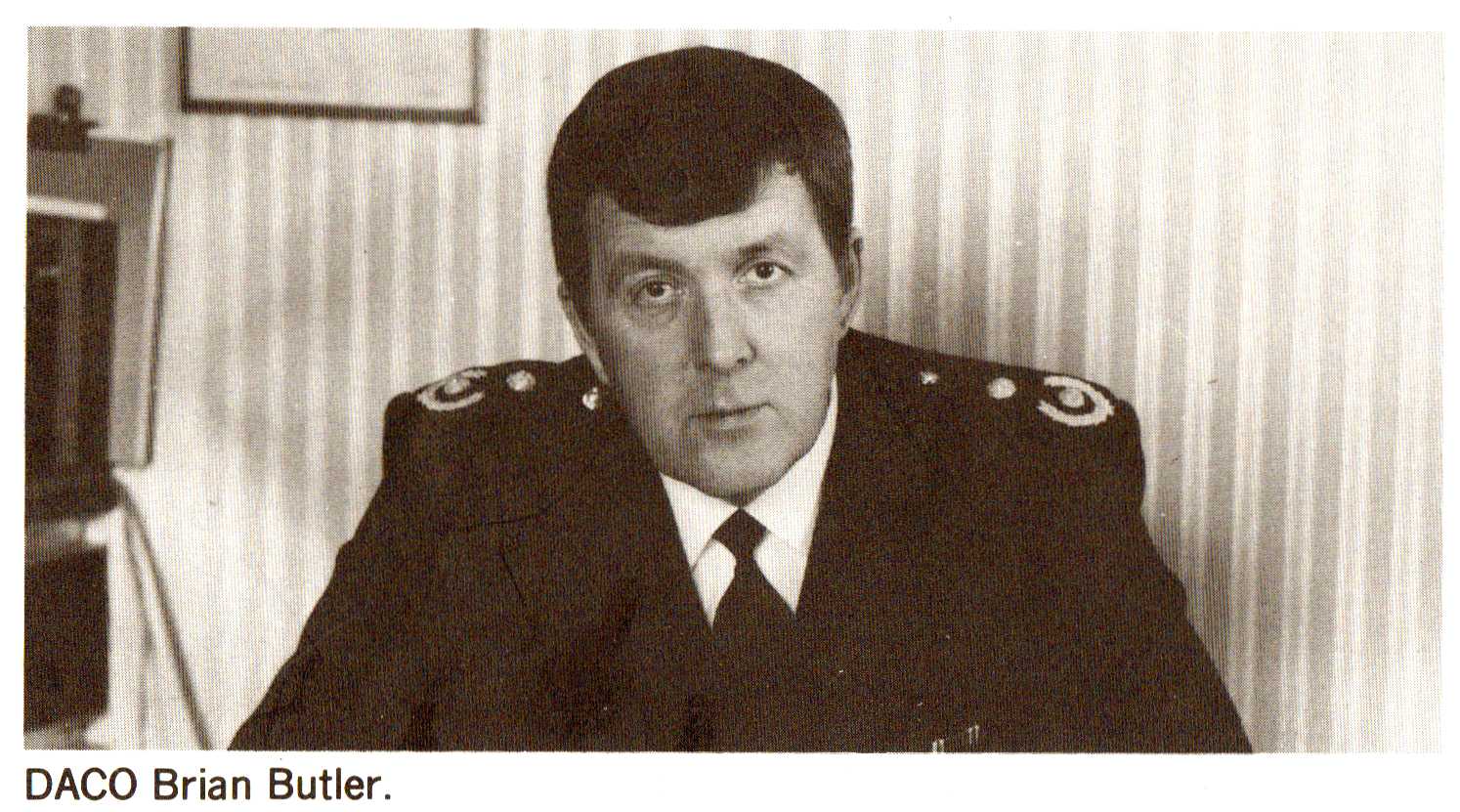
BRIAN WILLIAM BUTLER, better known affectionately as ‘Bill’, was born on the 3rd April in the mid-1930s in the shadow of Brixton Prison. Whilst parts of Brixton reflected the relative affluence of a part of London that spoke of the grandeur of its former Victorian London heyday, with tall spacious terraced houses, wide streets and open spaces, he was raised in a compact backstreet terraced house. His childhood open spaces were those created by Adolf Hitler and his V1 and V2 rockets.

Well-grounded after attending the nearby Clapham Secondary Central School, in his late teens he completed his compulsory National Service having been selected to serve in the Grenadier Guards, first performing pubic duties and then seeing active service in Egypt. At the age of 20 he joined the London Fire Brigade and was trained at Lambeth, the Brigade Headquarters, which was then the Brigade’s Training School.

His first posting was Clapham fire station, serving on the Red Watch. Gifted with an intelligent mind he listened to, and learnt from, the advice offered by the more experienced firemen who had served throughout the Blitz. He then returned to Lambeth and became a member of its emergency tender crew. A gifted athlete he represented the Brigade, internationally, at Volley Ball. As he honed his operational skills he rapidly gained promotion. At the relatively young age of 28, and after only eight years’ operational service (a meteoric rise in the early 1960s) he was promoted to Station Officer in charge of his own watch. Following a brief spell in East London he returned to the newly opened Divisional station at Clapham, frequently attending calls in the Brixton area. His local knowledge, combined with a proven talent as a competent fire officer, proved invaluable in those formative years and it would do so again.

Fireman Butler at the Smithfield Meat Market fire in January 1958.

With over ten years served in Station Officer rank, and as an outstanding operational officer, promotion to senior officer rank was inevitable. It was, however, a steady progression through the senior ranks, and one that saw him gain valuable experience within Fire Prevention, later rebranded Fire Safety, and operational train­ing in London’s A Division, which covered the West End. In 1980 he again returned to Clapham only this time as the Divisional Commander responsible for its eleven fire stations and the Fire Prevention depart­ment. As a Deputy Assistant Chief Officer he had a wider operational role, one that required him taking charge of major fires and other emergency incidents. However, the Brixton Riots, in 1981, were totally unprecedented. There had been skirmishes with stone-throw­ing youths attacking fire engines before, normally on Bonfire Night, but nothing on the scale that was to unfold. There were no published Fire Service rules of engagement or procedures when confronting a riot. Brian Butler was about to change that. This is his story…

The Brixton Riots.

Saturday, April 11, 1981 and late on that fateful Saturday afternoon the Brixton riots started. Their impact would have lasting implications felt across the capital, and beyond. This subsequently brought about both social change and much heated political debate. It certainly changed the public’s perception of the Metropolitan Police and then its pervading culture of racism that had, sadly, been demonstrated so forcibly by the officers involved in dealing with black people in the build-up to the riot.

During that Saturday morning Brixton fire station’s pump had been driving through the very streets that would, all too soon, be illuminated by the many fires that had been deliber­ately started. These would burn out of control, destroying pubs, local shops, houses and numerous overturned cars. To those riding Brixton’s fire engines that morning something was defi­nitely in the air. It was palpable. Lines of police ‘tactical support vehicles’ (transit vans) were parked in the side roads around Railton, Mayall and Effra Roads. A strong presence of uniformed policemen were everywhere. Many just standing on street corners, looking tense, and waiting for something to happen.

A fierce exchange had taken place the previous evening, involving the police and the young black men who frequented the private clubs and backstreet bars of Railton Road. This exchange had resulted in a number of arrests. Whilst the Station Officer at Brixton fire station had tried repeat­edly to speak to the duty officer at Brixton Police Station on that Saturday morning trying to gain an assessment of a clearly tense situ­ation, no information was forthcoming. It had seemed obvious to those local firemen, as they had driven around looking out from the safety of their fire engine, that all it needed was another spark to ignite the blue touch paper. To them the police appeared more than happy to supply the matches.

Having passed on his concerns to the duty senior officer at B Divisional headquarters, the Station Officer suggested that local stations be advised of the potential for trouble around the Railton Road and Mayall Road area. The message came back at 1.30pm saying the police were of the opinion that no flare-ups were likely to occur before nightfall. Clearly someone had spoken to the wrong policemen since those in the locality were planning to get the action going long before then. With Brixton’s Station Officer required to leave the fire station for a meeting in the early afternoon it fell to his deputy, a Sub Officer, to take charge of the station. However, unbeknown to the firemen at Brixton fire station rioting had already broken out in the area of Railton Road and Atlantic Road in central Brixton where police and black youths had clashed on Friday night. That disturbance was soon stamped out but the trouble that Saturday evening, which began after the arrest of a young black man, quickly spiralled out of control.  So when other police officers arrived and tried to make more arrests the ever-increasing crowd started throw­ing bottles and bricks. Despite the strong police presence in the locality reinforcements from other police areas were called in. In the 30 minutes it took for them to arrive the violence had escalated sharply. A charge by about 200 police officers, armed with plastic riot shields and batons, down Atlantic Road misfired. They were forced to retreat under a hail of missiles.

Brixton Road-April 1981.

At 5.30 p.m. Brixton’s fire crews got their first taste of a civil disturbance. (So much for nothing until nightfall!) Ordered to a house fire in Railton Road they never reached the incident. They were prevented from doing so by brick throw­ing mobs involved in street to street fighting with the shield wielding police officers. The mob filled Coldharbour Lane, Atlantic Road and Railton Road. Brixton’s attempt to get a police escort to take their fire engine towards the pall of smoke, clearly visible in the distance, failed. The senior police officer present on the ground was not committing his officers and told Brixton’s Sub Officer to forget it because of the vola­tile crowds and the danger they posed.

During the early stages of the riot West Norwood’s pump-escape had been sent to a blazing car in Railton Road. As they approached the incident from Brockwell Park a policemen waved the appliance through their cordon. However, their route became increasingly congested by people spilling onto the roadway. The Station Officer, Alan Lowles, had to order the driver of that appliance to slow down. The crowd, that had until then been attacking the police with bricks and stones, turned their hostility onto the approaching fire engine. First the wind­screen and side windows were quickly smashed and missiles hit the firemen inside the cab. The driver, Fireman Michael Harding, was concentrating on his driving and was unable to protect himself. He was hit several times by brick-bats. One particular missile, a large lump of concrete, hit him in the chest breaking two of his ribs and rupturing his spleen. Despite his severe pain Harding continued to drive in accordance with the Station Officer’s instructions. Reaching the Atlantic Avenue end of Railton Road, and in the protection of the police again, the Station Officer summoned an ambulance for Fireman Harding whilst his crew dealt with the severe vehicle fire.

Brixton’s pump crew had by now been joined by the crew of West Norwood’s pump-escape who had just made it down Railton Road. What was happening to London Fire Brigade crews was a new and the unprecedented experience. Unable to attend fire calls that some were ordered to they did not know if lives were in danger or not. The situa­tion in, and around, Railton Road was deteriorating rapidly. Both firefighters and police officers alike were in considerable danger from the constant hail of bricks, bottles and sharpened lengths of wood being hurled at them by the hordes now gath­ering in large numbers and charging at the police lines.

Railton Road-Brixton. Saturday night.

Unable to return to the local fire station, lest it be attacked, Brixton and West Norwood crews were ordered to a temporary holding point, a nearby coach station, just outside the immediate danger area. Widespread damage and looting had by now spread as far as central Brixton. Brixton’s crews were ordered by radio to attend further calls, including Burtons, the tailors, where the looters had fired the shop as they left with their arms filled with their spoils. By now other fire station crews were being ordered to the numerous 999 calls that the mobilising control at Croydon was receiving continuously. Fire appliances become a legitimate target for their ferocious attacks.

The disturbance very quickly escalated into major propor­tions. News of the events in Brixton had spread via a cultural grapevine and others joined in the street violence having trav­elled in from surrounding areas. Several hundred members of the local community and the wider society added their weight and acted in an extremely riotous manner. Their number was to swell into the thousands. It was something that police, at this stage, were totally unable to contain. In fact these were the first serious riots of the 20th century and the first entailing substantial destruction of property since the formation of the Metropolitan Police.

Due to the very pressure that the police were put under the level of protection which could be afforded Brigade personnel and their equipment, whilst trying to fight the fires started in this area of Brixton, was minimal. Crews from various parts of London were called into the area and they encountered previ­ously unseen hostility. Hostility that caused the most severe and difficult circumstances in addition to the normal hazards of fighting fire. Fire engines were bombarded with missiles, crews targeted for attack from bricks, masonry and bottles. Brigade equipment was sabotaged and even stolen whilst in operational use!

Brixton fire station. Gresham Road. SW4.

As the evening moved into night the day shift crews were slowly relieved and night watch crews took over. They faced a night of increasing violence, running street battles and having to deal with several major fires that were seriously under-resourced. This was the capital’s most serious public disturbance in modern times. Radicals and extremists from various parts of London were willing, and eager, to join in the violent assault on public order. They were coming out of the ground like rats from Brixton and Stockwell tube stations.

It was into this scene of chaos that Brian Butler, the local B Divisional Commander, found himself projected. He already knew that the mobilising control-room at Croydon was working under the most extreme pressure because of the riots. He had been monitoring the radio traffic on his ‘listening post’ located in his office at Clapham. Booking ‘mobile’ he sped through Clapham’s busy streets towards Brixton. He knew, in addition to the many fire crews already on the ground, he had at his disposal his team of duty senior officers, and he had access to more of each if required, but he soon realised that if ‘normal’ mobilising was maintained then fire engine crews would be sent unwittingly into hostile areas. This would expose them to an extremely dangerous and a volatile environment. On arrival he immediately took overall command of the fire brigade actions and, more importantly, its mobilisation within the area of the civil disorder. This was uncharted terri­tory in Fire Service operational tactics. Because of the number of fire engines in the vicinity the Divisional control unit, based at Clapham, had already been sent into the area and was located at the Effra Road ‘Orange’ coach station, which itself was now in imminent danger of attack.

Despite the smaller riot in the Saint Paul’s district of Bristol, in April 1980, and the attacks on Avon fire engines and their crews, no national fire service advice or guidance had been published in respect of dealing with such disturbances.

Brixton Prison is located on Brixton Hill. Whilst close to Brixton town centre it was not in any immediate danger of attack from the rioters. Access into the prison is via Jebb Avenue, a no through road. Brian Butler choose this location as his forward command post. He set about establishing a safe marshalling area for his appliances and crews. His were new operational tactics and they were being developed on the hoof. It was the first time that the deployment of a forward control point had been used in the British fire service. His vast opera­tional experience as a command officer, his intuitive and decisive decision making, together with an intimate knowl­edge of the affected area served to provide a comprehensive and effective plan of attack that the fluid and rapidly changing situation demanded. He made sorties into the area to make a personal assessment of the situation and ensured the best use was made of his personnel and the resources available.

With the Divisional control unit relocated and designated a “forward mobilising control” a number of appliances were held in readiness under the command of a nominated senior officer who dispatched the appliances into the riot zone. The control room at Croydon had been instructed not to mobilise fire engines into the Brixton area but to refer all calls to the forward mobilising control. Fire engine crews were fully briefed of the prevailing situation and strict observance of the necessary changes to normal firefighting techniques because of the very real threat posed to personnel by the rioters.

Painting a picture in words to anyone not directly involved in this situation, over those prolonged fraught hours, is diffi­cult if not impossible. This would be subsequently deemed a major ‘civil disorder’. It was a breaking news story. It went global. But not in todays terms of our instant 24 hour news coverage. The wider public woke up to graphic images of the street violence, the aftermath of the destruction that had erupted on South London streets. Sunday morning newspapers, the BBC and ITV news bulletins covered the events in great detail.

Brian Butler was not the only one to face severe challenges that night. The acting Station Officer of Brixton’s Green Watch, Chris Giles, had to fight a most serious fire, involving a three storey public house, with only two fire engines and eight firemen. Something which in the normal course of events would have demanded eight fire engines plus special supporting crews. Needless to say the pub, which was well alight when the crews arrived, was a burnt out shell by the early hours of the Sunday morning. However the crews fought hard and successfully prevented the fire spreading to other adjoining property.

Saturday night turned to Sunday morning. A massive police presence was mobilised. Reinforcements, from all over London, arrived in Brixton. Despite their weight in numbers the police tactics remained one of containment. Something that those rioting on the streets took scant regard of as their ferocious ‘hit and run’ attacks kept the police engaged and the fire brigade crews under the ever present threat of serious harm from this wanton violence. However, the plans put into action by Brian Butler were working and to good effect. The fact that injury to fire brigade personnel was restricted to a relatively small number was largely due to his presence of mind and his leadership qualities.

By the early hours of Sunday morning it was possible for Brian Butler to escort the Chief Fire Officer, Ron Bullers, to see for himself the plans Brian Butler had put in place and to view the work of his firemen on the ground. Both Brian Butler and the Chief were impressed, but not surprised, by the highest possible commitment from members of the Brigade who had demonstrated, in so many ways, the finest qualities required of a firemen.

By sunrise there was an uneasy calm. The forward command post was closed down. It was not necessary to reinstate it again. The Metropolitan Police flooded the area. Police officers, with what riot equipment the police had available then maintained a discreet presence, sitting in police vans parked in side streets. It was the traditionally clothed policeman that stood on the street corners and, together with the Brixton locals, surveyed the scene of considerable devasta­tion that surrounded them.

That Sunday evening, and with high risk of more riots, Brian Butler ordered the evacuation of Brixton fire station. It was not something the crews at Brixton were happy about. But it was obvious that this was not an issue for debate as far the Divisional Commander was concerned. Ten minutes later the station was secured and empty! Brixton’s pump and driver headed off to West Norwood fire station whilst the pump-ladder was driving towards Clapham fire station. Brixton’s fire engines would cover its own ground from these adjoining stations.

It was clear that fire engines remained a legitimate target as far as the rioters were concerned. Hostility and aggression had started for a second consecutive night, yet thankfully without the same level of destruction that had taken place only twenty-four hours earlier. Sunday night the tension, and running street battles, were confined to the rioters and the police who now presented a massive presence in the affected area. None of the numerous arson attacks that had materialised Saturday night were repeated.

Monday. Brixton’s night duty watch reported for duty at 6 p.m. They expected the same evacuation drill as nightfall came. None came and they remained at Brixton. Just before supper their first shout of the night was received. It was to a house alight in Mayall Road, the heart of Saturday night’s action. New tactics were now in place to ensure better crew safety in case of a hostile attack. Driving as close to the incident as possible the drivers reversed the fire engines down the cul de sac street to ensure a quick exit if necessary. Working directly from the street hydrant the dere­lict house, which was blazing merrily, was soon extinguished.

At 9.30 p.m both Brixton’s fire engines were ordered to a car alight in Railton Road. They rapidly applied the tactics that Brian Butler had insisted upon. The car was blazing fiercely as they approached. Stopping and turning the appliances around, they reversed the last 150 yards towards the incident. The street was illuminated by the light of the burning car. The air heavy with the acrid smoke of burning rubber and the car’s interior. Water, again used directly from the street hydrant, hit the burning car and the street filled with clouds of steam as it made contact with the white hot metal of the car. It burnt so fiercely that the car lay flat on the road surface, all its tyres’ completely burnt away. There was no police escort despite their strong presence. But these were not local Brixton policemen. They had little or no knowledge of the area. Small groups of stone-throwing black and white youths were playing cat and mouse with the policemen and causing a great deal of confusion as they attacked, waited for the inevitable chase and then disappeared down narrow alleys and pathways leaving the police increasingly frustrated and angry.

That was the last fire attributed to the Brixton riots. However, 14 Brigade personnel sustained injuries from bricks and other missiles and eight fire engines and one staff car were damaged. 299 police were injured, and at least 65 civilians required hospital treatment. The triangular area most affected by the arson attacks at the height of the rioting looked like a war zone. Damage to buildings and property was on an unprecedented scale then for a ‘peacetime’ London.

Some of the fires, that crews were prevented from attending, spread and involved other surrounding premises. In one particular case five build­ings were destroyed after the initial blaze spread out of control. Some 61 private vehicles and 56 police vehicles were damaged or destroyed, mostly by fire. 28 premises were burned down and another 117 damaged and looted. 82 arrests were made. Molotov cocktails were thrown for the first time on mainland Britain. There had, until then, been no such event in England in living memory.

Notes

  1. In 1981, Brixton’s Afro-Caribbean community comprised roughly 25% of its population. It was an area of high unemployment, particu­larly for black men, where rates were as high as 50%. Brixton was also an area of high crime, and in that April the Metropolitan Police initiated ‘Operation Swamp’. Within just six days, a massive police presence on Brixton streets (including plain clothes officers) had led to almost 1,000 people, mostly young black men, being stopped and searched. Police operated then under the ‘sus’ law. In order to stop someone, a police officer need only ‘sus’, or suspect that they might be intending to commit a crime. The police were exempt from the Race Relations Act, and seemed to some to be operating the ‘sus’ laws on the basis of racial prejudice.

Many found that the prevailing attitude of so many police offic­ers swamping the surrounding streets of central Brixton made them feel increasingly uncomfortable. Police officers’ attitude towards the black population was adversely impacting on the very public order task that they were meant to be performing. It would later come to light that very many were racist. They seemed to be itching for a fight with anyone of a skin colour different from their own, which was universally white. This was not just a local problem as they came from all over London, bussed into Brixton to police the area while it slowly reverted to normal.

Black people, especially youths, were more likely to be targeted and challenged in ways that would not be applied to white people. In the days and weeks following the riots much was reported nationally of the causes and implications of this civil unrest and the disturbances in Brixton. But it would take future public inquiries to recognise the ‘pernicious and institutional racism’ that prevailed throughout the Metropolitan Police Force. The Stephen Lawrence inquiry conducted by Sir William MacPherson and published in 1990 highlighted these very attitudes and the ‘institutional’ racism that had been witnessed in 1981.

Following the Brixton riots Brian Butler received many invita­tions to talk and comment on the lessons learned that had tested not only him but those under his command. He spoke far and wide and his actions set a new benchmark in the Fire Service response to civil disturbances. The events of that April were not only unprecedented in the history of the London Fire Brigade but the British Fire Service. It was something that would not be repeated on such a scale for thirty years and the widespread riots that erupted in 2011.

  • At the time of the Brixton riots Fireman Harding had been a Brigade heavy goods driver for only two weeks. Fireman Michael Harding and Station Officer Alan Lowles (West Norwood) were awarded a Chief Officer’s Commendation and a Chief Officer’s Letter of Congratulation respectively.
  • Fireman Michael Harding was subsequently awarded the Queen’s Commendation for Brave Conduct.
B.W.Butler MBE. OStJ. QFSM. FBLSM. GIFireE.
  • Deputy Assistant Chief Officer Brian ‘Bill’ Butler was awarded Membership of the Most Excellent Order of the British Empire (MBE) for his actions, leadership and officership during the Brixton riots in April 1981

Southwark, the soul of the London Fire Brigade succumbs to the demolition man’s hammer and developer’s dream of bejou dwellings!

The Metropolitan Fire Brigade headquarters located in Southwark Bridge Road. SE1. opened in 1878.

In this age of over-used catchphrases: an age of unprecedented ‘unprecedented’ times, one where tomorrow’s world has apparent scant regard for yesterday’s history the images of the demolition of a major part of the London Fire Brigade’s (LFB) former Southwark training school and the fire station left me feeling more than just a tad sad. So as 141 years of London Fire Brigade heritage succumbs to so called progress a reminder why, to many, its passing is mourned.

No 1 Station-Southwark, located the Metropolitan Fire Brigade headquarters Southwark.

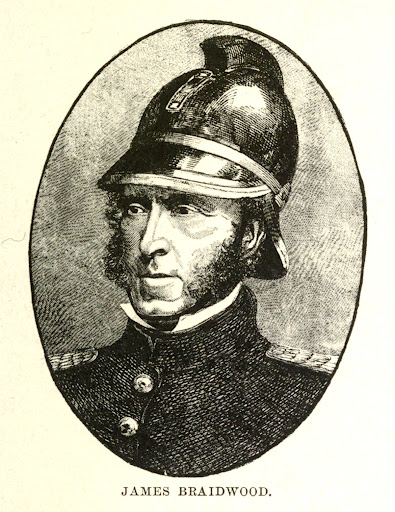
The idiom, “a picture is worth a thousand words” certainly has given many old London firemen time to reflect on this remarkable place A place entrenched in the LFB’s iconic history. Its official starting point was 1878, the date that the Metropolitan Fire Brigade moved in. Although we should look a little deeper into London’s fire service history to see what else we can discover. The LFB timeline, I would argue, started with the great-great-grandfather of London’s fire brigade; a Scot brought down to the capital in 1833 to establish the capital’s first properly organised fire brigade-the London Fire Engine Establishment (LFEE), albeit overseen by the Insurance Companies. Braidwood brought to London new ideas and original techniques for his small but novel London fire brigade. He encouraged the revolutionary idea of actually getting into a building to fight a fire and not applying the former insurance brigade’s practice of the ‘long shot’: a hose played at a distance from the outside of the building. (Strange how these things appears to have gone full-circle in recent times!) Braidwood also insisted that no fireman should ever enter a building alone and that there should always be a comrade to assist in case of an accident or if the colleague collapsed due to the heat or fumes. They became the tenets that resonated with firemen/firefighters for generations to come.

It was Braidwood’s tragic death at the Southwark Tooley Street fire in 1861 which brought onto the scene an Irishman this time, one Captain Eyre Massey Shaw. Shaw had been, until then, the Chief Constable and Chief Fire Officer of the City of Belfast. He took up the vacate position of the LFEE’s Superintendent job. But as they would say in today’s parlance the LFEE had become ‘not fit for purpose’. London was expanding. The cost of fire-fighting was growing very higher. The insurance companies struggled to continue to provide an efficient and effective fire service. By 1864/65 it was not a profitable endeavour. They were paid to provide insurance, not to fight fires.

Shaw was the first of London’s Chief Fire Officers, others would follow. Some added significantly to the brigade’s history and its progress, other merely passing through and with one required to resign! Although the use of the word ‘officer’ would much later became a taboo as it’s now all managers and a commissioner in the 21st Century. But two tier entry, so in vogue today, had a long history in the LFB too. Many of its finest offices came into the brigade via that route. The names of Major Cyril Morris. MC; Commander Firebrace. RN and Major Frank Whitford. DSO are to name but a few.

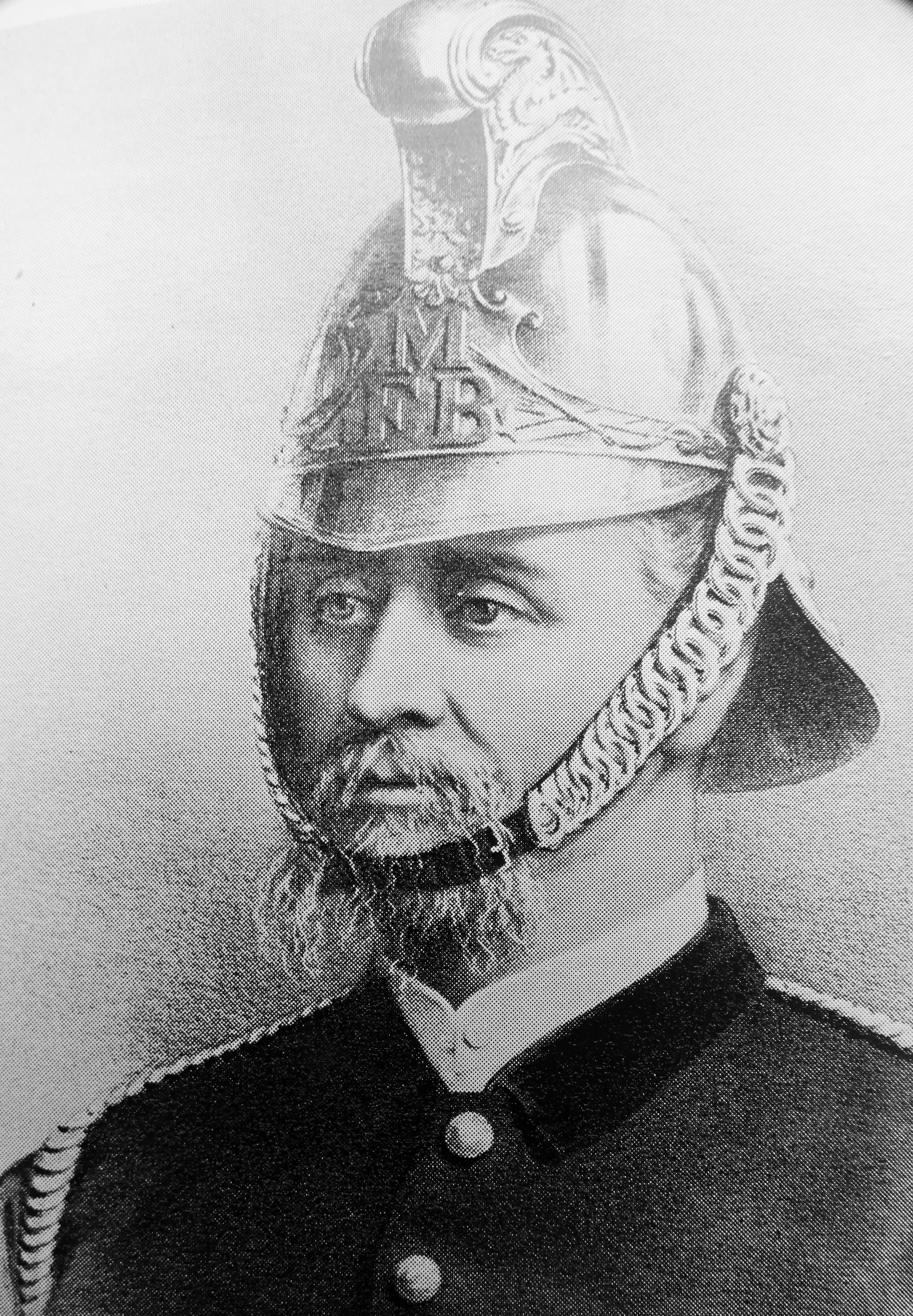
Capt. Eyre Massey Shaw. First Chief Fire Officer of the Metropolitan Fire Brigade and who had the Southwark headquarters built. He was Knighted upon his reitement from the Brigade.
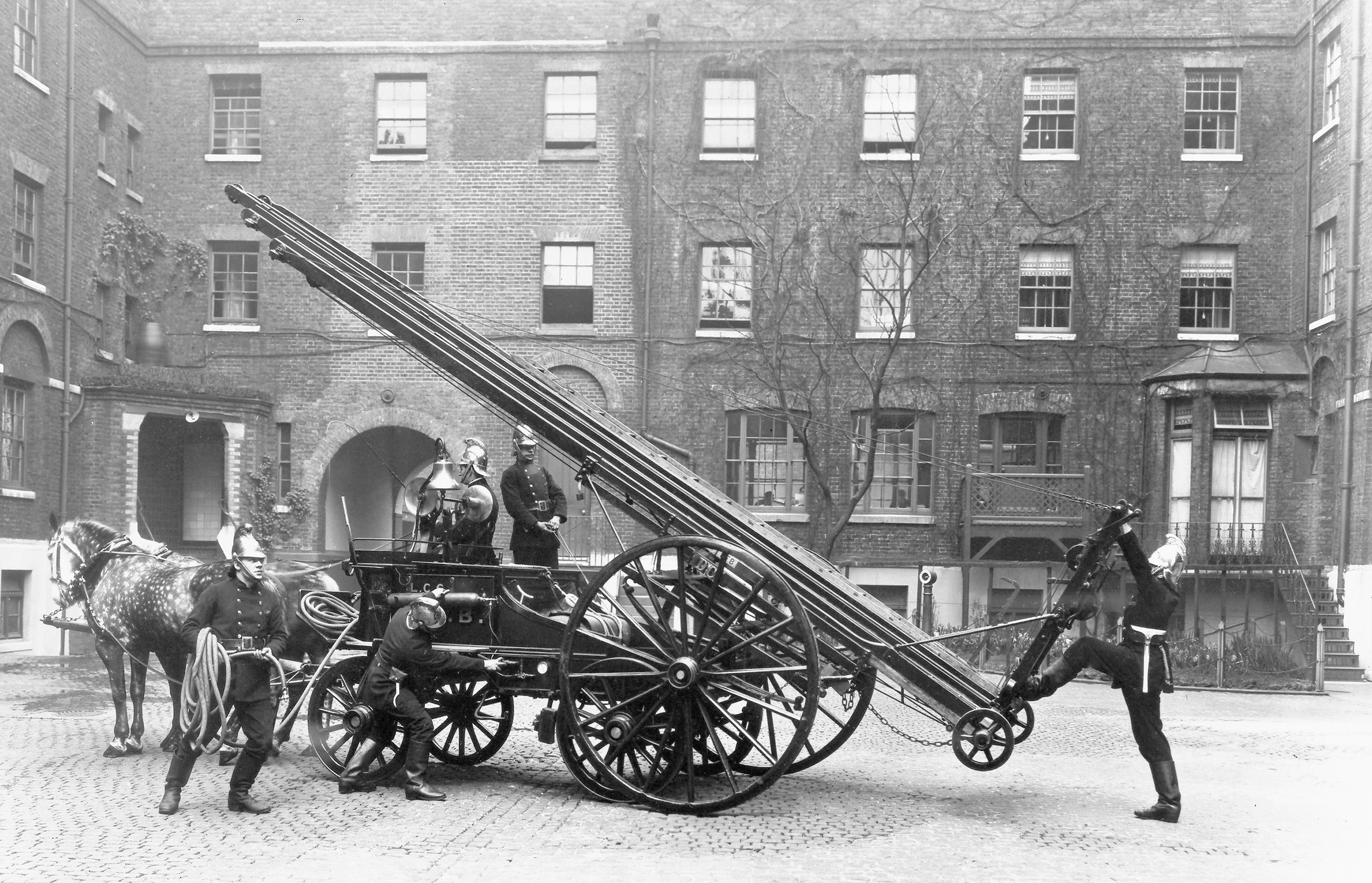
An escape cart with its 50 foot escape ladder in use in the drill yard at Southwark. The buildings remained until the present day.

London’s firemen, in the late 1800s, were at the height of the publics acclaim and the Southwark headquarters was the Brigade’s epicentre. But by 1910, in the prelude to the First World War, the fireman’s standing diminished considerably as a wider public struggled to make ends meet and absorb the technological changes. The advent of the motorised engine had started its irreversible course to transform public expectations and attitudes. The LFB was not immune from these pressures and changes and from its hub at the Southwark headquarters policy changes would modernised the LFB. In an extract from ‘Wonderful London’, published in 1920, the commentary went; “Today, such is the rush of modern life, it is probable only a minority of Londoners who know the name of Mr Arthur Reginald Dyer, the present chief officer of the London Fire Brigade. This in spite of the claim that, of all the fire brigades in the world, the LFB is the finest. That this is no idle boast is shown by the fact that from all over the world fire officers come to London to learn our methods of extinction, of organisation, of discipline directed from the Southwark headquarters.” (Dyer had joined the London Fire Brigade as a direct entry principle officer. By 1909 he was promoted to Divisional Officer North, taking up residence above Euston fire station. During the 1914-18 war he was on duty during every air raid on London. In 1917 he was awarded the Kings’ Police Medal for gallantry following a daring hook ladder rescue during the previous August.)

It was noted that Divisional Officer DYER “had shown conspicuous courage on at least two previous occasions, and since his promotion has shown marked ability.” Dyer was injured, at fires, on several occasions. Injuries which later played havoc on his health. At the ‘Siege of Sydney Street’ in 1910 he was one of 5 firemen seriously injured during the building collapsed and was buried under debris. It was Dyer, along with his successor, Major Morris, who modernised London’s then peacetime fire brigade from Southwark until the transfer of the headquarters’ to the new Lambeth location. (Dyer retired on 31st March 1933. The ‘Fireman’ magazine making this tribute: ‘A man of outstanding courage and tact, he is an ideal leader who early gained and has always retained the respect and affection of his men. No British fireman has ever more worthily upheld the great traditions of the service and none has carried with him into retirement as greater measure of esteem and goodwill.” Arthur Dyer died in Sussex on the 4th May 1951.)

London’s first horse drawn turntable ladder at the Southwark headquarters. 1905.

Southwark’s time in the LFB wilderness lasted from the late 1930s until the early 1960’s. It fire station however retained its status as one of the capital’s busy inner stations. (This being the days of the London County Council and its 58 fire stations.) It was a casualty of the blitz and suffered bomb damage to the former Metropolitan Fire Brigade frontage which ran along Southwark Bridge Road. Senior officers, and their families, resided in the residential accommodation but adequate funding and maintenance of the site remained a struggle. The Victorian buildings increasingly looked their age.

Built for the Metropolitan Fire Brigade, after the Watling Street headquarters building became too small for the growing fire service, this building in Southwark Bridge Road SE1 remained the Brigade’s headquarters until relocation to the new Lambeth site on the Albert Embankment in 1937. The fire station to the left of the square tower was added in 1911. The arched frontage with the spired tower was demolished in the late 1960s by the Greater London Council. Picture circa 1920s.

Except for the very senior retired London firemen, who did their recruit training at the Lambeth headquarters, the vast majority of those joining from the 1960s and into the 1990s attended Southwark to undertake their initial fireman training. It is here that their connection with Southwark, its entrance arch, the cobbled yards, all started. The exception being those who undertook ‘satellite’ training during the mass recruitment drive of the early 1970s.

Hook ladder drills at the Southwark training school.

It’s that Southwark training school, with its slippery granite drill yards, a fleet of basic out-of-service fire engines, 50 foot wooden escape ladders, canvas hose and hook ladder drills that would leave them sweating, either from their sheer exertions or wet through from the drills (and frequently both), before grabbing a mug of tea or a pint of milk from the cigarette smoke filled canteen before doing it all again.

With the creation of the Greater London Council Southwark took on the mantle of the Brigade’s principal training school. Its base for motor driving courses, breathing apparatus training, emergency tender courses and teaching 100 foot turntable ladder operator skills plus recruit training, and later junior officer training, was firmly established. Southwark proudly bore the title of the Brigade’s ‘training school’, it had ‘instructors’ and was ran by the ‘Training Commandant’ in the days before the PC brigade started to change our everyday LFB lexicon.

Recruit firemen at the end of their Southwark training course in the early 1970s.

My own connections with Southwark, its fire station, and later the Training ‘Centre’, remain personal. My junior fireman training started at Southwark. The drill tower sills carried the evidence of hook ladder teeth indentations, evidence (if it were need) of the confidence the ladder gave as you progressed ever higher up the drill towers. The deep grooves letting you know you weren’t the first to punch those ladders up the tower and as your own skills developed the teeth leaving their mark, a message to those who followed in your wake.

Southwark’s White Watch in 1973.

My two postings to Southwark fire station, both in junior officer rank, provided the bed-rock for the years that followed. My starting date there was shortly after the Brigade found itself under the leadership of a new Chief. A rather special man too and my nomination for a Chief Officer who steered the brigade forward whilst being able to communicate and relate to the London ‘firemen’s’ lot. That man is the late Joe Milner. His presentation to the Brixton Round-Table on the job of a London firemen’s remains a ‘tour de force’. Yet it was on Joe’s watch that the decision to close Southwark fire station was presented to the GLC for ratification. It was decision that I and others objected to. It was an ill found decision and a hard fight followed. Southwark’s arguments won the day and the station remained open until 2014. Although as great as the man was during his tenure Southwark appears to have remained on the back burner in terms of it revamping and upgrading.

The fire station ‘open-day’, celebrating the saving of Southwark from closure with children, and their nurses, from the Evelyna Children’s Hospital invited to the special event.

It would not be until the early 1990s that sufficient funds were allocated to a complete overhaul and refurbishment of the now Southwark Training Centre. The cost ran into the millions of pounds. On the back of the Health & Safety Excutive Improvement Notices served on the LFB, following the fatal Gillender Street fire, money poured into Training Department and the main beneficiary being Southwark. Improvements were substantial and meaningful until the ill-fated fire house project ended in tears after it caught fire and was deemed to be beyond economic repair! Despite the much hyped comments of the then Chief Officer (Brian Robinson) that Southwark was a centre of excellence fit for the new millennium it never got too far into it.

The Training Centre fit for the New Millenium never got too far into the 21st Century. Southwark fire staion was closed in 2014, the whole site sold in 2018 and the demolition men moved in January 2019!

The rest, as they say, is history. Southwark is today a redevelopment site. Under new ownership. So where are these guardians of the LFB’s history? Clearly recent events have taken us down paths that have left us ‘dinosaurs’ scratching our heads as to who really cares about its heritage? Sometimes in total disbelief! We LFB retirees are told we no longer understand the complex changes, or values, affecting today’s modern LFB by those in Union Street’s Brigade headquarters ivory tower. What absolute rot. There have always been complex challenges facing the Brigade. Dyer faced, and dealt with, some of the most challenging such as the mechanisation of the LFB and largest fire station closure programme the Brigade has ever gone through. Major Morris forged ahead with building a state of the art fire brigade Headquarters at Lambeth in the mid 1930’s-a bulding that has largely unoccupied since 2007!

The former Lambeth Brigade headquarters building-closed in 2007.

Nothing will put the clock back. Southwark’s fate is sealed. Today’s people riding London’s fire engines are significant players in the capitals first responders. It is they who have to cope with the Brigade’s corporate language and the top-down driven standards and values. But it appears that they are also the same people who don’t fight to protect the LFB’s heritage, its values, and have scarce regard for its traditions, its customs and its iconic past. Maybe they only see today and tomorrow. Maybe they are right to do so. But are they just turning the LFB into another utility. Outsourcing whatever they can whereever they can.

I can’t just let this moment pass without a personal tribute, a eulogy if you wish, to that special place we simply called Southwark. If the LFB had a soul Southwark was it keeper. This is a homage is to all that passed through it gates. Some would never to return after their initial recruit’s course, others would return again and again. Yet while we take breath it will remain alive in our memories. But for those whose brought about its demise-SHAME ON YOU.

Lest we forget

RIP SOUTHWARK.

Hook Ladders, love ’em or hate ’em?

LCC-LFB horse drawn steamer at hook ladder drill at the then London Fire Brigade-Southwark Headquarters. circa 1909

To some London firefighters they are simply the stuff of myth and legend. Another piece of defunct fire kit, along with the 50 foot escape ladders, Proto sets, that the old ‘soaks’ around the fire station would go all dewy eyed about when referring to them. But for those of a certain era, those who once called themselves ‘firemen’ they were a regular companion. And for a few a companion they were not overly keen to keep company with on a regular basis either. But regardless, if we weren’t testing them, checking them for incipient flaws, we were polishing the reinforced steel ring with the tiny bit of emery cloth which we kept tucked in the back pocket of our blue overalls, especially when the Sub Officer was on the prowl looking for those striving out of station work!


Hook ladder training of London Fire Brigade recruits at the then Lambeth training school. Circa 1950s.


There were the hook ladder drills; one man-one ladder, two men-one ladder, two men-two ladders. Hooks ladder(s) from the head of the 30 foot extension ladder, from the head of the escape ladder or from the head of the first floor ladder, tied onto the head of escape. Even used from the top of a 100 foot turntable ladder. The combinations were as versatile as the ladder itself. Of course the hook ladder was, like other ladders, a rescue ladder. So rescue drills were frequently incorporated into its training use. Firemen carrying a lowering line aloft across their backs before lowering a casualty underfoot. Station drills, combined Divisional drills and the annual Brigade reviews, a regular constituent was always the hook ladder.

It was a ladder that always demanded the utmost respect. Tragic losses had resulted from its use in training however, never operationally. As tragic as the deaths of London firemen were (they were not termed firefighters then) it was never because of a defective or a malfunctioning hook ladder.

Hook ladders scaling Lambeth’s nine storey drill tower in the 1930s.

All would train with then, get to know every square inch of its ash (free from knots) timber construction, its metal reinforcing rods, the pianoforte wire, the strengthened top three rounds, the shroud, the steel ring and not forgetting the hook itself with its eight teeth and six inch bill, that gave the ladder vits name. That said relatively few would bring all that training into play and get to use the ladder operationally, despite the secret desire of many to do just that.

Hook ladders also had their own companion, the hook-belts. You could tell a lot from the hook-belt, or rather the wearers of the said device. No’s 3 & 4 of the pump escape crew should always have worn them on any turn out to a fire call (and you could bet that at least one of the wearers was the stations young junior buck!). Some station watches, that took a lax approach towards such rules, would frequently raise doubts in the discerning eyes of others as to what else they might be lax about? (But let’s not go there…)

Testing the hook belt before use.


The hook ladders demise by the early 1980s was hotly debated. Its withdrawal from service lamented over by most at station level, barring those that were less than confident in its use. I was one that thought the removal for the ladder a grave error of judgement. A judgement made on the back of economic considerations and pressure from the Fire Brigades Union (who had a national policy for the ladders removal). It was an area where the Union and I agreed to differ-not that they listened to me much anyway…

During its time the ladder had a checkered history. It was first introduced because people (mainly young women) had died on the upper floors of a City of London office fire. A blaze that the normal escape ladder couldn’t reach. Its ultimate demise was, in part, due to the loss of firemen’s lives training with the ladder, but the ladder was a saver of life throughout its 80 year tenure. Now just another item of fire service history the debate continues between the detractors and the supporters of one the special items in the once firemens tool bag.

Hook ladder rescue-City Road. EC2. 1950s.


Those that perished.
17th September 1913. (Died 18th September-Fell from hook ladder)
Fm William H.E. Martin. Knightsbridge fire station.

3rd January 1933. (Died 5th January- Fatal injuries performing hook ladders.) Fm Arthur J. Stillman. Southwark HQ.

13th June 1935. Fatal injuries performing hook ladder drills.)
Fm Arthur J. Putt. Edgware Road fire station.

1st June 1956. (Fatal fall whilst at hook ladder drills)
Fm Ronald Stiles. Downham fire station.

Those that were saved.
1950. Fireman Dan Ival (Soho). Awarded a Chief Officers Letter of Congratulation for his actions in rescuing a badly burned man from the second floor by hook ladder at a fire in Gerrard Street.W1.

1955. Leading Fireman Dan Ivall and Fireman Beer (Knightsbridge). Were both awarded a Chief Officer’s Letter of Congratulation for the rescue of a woman from the rear fourth floor window using hook ladders and carrying a lowering line.

1961. Fireman Richard Errington (Holloway) was Commended by the Chief Officer for the hook ladder rescue he performed at a fire in Holloway.

1964. Sub.O Tony Lynham (Kentish Town) received a Chief Officer’s Letter of Congratulation for his actions in performing a hook ladder rescue and bringing to safety 5 children and a large woman.

1966. Sub Officer Leonard Tredwell, Leading Fireman Leslie Hone, Firemen’s Norman Long, Colin Oliver, Christopher Richardson, Colin Wyatt and John Wyatt (Hendon) were each awarded a Chief Officer’s Letter of Congratulation for their actions at a fire in the Hendon Hall Hotel. A man was rescued by means of an escape and hook ladder.

1968. Fireman Robert Arrowsmith (Shoreditch) received a Chief Officers Letter of Congratulation for performing a hook ladder rescue of a man from a fire at Grimsby Street, East London in September.

Multipule rescues at the Leinster Tower hotel fire in 1969.

1969. Leinster Tower Hotel fire. Leading Fireman Gerald Fuller and Fireman Peter Mars (Paddington) for rescuing at least 15 people between them and using hook ladders to bring people to safety from the third and fourth floors. Both men were subsequently awarded the Queens Commendation for Brave Conduct. Leading Fireman Richard Ellicott (Euston) for the difficult hook ladder rescue of a man trapped at a third floor window. Firemen John Hughes and Paul Stephens (Manchester Square) for a hook ladder and line rescue of a man from a fifth floor and lowering the man to safety. Both men were subsequently awarded the Queen’s Commendation for Brave Conduct.

1969. Leading Fireman Robert Fielder, Fireman Michael Ruffell (Paddington) and Sub Officer Roger Winter (Westminster) received Chief Officer’s Commendations for a hook ladder rescue at the St Ermin’s Hotel fire in Caxton Street. Victoria in June. Using the hook ladder they brought with them they climber to the sixth floor and entered the room where the elderly man was suffering from heat and smoke. Sub Officer Winter was also searching for the man and had reached the fifth floor. Seeing the hook ladder he climbed to the sixth. The three men lowered the elderly man by line to ground level where he was treated and removed to safety. Leading Fireman Fielder and Fireman Ruffell were subsequently awarded the British Empire Medal for Gallantry.

Passer-bys photograph of the Fielder/Ruffell rescue at St Ermin’s hotel.


1969. Temporary Station Officer Charles Dixey (Dockhead) was Congratulated by the Chief Officer for his part in rescuing two men from a fire at Rotherhithe New Road in August. On arrival the Brigade found the upper two floors of the building alight and two men, at different windows, were trapped at the rear of the building. Using an extension and hook ladder so as to reach the men they helped one man to climb down to safety. Whilst reaching the second man Station Officer Dixey was burned when a lower window shattered and a heat blast caught him and the hook ladder, undaunted he carried on and helped the man down to safety.

1970. Fireman Keith Wheatley (Barnet) received a Chief Officer’s Letter of Congratulation for rescuing a man from a block of flats in Margaret Court, Barnet in May. Using a hook ladder Fireman Wheatley gained access to the flat via a rear window. Although there was dense smoke and very hot he searched the flat and found a heavily built man, overcome on the floor, by a burning settee. With considerable difficulty he managed to drag the man to the window and lift his head and shoulders so they were outside. The man was then carried down an extension to safety.

1970. Fireman Donald Maclean (Belsize) was awarded a Commendation and Sub Officer Colin Brum (Belsize) a Letter of Congratulation for rescuing a girl trapped by hook ladder at a house fire in Glenilla Road, Belsize Park in December. The operation was particularly difficult because of the nature of the windows, which were set back of a flat roof. Sub Officer Brum had to hold Fireman Maclean by the hook belt so the ladder could be pitched to the next level. A precarious climb but Fireman Maclean managed to reach the girl and assisted her back down the ladder to safety.

1971. Sub Officer Douglas Horsman (Kentish Town) received a Chief Officer’s Letter of Congratulation for the part he played in performing a hook ladder rescue of two women and one man at a fire in Maiden Road, Kentish Town in April. One of the women was pregnant and in considerable distress.

1971. The Chief Officer issued TEN Commendations following the serious and fatal fire at Hill’s Hotel, Kensington in May. Temporary Station Officer Ellis, temporary Sub Officer Levitt and Firemen Cannon and Austin, using hook ladders together brought down a woman trapped on a window sill difficult to reach at the rear of the hotel and who had collapsed and had to be carried down.

The scene at the Hill’s Hotel the morning after the fire.

1971. Temporary Sub Officer Colin Livett (Kensington). In less the 3 weeks Colin Livett earned a second Chief Officer’s Commendation for his actions in rescuing a man from the a hotel fire in Inverness Terrace, Bayswater in June. Arriving at the scene of the fire Temporary Sub Officer Livett and two other firemen went with hook ladders and lowering lings to the rear of the hotel. A man was seen trapped at a third floor window and the rooms below and above, together with the only staircase leading to the room, were alight. He used a hook ladder, through extremes of heat, to reach the man in a hazardous rescue operation. He persuaded the man to get on the hook ladder and guided him to eventual safety. Temporary Sub Officer Colin Livett was subsequently awarded the British Empire Medal for Gallantry.

1973. Fireman Derek Simpson (Ealing). Awarded a Chief Officer’s Letter of Congratulation for reaching a woman, trapped at a third floor window, by hook ladder at a fire at Fairlea Place, Ealing in October. He then calmed the woman down sufficiently so she come be assisted down an extension ladder.

1974. Station Officer Keith Hicks (Soho) and Temporary Station Officer Roy Dunsford (Knightsbridge) were both awarded a Chief Officer’s Letter of Congratulation for their efforts at a fire in Rathbone Place, off Oxford Street in April. A fierce fire was in progress on the top floor of a four storey building. A woman was seen shouting for help on the roof outside a top floor dormer window at the rear of the building. With access for other ladders impossible and the internal staircase impassable Temporary station Officer Dunsford, assisted by Station Officer Hicks and other firemen took a hook ladder to the rear of the building. Working from the flat roof of an adjoining building they managed to pitch the hook ladder to the parapet where the woman was trapped. Station Officer Hicks climbed the ladder, through considerable smoke and heat, and reached the woman who he discovered was in her late seventies. Shielding her from the heat he persuaded the woman, who was also in shock, to return to the ladder where Temporary Station Officer Dunsford was waiting to assist the woman down the ladder and back on to the adjoining building and safety.

1978. Acting Leading Fireman Christopher Shaw (Kentish Town) was Congratulated for his actions at a fire at Rectory Road, Stoke Newington in February. Called to a three storey terraced house fire, thick smoke was coming from the top floor and one person was believed trapped. Joined by two other firemen, who had brought a hook ladder with them, Acting Leading Fireman Shaw climbed the hook ladder and reached the man, but only after a difficult climb. The man was removed to hospital suffering from burns to his head and feet.

1981. Fireman Peter Bailes (Willesden) and Fireman Robert Webb (Wembley) were Commended whilst Station Officer Lionel Galleozie and Fireman Michael Walker (Willesden) received Congratulations from the Chief Officer for their actions at the fire at Redcliffe Walk, Chalkhill Estate, Wembley in February. A severe fire was affecting the fifth and sixth floors of a block of flats. Access to the fire was severely hampered by vehicles blocking the way and sloping and muddy grassed areas. Station Officer Galleozie and his crew together with Wembley’s TL and crew went to the rear of the flats and saw a number of people, cut off by fire, screaming for help from their flats’ balconies. The fire was getting much worse the Station Officer ordered another escape pitched to the fourth floor and a hook ladder pitched to the fifth floor. Fireman Webb took a hook ladder to climb to the fifth, reassuring people as he went. Now assisted by Fireman Bailes they passed three children and two adults out from the fourth floor to other fireman on the escape. The escape was pitch for the third time and Firemen’s Bailes and Webb went aloft carrying a lowering line. Fireman Bailes grabbed a hook ladder on the way up and pitched it from the head of the escape and climbed to the top floor. He and Fireman Webb lowered a woman and child to safety. With fire now affecting the balconies Webb and Bailes came down the hook ladder again to the fifth floor. In the meantime Fireman Walker had climbed and escape to the fourth floor and hook ladder to the fifth where he found a family trapped by fire. Station Officer Galleozie had followed him to the fourth floor was now sat astride the fourth floor balcony parapet. With the father placing one of his children on Fireman Walker’s back he went down the hook ladder where the child was taken by Station Officer Galleozie. The operation was repeated for the second child before the wife was assisted down followed by the father.

Hook ladder rescue. 1930’s


1982. Fireman Stephen Colman (Westminster) was Commended and Fireman Ian Nivison (Chelsea) received a Chief Officer’s Letter of Congratulation for their actions and rescues at the Shelavin Hotel fire, 98-100 Belgrave Road, Pimlico in March. A severe fire was in progress when the Brigade arrived at the hotel. With some 80 guests residents and debris flying from the upper windows firemen were told people were trapped at the rear of the hotel and children were on a small flat room, also at the rear. Using the short extension ladder on the flat roof and hook ladder from the head of that ladder Fireman Coleman, followed by Fireman Nivison climbed the ladders. Thick smoke and flames poured from a window overlooking the flat roof totally obscured the boy who was now screaming he was alight. With complete disregard for his own safety lunged through the smoke and flames and whilst reaching for the boy was completely enveloped in a ball of flame but still managed to retain his grip on the boy and pull him to the top of the hook ladder. Despite the intensity of the fire Fireman Nivison remained at the head of the hook ladder and took the boy from Coleman before carrying the boy down to a waiting colleague. He then returned to assist Fireman Coleman down the hook ladder. Fireman Coleman sustained severe burns to his hands and right knee during the rescue, was taken to hospital and detained. Fireman Stephen Coleman was subsequently awarded the Queen’s Commendation for Brave Conduct.

Lodon’s last hook ladder rescue-1983.

There were undoubtedly other acts of bravery using a hook ladder. Many went unreported, others attracted local congratulations from the Divisional Commander. By the mid-1980s all the hook ladders were withdrawn from operational service in the London Fire Brigade.

Pump escapes showing the pairs of hook ladders carried, in addition to the escape ladder and a first floor ladder, which could be tied to the top of the escape to give additional height.
Fulham Road. 1960s.

The Clapham Rail Crash-12th December 1988.


On the railway lines between Waterloo and Wimbledon four tracks run through a cutting a mile or so to the country side of Clapham Junction railway station. The nearest track to the steep embankment running alongside a road called Spencer Park is the ‘Up’ Main line. Peak hour trains pass through that cutting on anormal working morning at intervals of less than two minutes. The signalling system upon which the running of the railway depends is designed to ensure that these intervals can be maintained with complete safety. There is nothing abnormal or intrinsically dangerous in that degree of separation between trains. Equally, there is nothing abnormal or dangerous about the physical state of the line as it runs the last mile before Clapham Junction, first along a straight, then descending in a gentle left-hand curve through the cutting.

Just after  8:00 a.m. on Monday 12th December crews at London’s South-west area fire stations are sitting down to their breakfast after completing early morning work routines. At Spencer Park three specific trains were running towards that cutting on their normal timetables. Two passenger trains were heading into Waterloo along that line, one from Basingstoke, the other, running behind it from the South Coast, the ‘Poole’ train. The third train, the Waterloo to Haslemere, was running without passengers out of London on the adjoining, and opposite, ‘Down’ main line.

 At about 8:10 a.m. on that fateful morning the driver of the ‘Poole’ train, Driver John Rolls, having come into the cutting on his way into Waterloo from Wimbledon and having passed signals in his favour at all stages, cleared the visual obstruction of the steep bank on the left-hand curve. At that moment he must have come upon what was impossible! Immediately ahead of him was the Basingstoke train on the same line, stationary and within a distance in which the ‘Poole’ train could not possibly be stopped.

Despite full emergency braking the ‘Poole’ train collided head on with the rear of the Basingstoke train. That collision forced it out to its off-side where it struck the third “empty” train going in the opposite direction. This second impact was more of a glancing blow, which, while it derailed part of the Haslemere train, probably kept the ‘Poole’ train from moving further to its off-side across the other tracks. An appalling accident had happened. This was immediately apparent to people nearby who heard the noise of the impact or saw the cloud of dust rise from the cutting.Their telephone calls triggered a response from the emergency services, a response that the subsequent ‘Hidden’ Rail crash inquiry commented; “was totally admirable in its speed and efficiency. The emergency services worked together at the site in an exemplary manner to carry out the rescue operation.” The disaster would leave 35 dead and 113 people injured.

The first call to the London Fire Brigade (LFB) was received at 8.13 a.m. A call made by a member of the public. The London Ambulance Service (LAS) had its first call from a member of the public at 8: 16 a.m. Six minutes later LAS records show a call from the LFB to “make ambulances 8-medical team required”. The cooperation between the emergency services was illustrated by the evidence of one of the first members of the public to the scene, Mr George Cannon, a schoolmaster at Emanuel School. He was in the Staff Room when he heard”a tremendous bang”. He ran out and down to the bridge. He jumpedover the edge of the parapet and worked his way back down the side of the embankmentuntil he was able to climb into the third carriage of the ‘Poole’ train.This was the coach with a large luggage cage; passengers in the coach had received serious injuries and some were trapped in the wreckage? He was there for some time assisting passengers. It seemed to him that “the rescue services” as he called them were there within about three minutes. He said: “I thought they were marvellous. They seemed to restore order, provide help. The whole organisation seemed to be very smooth and efficient.”

For the emergency service there were problems in getting access to the site. There were tall metal railings, a steep wooded embankment followed by a 10 foot high concrete wall to be negotiated before it was possible to get down to the track.The first three carriages of the ‘Poole’ train had suffered enormous damage.The first carriage had totally collapsed. The second carriage, the buffet car, had been devastated more particularly upon its left near-side. The close proximity of all three trains on the track made for great difficulty. Within four minutes the first fire appliance from Battersea had arrived at the scene, followed almost immediately by the second, carrying Temporary Station Officer Glenn Mills, who took charge of the incident. As he crossed the railway bridge beforeSpencer Park, he was able to look downon the accident and immediately sent a priority message making “pumps eight”. He then ordered his crews to use short extension ladders to get to the scene with allavailable first-aid kits. He sent further messages at 8:19 a.m. and 8:20 a.m. requesting the attendance of eight ambulances and a surgical unit. He climbed down the embankment to assess he situation and directed both fire brigade and ambulance crews, plus the police as they arrived. He decided to allow the ‘walking wounded’passengers to leave the train. He saw more and more injured passengersand became aware of the many fatalities. The full extent of the crash was now clear and he sent the priority message declaring the incident a “MAJOR INCIDENT”.

At 8.27 a.m. Mills sent “make Emergency Rescue Tenders 3.” However,when T/Stn. O. Mills declared a major incident to the LFB Croydon  Control room the procedure called for the fire brigade to contact the LAS, whose duty it was to notify the hospitals that they were designated or supporting hospitals. That should have happened within a minute or so of Mills’ message. It should have led, amongst other things, to the immediate despatch of a medical officer to the incident. Unfortunately, when the LFB Croydon Control attempted to contact the LAS its call was caught in the queuing system for eight minutes! It was not until 8:35 a.m. that the message got through and by then it was only one minute ahead of the LAS’s own declaration of a major incident.

Medical teams had to perform surgery at the scene. Many of those trapped required the LFB to cutthrough the tangled carriages to reach them. The extent of the injuries meansome passengers have received operations at the scene. Extricated casualtieswere transported to St George’s Hospital in Tooting where its staff were on emergency alert waiting to receive ambulances bring those requiring urgent medicalcare.

One such passenger was Lee Middleton. He was a civil servant and travelling on the ‘Poole’ train in the front carriage when it slammed into the back of the stationery train. Lee, who was 39 at the time and a father of two children aged nine and 12, was pinned to the floor when part of the carriage ceiling fell on him. He recalls; “Quite honestly, I thought this is it. I am going to die. I just looked up at the sky. It was a nice sunny, dry day and the sky was clear blue. I heard crying and moaning. It was horrible. I thought it was curtains for me. In a perverse way the bar pinning me to the bottom of the carriage was good because it meant I didn’t see anything. I’m grateful for that because it meant I haven’t suffered nightmares.”

London firefighters battled to prise the metal from Lee’s neck. He was taken by ambulance to hospital with a broken collar bone and a badly broken leg. He was later transferred to Southampton General Hospital on December 23 and was discharged on January 11. Lee needed a bone graft and had nine months off work. The rail enthusiast spent months conquering his fear of trains. “Every year is always quiet reflection day for me. I always say a prayer and light a candle for the other commuters that day and to the families of all those who lost their lives.”

At 8.39 a.m. The Brigade sent an informative message stating;“2 commuter trains in collision; five carriages involved; approximately 150 casualties; unknown number of persons trapped, efforts being made to release.” At 08.48 pumps were increased to 12 and at 9.51 a.m. to 15. The informative message stated; “3 trains involved; 8 coaches damaged; 50 casualties removed; a number ofcasualties still trapped. Heavy British Rail ‘road’ crane ordered.”

By 10.00 a.m. it was confirmed that 15 live casualties were still inside trapped the train together with an unknown number of dead.  By mid-morning a request was sent for an 18 pumps to attend as reliefs in order to release firefighters who had started work at 6.00 p.m. the previous night. By 11.21 a.m. Croydon control was informed that only 3 live casualties remained trapped, the first of which was removed at 11.58am, the other two would take until 13.04 p.m. to be removed due to the difficult conditions encountered in the attempt to release them. The LFB sent a radio message at 15.52 p.m.”All bodies now removed from remaining coaches – British Rail heavy cutting and lifting units in operation.”

Following the Clapham Rail Disaster the LFB constituted an ‘Honours and Awards’ Committee to examine the actions of Brigade personnel and to make recommendation to the Chief Officer. As a result the following awards were made:

Fireman Anthony Hanlon (Euston) was awarded a Chief Officer’s Commendation. A member of Euston’s ERT crew, Fm Hanlon initially worked on the extrication of several casualties before going in search of others in severely compacted carriages. He assisted in locating and recovering two live casualties before assisting a medical team trying to save another man. Fm Hanlon worked below the team with spreading gear in challenging circumstances. He then moved onto assist in the release of the train’s guard. This was a most difficult extrication carried outunder the most punishing and precarious conditions. For his skill, dedication and expertise in extrication work Fm Hanlon was subsequently awarded the BEM for Gallantry.

 DeputyAssistant Chief Officer Brian James Ash (South East Area HQ) and Station Officer Charles Henry William Beauchamp and Sub Officer Stephen Nellies, both attached to Tooting fire station, were all awarded the Chief Officer’s Commendation. Station Officer Beauchamp attended on the ‘make pumps 8’; DACO Ash was the first principal officer to attend, both officers displayed outstanding professionalism and leadership. Sub Officer Nellies assisted in the difficult release of several fatalities with a high degree of initiative.

Brian Ash giving a press statement to the media.

Divisional Officer Gordon Crompton (South West Area HQ) and Station Officer Glyn Michael Mills (Battersea) were both awarded Chief Officer’s Letter of Congratulations. Station Officer Mills was the officer in charge of the first attendance, Divisional Officer Crompton, one of the first senior officer’s to arrive. Their combined skills and leadership undoubtedly assisted is saving the lives of many of the victims of this disaster.

T/Sub Officer Stephen Paul Williams (Battersea), Firemen Stuart Edward Durrant (Wimbledon) and Thomas Michael McGovern (Wimbledon), were each awarded a Chief Officer’s Letter of Congratulations for the decisive actions they took which significantly contributed to the overall success, whilst working tirelessly to locate, release and comfort passengers. Leading Fireman Gordon Button (Clapham) and Fireman Michael John Harwood (Euston) were both awarded Chief Officer’s Letter of Congratulations for their high degree of initative and providing valuable assistance in the release of trapped passengers, in difficult and hazardous conditions.

The Clapham Rail Disaster-1988.

Footnote.

British Rail said initial reports indicatethe crash was caused by signalling failures. It took more than a year for the 250-page report by Anthony Hidden QC to be published confirming those findings.

The (Lambeth) Headquarters of the London Fire Brigade. 1937-2007.

Located on the Albert Embankment. SE1 the building was the bespoke headquarters of the London Fire Brigade from 1937 until 2007.

This is not simply a case of nostalgia, not least because the former HQ, in Lambeth, still stands. Although, today, is does remain predominately empty! I am writing this reflection as I remain, shall we say, niffed. In fact I could describe my feelings as more than just niffed. I always thought the LFB ‘bean counters’ decision (aka Sir Ken Knight-the then Chief Officer) arcane. It was an ill-founded decision at the time and nothing has changed my views since then. The Lambeth site was crudely seen as a cash-cow. It was the equivalent of selling off the family silver…Well a lot of good that did them!

Opened by King George VI in 1937 the building now just houses Lambeth fire station and a specalist operational team. 

Now I don’t pretend to understand the machinations of local authority finance but what so called ‘intelligent’ person moves out of their rent free accommodation to get landed with a multi-million pound lease! Plus they then incur the additional cost of refurbishment to make the new place, the former post office sorting office in Southwark, fit for purpose? Not the first time that the ‘bean counters’ have wasted millions of pounds to see a minimal return in respect of enhanced Brigade facilities and achieving long term value for money. But don’t start me off on Southwark and the defunct ‘fire-house’ otherwise this will go on forever…

So I am sad at the demise of the LFB’s Lambeth headquarters? You bet I am. For some old firemen the ‘big house on the river’ holds no special place for them. It was a place for the ‘occifers’ to mix and strut their stuff. But for many both the fire station and the HQ hold special memories. Some just passed through Lambeth, others were stationed there for all their careers and cracking firemen/firefighters they were too. For others it was their home. A place where they grew up in the residential accommodation. It was a place of competitions; of annual reviews; of promotion boards or Honours and Awards Committees; and for a few the venue for a discipline tribunal. Some even undertook their recruit training at Lambeth as recruits trained there from 1937 until the late 1950s.

LFB recruits taking part in hook ladder training at Lambeth, the Brigade’s recruit training venue. Having reached the top of the tower with a single hook ladder, the recruits learnt the two-man hook ladder drill. 
 A Lambeth recruit training squad at their passing out.

So whether you loved Lambeth or loathed it, worked in Brigade Control, the fire station, or the headquarters complex, something to explain what the London Fire Brigade once had and what it chose to discard….but, so we are informed, it may still not be too late! There are redevelopment plans afoot, yet to be formally approved. So who knows?

In the meantime some facts and history about the London Fire Brigade’s iconic Lambeth HQ for your reading pleasure.

The former London County Council-London Fire Brigade headquarters was built on part of the original Dolton & Watts Pottery site that was in operation from 1826 till 1934. However Lambeth during the medieval period was probably just open farmland and marshland.

The London County Council sought a suitable site for its new fire brigade headquarters as early as 1930 to replace the outdated, Victorian, Southwark headquarters. On the 5th March 1935 the Council approved the proposals to build a bespoke, and showcase, LFB headquarters complex on the Albert Embankment at a cost, estimated at £280,000. Its total cost, when fitted out, came to £390,000. With the site cleared, building works commenced in May of 1935. The Brigade headquarters complex was divided into two blocks. It was reported at the time to be, “The most efficient unit of its kind in existence.”

The steel framework for the ‘new’ HQ complex nears completion in 1936.

The design brief was for a main block of ten floors and basement comprised of; a seven bay appliance room, watchroom, breathing apparatus room, control room, gymnasium and canteen, first floor station accommodation, offices and timber panelled double billiard/snooker room, second floor administration section, large conference room and offices for the Chief Officer, senior officers, district officers and sub- officers. On the third floor were general administration, records, waiting room and Station Officers. On the fourth floor, residential quarters for the Chief Officer and senior (principal) officers. Fifth floor was residential quarters for the senior district officers and two station officers. The sixth floor accommodated the residential ADO South, District Officer and a Station Officer. On the seventh and eighth floor residential quarters were provided for the Headquarters ADO and four Station Officers. Access from the top of the building to the appliance room for fire calls was via four sliding poles.

A Brigade museum was located with the building and a dedicated memorial to those that lost their lives in the course of their duty was provided in the main entrance lobby. To the rear of the main building where balconies on the first, second and third floors that would accommodate 800 people to watch the weekly brigade drills held in the headquarters drill yard, which was 230 feet long and 110 feet wide. Placed in the easterly corner of the drill yard was the 100 foot tall, nine storey, drill tower with its smoke chamber and internal wet hose hoist. At the west end of the drill yard was the covered band stand.

Designed by Mr E.P. Wheeler of the London County Council’s Architects Department, the front of the main building incorporated central stone reliefs by Gilbert Baye with gold mosaic backgrounds for the 1st to the 3rd floors. The interior also possesses highly decorated internal reliefs in a similar style. The purpose built headquarters steel framed structure was faced in brown brick laid in English Bond with the ground and first floors and the top of central tower faced in Portland Stone.

The rear block, of four floors, was designed as the Brigade’s new training school for its recruits, lecture rooms, space for brigade appliances and staff cars and residential quarters. Behind this building were the Brigade workshops, mostly of two floors and giving an area of 43,000 square feet. Incorporated into the deign brief was the erection of a new fireboat pontoon and prow located directly opposite the headquarters station on Lambeth Reach.

The iconic LFB Headquatarters building and the original river station on its floating pontoon . The fireboat’s tender can be seen on the right as it moves up river towards Vauxhall Bridge. 

The tender of Gee, Walker and Slater Ltd, of £14.825, was accepted for the ground works and construction of the ‘raft’ foundations. They completed their work the same year-1935. Archibald Dawnay and Sons won the tender for the main construction of the steel frame work at a price of £20,688 10s 4d. Both contractors stipulated that all materials were supplied wholly by British Empire origin or manufacture.

April 1937 saw the partial occupation of the new Lambeth fire station and the closure of the Vauxhall fire station, also located on the Albert Embankment, Waterloo fire station in Waterloo Road, and Battersea river station. May saw the formal transfer of the Brigade Headquarters from Southwark to Lambeth with the new fireboat station opened shortly afterwards.

On the 21st July 1937 the London Fire Brigade headquarters was officially opened by King George VI together with Her Majesty the Queen Elizabeth. It was one of the social highlights of that summer with a display of fire drills and rescue work together with an inspection of the men and their appliances. It was also the last occasion that such a parade would see the brass helmet worn en-mass as it was being replaced by the new style cork helmet.

King George VI, accompanied by Her Royal Highness Queen Elizabeth, in the presence of the Chief Officer- Major Morris. MC. on  formal opening of the new headquarters.

By August the same year both the Workshops and Brigade Training School were occupied and recruit training commenced at Lambeth. The Brigade also took out long term leases from British Railways (Southern) on the railway arches at the rear of the Workshops as additional facilities and a Band Room.

In March 1938 recruiting in London for the Auxiliary Fire Service started. War was considered imminent. Major Morris, London’s Chief Fire Officer, who had overseen the building of the Brigade’s new headquarters complex, retired in June 1938. He was succeeded by the Deputy Chief, Commander Aylmer Firebrace. RN. (He was later knighted for his outstanding contribution in the establishment and leadership of the National Fire Service).

In April 1940 Lambeth opened its new underground fire brigade control room. It was constructed to withstand a direct hit from a high explosive bomb and also to render ineffective a poison gas attack. The control room, which had its own reserve generator of lighting and forced ventilation, was also sealed by water tight doors. Above ground the ‘snorkel’ tower (which also provided an emergency escape route) was built in the shape of an obelisk and designed to pierce any debris from any building that might fall upon it.

The Lambeth Brigade Control room.

During the war years (1941-45) and post war until 1948 Lambeth was the Regional Headquarters within the National Fire Service structure. In 1948 the fire service reverted to local authority control and the LCC-LFB was reformed under Chief Officer Frederick Delve.

The Roll of Honour, in the main entrance to the headquarters building, where the names of all London firemen and firefighters who died in the line of duty are recorded.

In the early 1950s the London County Council erected the Firefighters Memorial in the main entrance lobby of the Brigade Headquarters to record the names of the London firemen and firewomen, both regular and auxiliary, who perished in the line of duty as a result of enemy action in London and the UK in World War Two.

The London Fire Brigade war memorial, erected to members of the Fire Services who lost their lives during the Second World War. Seen here at the conclusion of the dedication and unveiling ceremony, 10 April 1956, with additional flowers placed by relatives and friends. Date: 1956

In 1965 Brigade HQ became the headquarters in the enlarged London Fire Brigade with the creation of the Greater London Council. The following year the Headquarters hosted the Centenary of the London Fire Brigade, an event attend by Her Majesty Queen Elizabeth II and Prince Philip. The Queen also formally opened the refurbished and modernised Brigade Control (M2FH).

The building of the Brigade’s Command and Mobilising Complex (CMC) saw the demolition of the defunct bandstand and the Officer’s Club. After many delays it was formally opened in the early 1990s. (The disused CMC building, forming the southern extent of the site fronting onto Black Prince Road and is not Grade II listed.)

Lambeth’s main building was listed on the 2nd December 2002 as being Grade II. The Drill Tower (also designed by E.P. Wheeler) was separately listed as Grade II at the same time as the HQ building.

The London Fire Brigade Headquarters was transferred to its present Southwark location (the former Post Officer sorting office) in 2007. There are plans afoot for a redevelopment of the Lambeth site and possibly a new home for the Brigade’s presigious museum after the Brigade management sold off the historic Southwark site and shut down the former Brigade museum! Its many unique and iconic artifacts and memorabilia locked away from public’s gaze and placed in storeage. The future of Lambeth still remains uncertain.

The Lambeth, former headquarters site, today. Photograph couresty of Nigel Saunders.