
The evening rush hour of Wednesday 4 December 1957 was a very foggy one. If she had not been seven months pregnant at the time, my sister would surely have died on 4 December 1957. As long as I could remember my sister was always in a hurry, always running when others chose to walk. Why stroll to the station when a last minute dash would achieve the objective? Such was the case on that fateful, cold and murky day when most of London lay shrouded in one of those distinctive yellowish fogs that preceded the dawning of the smokeless-zone age.
My sister worked as a receptionist for a London advertising agency just off the Strand. Her lunchtime had been spent dashing, as usual, from shop to shop searching for and buying Christmas presents. There was an added dimension to her urgency since it was to be her last Christmas at work and she planned to buy gifts for close colleagues as a farewell gesture. The baby, her first, was due in February.
Her regular train home to the south London suburbs was the 5.18 p.m. electric service from Charing Cross to Hayes in Kent, which she would board at Waterloo (now Waterloo East). Her breathless arrival on the platform invariably coincided with the train’s imminent departure which meant standing room only in one of the last two carriages before the throng of commuters thinned out as the train made staccato progress to its final destination.
Clutching an assortment of bags and parcels my sister was, as usual, late leaving the agency building in Brettenham Place. The fog was thick enough to blanket the view of the vast Shell Building, which then dwarfed Waterloo Station, from the north side of the bridge. Five minutes would normally have been enough time for my unencumbered sister to catch her train. Now, weighed down with her unborn son and her clutch of parcels, she lost the race. It was to be the saving of her life. She arrived breathless on the platform just to see the red tail light of her train vanishing rapidly into the foggy gloom towards London Bridge. Her long wait on the cold platform at Waterloo began.
The fog had disrupted the British Rail train services. Not severely, but enough to throw the already hectic rush hour timetable into disarray. Particularly badly hit were the longer distance commuter trains to and from the Kent coast, which in those days were hauled by stream locomotives. Lacking the acceleration of the electric trains the steam engines found it virtually impossible to regain time lost through a series of signal checks which accompanied the fog.

The steam express locomotive ‘Spitfire’ was barely ten years old and capable of hauling the coastal trains with consummate ease. It was scheduled to pull the 4.56 p.m. service from Cannon Street to Ramsgate. Already arriving late in London on the inward journey the steam engine was well behind on the days schedule when it reversed onto the carriages waiting at Cannon Street. There was no time for the engine’s fireman to fill up the tender with water. The crew were told to take on water at Sevenoaks, the first scheduled stop. With no sign of the thick fog lifting Spitfire got under way from Cannon Street, easing slowly round the curve into London Bridge and then off across the viaducts of Bermondsey towards New Cross.
Some two miles ahead of Spitfire, the Hayes electric train had set off again, through the murk, after a stop at New Cross. This train was not booked to stop at Lewisham and after passing through St John’s station it was switched to the down main line. It would follow this for a short distance, before veering off at Parks Bridge Junction to regain the Hayes line, just before Ladywell station. A red light brought the Hayes train to a halt on the main line just before the junction.
With its brakes applied fully, to counteract a slight incline, the ten-carriage Hayes train trailed back to a point where its two rear coaches stood beneath an overbridge that carried the railway line from Nunhead to Lewisham. The scene was now set for a tragedy.
Despite the poor visibility the crew of the Spitfire had built up speed on the long, straight run from London Bridge to New Cross where it passed through the station at something like 40mph. For many years this stretch of line had been equipped with multi-coloured signalling, in theory, was far easier for a train driver to read that the conventional semaphore signals that were mounted on posts or gantries. Tragically the driver of Spitfire powered his train, first, past a double yellow signal light, and then a yellow signal. This should have warned him that the next signal would be RED and require him to bring his train to a standstill. Instead only after Spitfire, the Ramsgate express, had passed the red signal at St John’s was there a brake application. It was too late.
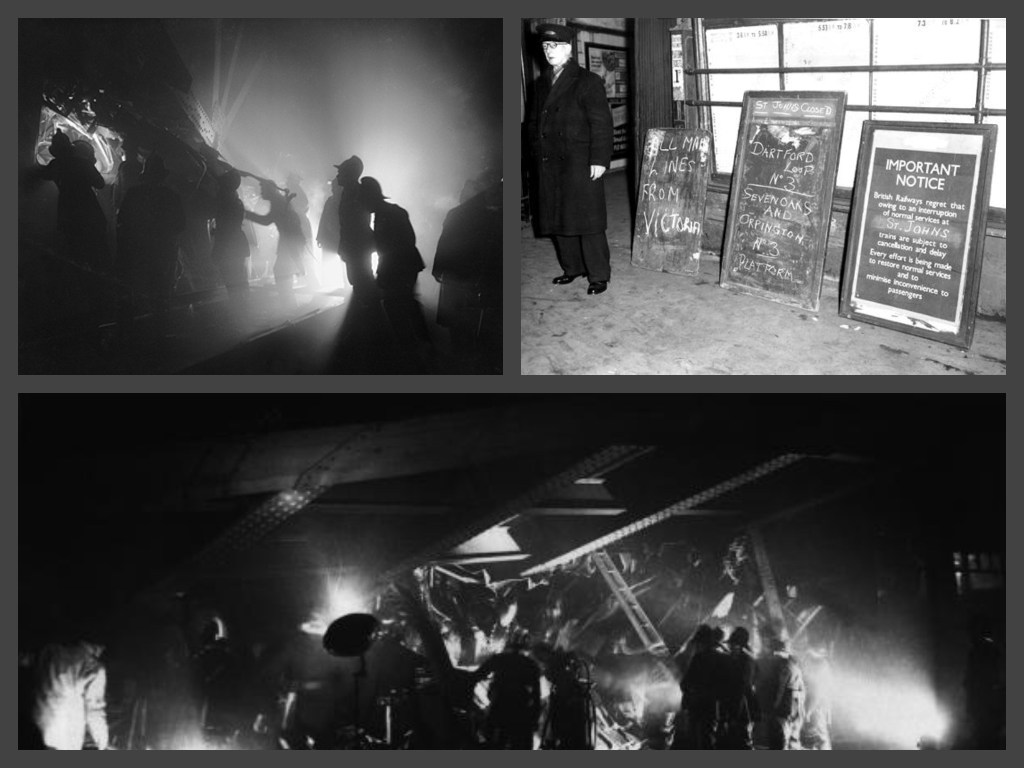
Spitfire and its train, several hundred tons all told, ploughed into the back of the still stationary Hayes train. The force of the impact was catastrophic and deadly. With its brakes on, the Hayes train offered a dead weight resistance. Its rear carriages were smashed beyond all recognition. The leading coaches of the Ramsgate train buckled and the locomotive hit the pillars supporting the overbridge with such force it caused the structure to collapse on the wreckage below.

The one glimmer of fortune to shine on an evening of carnage came moments later when the driver of the train approaching on the line from Nunhead, that would take him over the bridge towards Lewisham, saw through the fog that the line suddenly disappear in front of him. Applying the brakes for an emergency stop he brought the train to a jolting halt just yards from the precipice where only minutes before the bridge had been. An even worse disaster had been averted by only the narrowest of margins.
A characteristic of fog is that it muffles sound. Residents from nearby streets would later recall hearing only a ‘dull thud’ at the moment of impact. Fortunately some who had telephones had the presence of mind to realise that something had happened and summoned the emergency services. Others scrambled up the embankments flanking the lines to see what could be done. The driver of the Hayes Train which had been catapulted forwards by the collision, staggered from his cabin to the signal box at Parks Bridge Junction to report the crash. He found that the signalman had already set all the signals under his control to red.
In 1957 ‘major accident procedure’ did not exist. But it was very apparent to the three emergency services that the crash was of catastrophic proportions. Access to the crash site was extremely difficult. It could only be made, initially, by means of an extension ladder pitched, to form a bridge, from the roof of an appliance to the top of a 12ft high brick wall. Also a steep embankment had to be negotiated to reach the permanent way.
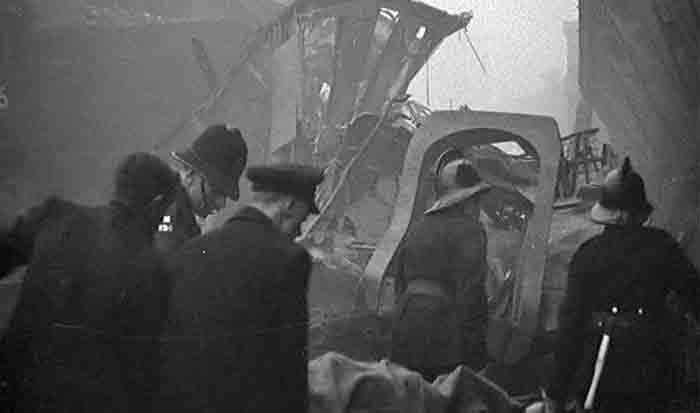
The sight that met the first fire engine crews from Lewisham, and then surrounding fire stations, was almost impossible to comprehend. The impact had thrown many passengers from the trains and they were lying, some already dead and others with life-threatening injuries, on both the permanent way and the embankment. The death toll was the most severe, however, in the rear coaches of the Hayes train. These had been packed to ‘standing room only’ capacity. Miraculously, some passengers in this part of the train had survived the crash itself but now lay entombed in the midst of the entangled remnants of the carriages.
Emergency tender crews were to the fore – there were only two then in the London Fire Brigade – and set about the task of extracting the trapped and moving away the bodies of the dead. Alongside London’s firemen, doctors and nurses also moved among the injured administering morphine to those in pain.

The Brigade control unit, from Lambeth, was located in the adjacent Thurston Road, and four advanced control points were established around the scene of the wreck making use of the walkie-talkie equipment. Extra cutting equipment was brought in as rescue work continued through the evening and into the night.
The cold, grey light of dawn revealed the true scale of the disaster. It was as if a giant had plucked the trains from the track, crumpled them in a rage and hurled them back to the ground. The last remaining bodies were removed to a makeshift mortuary at Lewisham Hospital. Grim faced police officers gathered up the array of personal belongings that littered the scene whilst British Railway workman busied themselves with the task of shoring-up the overhanging sides of the overbridge.
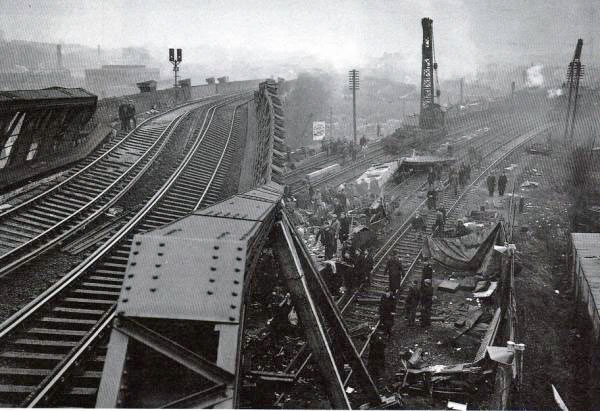
The death toll was initially ‘officially’ listed as 90, although subsequent records would show a slightly higher number due to the victims who succumbed to their injuries.
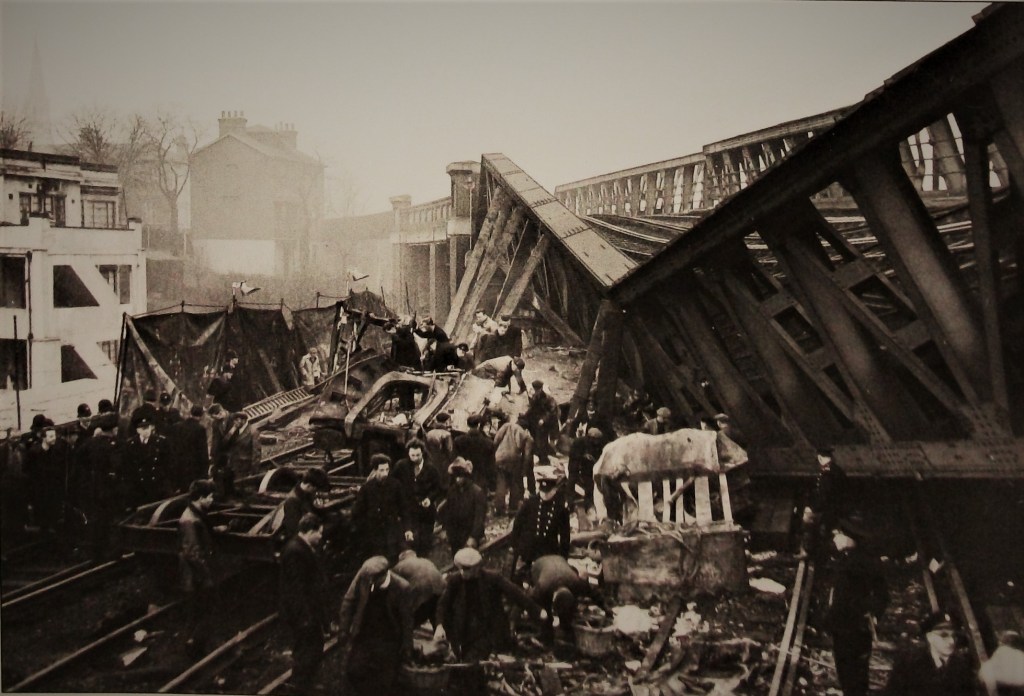
The communities of Hayes, West Wickham, Elmers End and Eden Park, where my family lived, were hard hit by the tragedy and as a schoolboy I recall the seemingly endless processions to the local crematorium. We all seemed to know at least one family affected by the crash. The inevitable inquiry into the ‘Railway Accident at St John’s’, not Lewisham as it was, found that the colour light signals had been installed at a time when most locomotives were right-hand drive. Conversely Spitfire was driven from the left-hand side which, coupled with the length of the engine’s boiler, made the sighting of the signal less easy. However, the point was made that given the weather conditions the train driver should have asked the fireman to assist with the observation of the warning signals from the right-hand side of the cab. Comment was also made on the pre-war, WWII, rolling stock of the electric train, which offered little protection to passengers on impact.
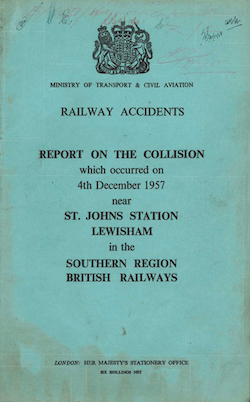
The officiaL inquiry concluded that the sole blame for the accident rested with the driver of the Ramsgate train. Yet public opinion was divided when the decision was made to charge him with manslaughter. Many felt that little could be gained from prosecuting a man who was never going to wipe from his memory the event of that fateful day. A broken man, he died within a few years.
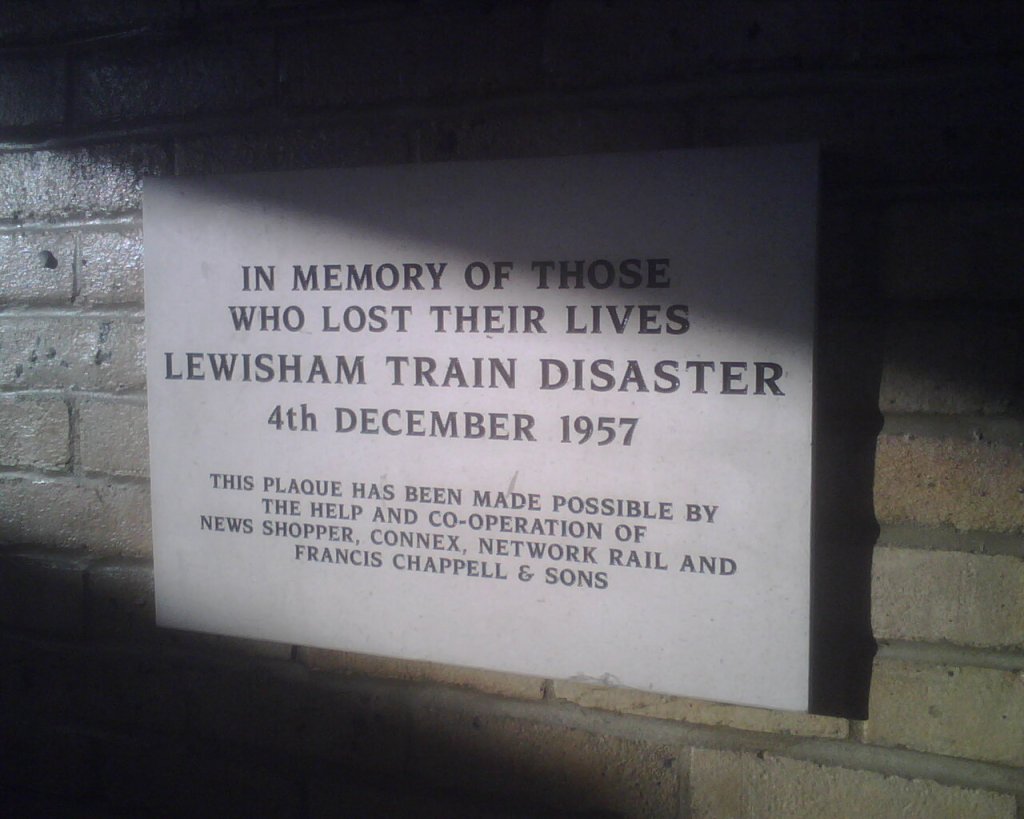
(First published by Gordon White (RIP). Gordon was the editor of the London Fire Brigade’s in-house magazine London Fireman. He died in January 2016.)
 A retired London Fireman